
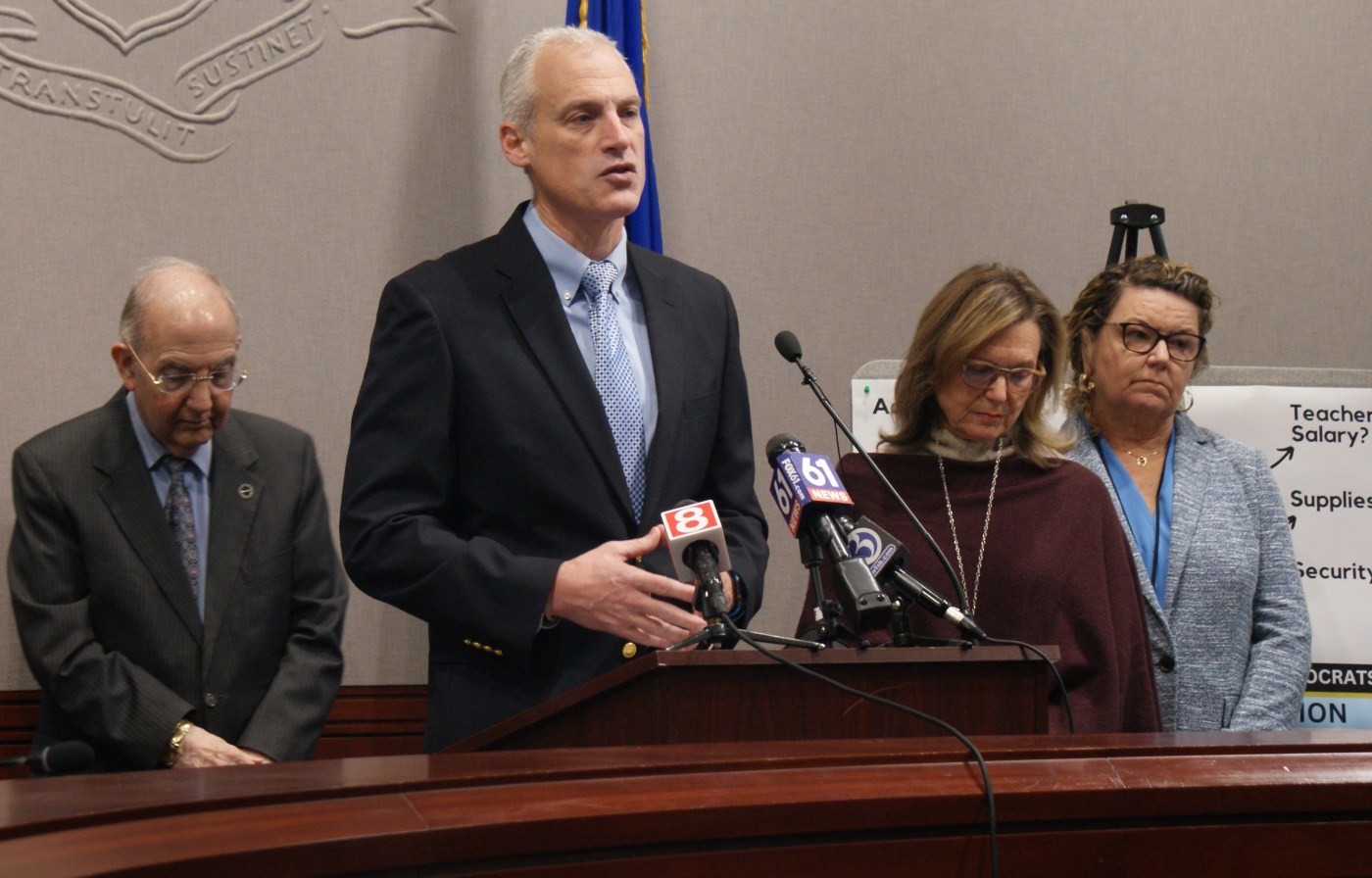
With hospitals facing ongoing nursing shortages, higher education officials, nursing directors, social workers and physical therapists are calling for Connecticut to help fund the next generation of human services professionals, whom the Trump administration recently barred from certain graduate loans.
The advocates called Tuesday for passage of a proposal, introduced by Sen. Derek Slap and a group of Democratic state representatives in January, that would establish the Connecticut Supplemental Graduate Student Loan Program, saying the legislation is critical to avoid workforce shortages in those fields and enrollment declines at universities and colleges.
Connecticut, like other states, is already experiencing workforce shortages in nursing and other health professions, health officials have said.
Gov. Ned Lamont announced last week that he would create the graduate student loan program in response to significant changes to “federal student loan borrowing and repayment in decades” following the implementation of the Big Beautiful Bill Act into law. The governor’s proposal included in his budget allocates $10 million in bonding to jumpstart the program.
Kimberly Sandor, executive director of the Connecticut Nurses Association, representing 88,000 nurses, said at a public hearing Tuesday at the Higher Education and Employment Advancement Committee that, HR 1 also known as the Big Beautiful Bill, will impact the nursing profession.
“The consequences are direct,” she said. “If enrollment declines, graduations decline. If graduations decline, shortages deepen. We know we already have significant shortages in primary care, mental health, maternal health and anesthesia services faculty roles, and the list goes on.”
Sandor said this is not simply about financial aid but about “being able to have the workforce to care for Connecticut.”
The Big Beautiful Bill Act eliminated Graduate PLUS loans for new borrowers, which the governor’s office said “was the sole program dedicated to helping graduate and professional students finance the whole cost of attendance for their education.”
The Big Beautiful Bill Act established new “limits on how much graduate students can take on in federal student loans based on whether the degree is categorized by the U.S. Department of Education as a ‘graduate’ or ‘professional’ program, according to the governor’s office.
As a result, those seeking a graduate degree in physical therapy, social work, nursing and education, among other professions will have tighter borrowing limits because the Trump administration does not classify them as a “professional program.”
The Higher Education and Employment Advancement Committee introduced Senate Bill 8 authorizing and establishing the loan program, which is sponsored by 23 Democratic senators.
Sen. Derek Slap, co-chair of the Higher Education and Employment Advancement Committee and a West Hartford Democrat, said the proposed legislation is critically important.
“We will be one of the national leaders when we pass this bill with funding,” he said. “We want to do it as quickly as possible too because this is the time that students are making decisions about their future. If we do nothing, $90 million dollars’ worth of low-interest student loans vanish July 1.”
Slap said “there are a lot of aspiring teachers and nurses who want to go to grad school, want to continue their studies and want to be public servants and they don’t know how they are going to pay for it with the elimination of this program. They are either going to go out to the free market and end up paying a lot more per month, per year, which will cost them thousands of dollars and be drawing in debt or they will just decide that they can’t afford to pursue education and to go onto graduate school.”
Slap said the elimination of the Graduate PLUS program is a “big problem and it is going to affect our workforce.”
The new caps in the Big Beautiful Bill, which takes effect July 1, specifies that those pursuing a “graduate” program can only borrow $20,000 or $100,000 overall compared to $50,000 or $200,000 for those the administration considers a “professional” degree including veterinary medicine, chiropractic, law, medicine, optometry, dentistry, pharmacy, among other professions.
“I’m particularly concerned that these new federal changes are going to make it even harder for students to seek graduate degrees in areas such as nursing, social work, and physical therapy, when we actually should be doing more to encourage people to enter these fields,” said Lamont in a statement.” Creating this loan program at the state-level is a way that we can help ensure that the opportunity for people to seek graduate degrees is still obtainable and not only for those whose families have the means.”
Asked how Sandor’s members feel about the reclassification of the nursing profession by the Trump administration, Sandor said it is insulting.
“We also recognize that anyone can call us what we want,” she said. “We know we are professionals. I don’t think we are going to be beaten down by that as a profession but that doesn’t mean our future profession isn’t being impacted by this. How do they begin to think of being a nurse if it is not being seen as a profession through the eyes of others?”
Sandor also shared concerns about long-term impacts of the law, which she said could include the ability to access research, future funding or initiatives.
Maryclaire Capetta, president of the American Physical Therapy Association, said in her testimony that the state is “already facing a significant and worsening shortage of physical therapists.
“Our members consistently report prolonged vacancies, difficulty recruiting clinicians and challenges retaining staff, particularly in rural areas and outpatient practices,” she said.
Capetta said in her testimony that as program director involved in admissions that “students are already reacting” to the federal student loan program changes.
“Many express hesitation, fear and uncertainty about whether they can afford to pursue a physical therapy degree,” she said.
Jocelyn Medina, a graduate student at the University of Connecticut School of Social Work, said in her testimony that “without a state-level solution, graduate students will be pushed toward private loans with higher interest rates and fewer protections, or forced to forgo graduate education entirely.”
CSCU Chancellor John Maduko told the Higher Education and Employment Advancement Committee that based on the current cohort of students nearly “4,000 students will be impacted to the tune north of $26 million,” due to the changes in federal student loan borrowing limits.
“Reducing federal borrowing may increase demand for institutional aid at a time campus resources are already limited,” Maduko said.
Maduko said a reduction in the borrowing limits will result in “ our students being unable to afford to take the number of courses needed to stay on track.
“It will result in delayed completion and lead to students dropping out altogether,” he said.