
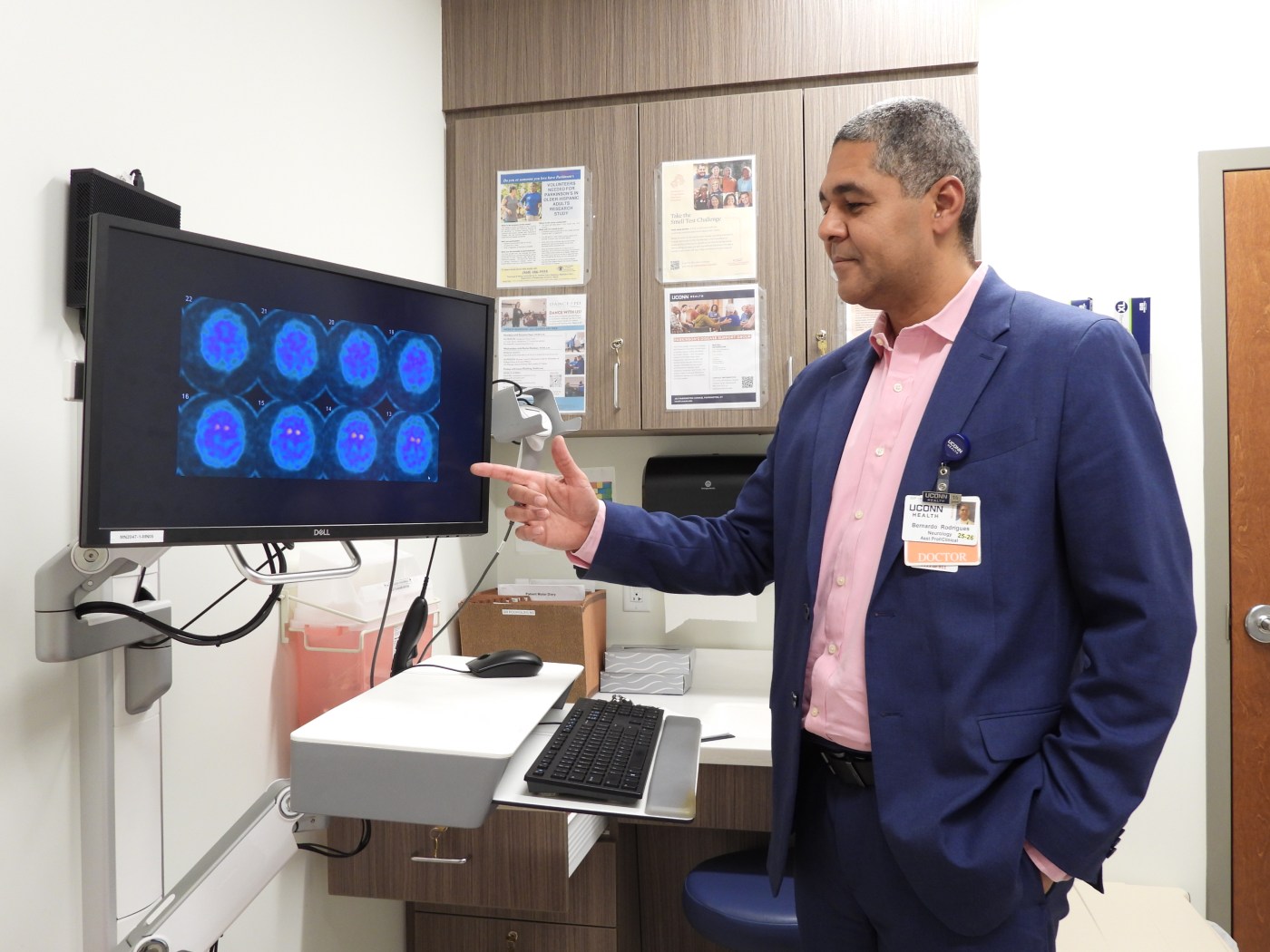
A Connecticut resident was diagnosed with a life-altering disease almost a year ago and while waiting to be seen at a UConn Health clinic, his wife spotted a flyer about a study that’s seeking a treatment for his condition.
Bill, who is in his 50’s, became the first person to enter the Parkinson’s disease trial.
Bill, who asked that his last name not be used for privacy reasons, was diagnosed last May at UConn Health’s Brain and Spine Institute and it was there his wife saw a notice for a study and he decided to be part of the clinical trial.
Bill said he has been a part of the study for about a month now and began taking the pill every day two weeks ago. He hasn’t felt any impact from the medication two weeks in, he said. He purposely has not been told whether he was given the actual medication or the placebo.
The trial has a goal of finding a medication that can slow down or stop the disease, according to Dr. Bernardo Rodrigues, an associate professor of neurology at UConn Health.

The UConn School of Medicine is in the beginning stages of recruiting for the clinical trial that will test a medication’s impact on reducing inflammation to treat Parkinson’s disease.
The School of Medicine began recruiting for the clinical trial last month. The trial is sponsored by New Haven-based pharmaceutical company Biohaven Pharmaceuticals, Inc.
Rodrigues, who has been at UConn Health since 2015, and founded the Parkinson’s Disease Clinic at UConn that sees more than 300 patients annually, said the trial is for the experimental new medication, BHV-8000. The hope is the trial will show the once-a-day tablet will slow disease progression for those who have early-stage Parkinson’s. The trial will have either a daily dosage of 10MG of BHV-8000, 20MG of BHV-8000 or a placebo for 48 weeks.
“(Biohaven is) amazing and they struck gold when they found a very unique medication for migraines, called Nurtec,” Rodrigues said. “They were able to join forces with Pfizer, and now they’re developing even more products.”
Rodrigues said Biohaven is thinking about Parkinson’s in a novel way.
“They think that there is some inflammation happening in the brain, that really start a cascade of events,” Rodrigues said. “We’re not even sure where this inflammation is coming from. But they are trying to find a way to stop some inflammation markers, some messengers of inflammation. And that way, halt the progression of the disease.”
“We’re super excited because of those words,” he added. “Slow down disease progression, hold progression, maybe even who knows — a cure. Besides the excitement, if we put the excitement to the side like, this all has to be proven. And the only way we can prove this, it’s with a rigorous clinical trial. I don’t want to overhype this because I’m excited and I’m hopeful that this is going to work.”
Millions face the disease
Parkinson’s disease is a disorder of the nervous system and movement that worsens over time. The nervous system is a “network of nerve cells that controls many parts of the body, including movement,” according to an overview of Parkinson’s by the Mayo Clinic.
Parkinson’s affects more than 10 million people around the world, 1.1 million in the United States, and is the second most common neurodegenerative disease in the world and there is currently no cure, according to the Parkinson’s Foundation.
The “incidence of Parkinson’s disease increases with age, but an estimated 4% of people with PD are diagnosed before age 50,” according to the Parkinson’s Foundation.
The profile of public attention on the disease increase in recent years in part due to the Michael J. Fox Foundation. The actor was diagnosed with the disease when he was 29.
The design of the trial is that of a double-blind placebo-controlled study. It’s designed to make sure that the patients’ emotions, doctors’ emotions and doctor’s impression don’t compromise the nature of the medication.

Rodrigues said the trial is seeking people between the ages of 40 and 85 who have been diagnosed with Parkinson’s within the last two years. Also, they are looking for people who are not taking medication for their condition. As of Sunday, the trial had three participants, two from Connecticut and one from Massachusetts.
Those who are diagnosed with Parkinson’s by their neurologist and meet the criteria will be considered for the trial.
“If a patient is interested, we book them a screening visit,” Rodrigues said. “On the screening visit, we’re going to check if their diagnosis of Parkinson’s disease is correct. We’re going to request an MRI of the brain to make sure that the brain is normal. And we’re going to order a brain scan that helps with the diagnosis of Parkinson’s disease called a DATscan, which stands for dopamine transporter scan.”
Rodrigues warned that there is a chance that the trial is not going to work and the medication will not do anything but said he is excited to see if it does.
“We really want to know, does the medication actually work independently of what … the patient feels,” Rodrigues said. “It has to be a true significant change to their feelings. That’s what drives the excitement. It’s the fact that it’s a new way of thinking about Parkinson’s disease is a new mechanism. It works by blocking the proteins (TYK2/JAK1) responsible for transmitting the inflammation.”
UConn Health has been collaborating with the American Parkinson’s Disease Association in their recruitment efforts in the state. dopamine transporter scan
“We don’t want to steal anyone’s patients. We don’t want to change their management. We just want to be able to offer the ability to participate in the trial. The patients will continue following with their regular neurologists, the patients will continue to take their regular medications, everything is decided by their regular doctors,” Rodrigues said.
In all, the trial is seeking 500 to 600 patients and is expected to last about two years, but the trial is also designed to be extended.
“It’s planned to have what we call an open label extension. Even after the first year of treatment, in the first year of follow-up, patients should be able to be enrolled on what is typically called an open label extension. An open label extension is when everybody that participated in the trial will actually get the real medication,” Rodrigues said. “Even if you’re on the placebo group, and you were taking, let’s say, sugar pills. On the open label extension, patients will be receiving the actual medication. And that all depends on how the study progresses.”
‘It would be remarkable’
Rodrigues said the trial is good news and should be a sign of hope.
“When you see a company investing millions of dollars on a new product and leading the charge for a new clinical trial is an exciting moment. There is definitely hope that something new is around the corner. It’s definitely exciting that this trial is happening.”
Rodrigues said patients will keep a daily log of symptoms, food, medications and supplements during the clinical trial.
“These are kinds of things that Parkinson’s disease impairs, and it can be disabling,” Rodrigues said. “It’s difficult to know right now what the true impact of the disease is. If we are going to go to the dreamland and if we can speculate, if this stops the disease, it stops the progression and patients could live healthy forever – we are going to find out.”
Rodrigues said Parkinson’s is one of those diseases that progresses over time.
“No matter what I do, no matter what patients do, they do get worse over time. Imagine now finding something that stops that progression. It would be remarkable,” Rodrigues said.
‘A great thing they’re doing for sure’
Bill said he’s is an active person, who’s involved in several sports and physical activities, including lifting weights. Rodrigues recommends that his patients to stay active and involved in activities. He said physical activities have shown benefits to Parkinson’s patients.
“I still stay active. I’m still doing everything I used to do. It hasn’t … changed my lifestyle whatsoever,” Bill said. “At this point, I just exercise and follow that regimen. I’m just taking that study drug at this point in time.”
“I had a DAT scan, an MRI and every two weeks I’m getting blood drawn and a EKG,” Bill said.
During the trial, Bill said, the checkups will become monthly, then bi-monthly and then every three months.
“Hopefully, this drug will have some positive impacts, not for me specifically but for folks moving forward. I am definitely in the early stages. I’m not sure what the impacts would be for someone in the later stages of Parkinson’s,” Bill said. “I kind of fell into this thing. But I think it’s a great thing they’re doing for sure.”
Bill said there were no dietary restrictions given to him for being a part of the trial but he said he eats healthful foods.
“I hope this works. You always have that hope. From what I understand, it’s not just UConn that there are institutions throughout the country doing this so I have a positive outlook on it.”

Rodrigues said he hasn’t seen enough improvement over the last 10 years in treatment and hopes this clinical study be a big step forward.
“We want a breakthrough and that’s what we’re looking forward to,” Rodrigues said. “Over the last 10 years there have been some changes in the way that medication is delivered. Now they can be delivered in pill form.”
Rodrigues said there are recent advancements with two brain surgeries that are able to treat and control Parkinson’s disease symptoms “for some extent, but they don’t stop the disease and that’s the downside of these surgeries.”
The surgeries are for more advanced patients having trouble controlling their symptoms with medication alone. The surgeries are, a deep brain stimulation surgery and a high-intensity focused ultrasound. Rodrigues said the procedures improve tremors and other symptoms.
For more information about participating in this clinical trial, email [email protected].