
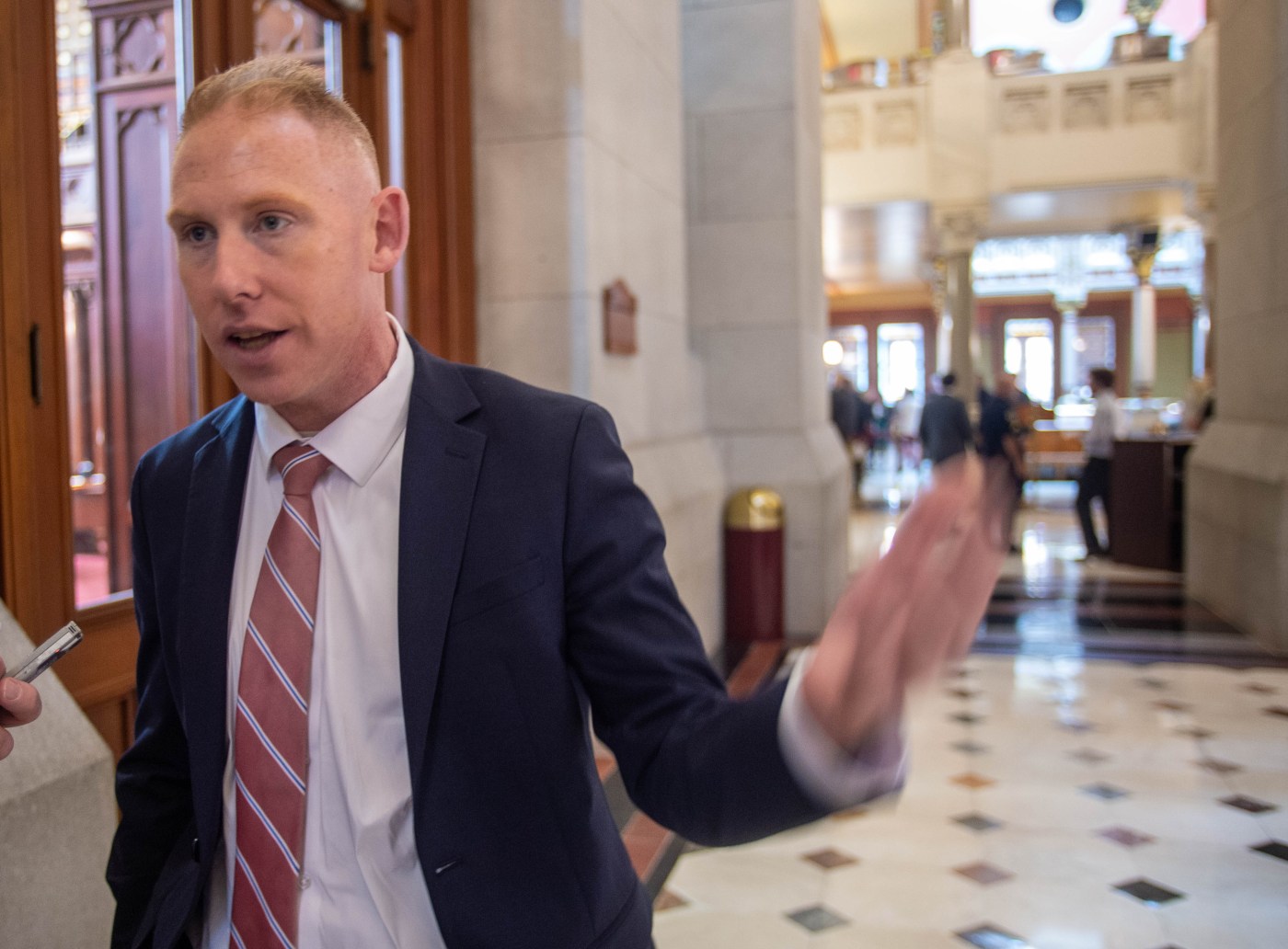
Saying Gov. Ned Lamont’s plan is not enough, Senate Republicans are calling for $1.5 billion in tax and electricity relief in an election year.
Lamont called last week for a tax rebate of $200 per person, which would cost an estimated $500 million overall. The Republican plan is nearly three times larger with a combination of cuts in the state income tax, local car taxes, electricity bills and other charges.
Senate Republican leader Stephen G. Harding of Brookfield blasted electricity rates, saying that he recently received a bill for more than $1,000 per month. He has a home with electric heat and two young children in the state with electric rates behind only Hawaii and California, he said.
Harding said that Lamont’s “answer to the public on the third highest electric rates … was here’s a $200 campaign bribe for you to take and walk away and pretend there’s not a problem here,” Harding told reporters at the state Capitol complex in Hartford. “We have a $4 billion-plus rainy day fund. The people of the state have essentially been overtaxed by that much. … Two hundred dollars is not an answer.”
The Republican tax plan is affordable, senators said, because Wall Street has been booming with capital gains that have filled the state coffers through the state income tax from stock traders that include millionaires and billionaires in Fairfield County. Under a state law passed in 2017, lawmakers cannot spend Wall Street money above a certain threshold under a “volatility cap” that Democrats have changed in order to provide more spending for social programs.
“What we’re saying here today is if you’re going to modify the volatility cap once again, return it back to the taxpayer,” Harding said.
Couples filing jointly could save up to $1,600 per year, while single filers could save $800 per year, lawmakers said. Joint filers earning $100,000 per year would see a 40% reduction in their income tax, while couples earning up to $200,000 per year would receive a 16% reduction under the plan. In addition, the proposal calls for eliminating the local car tax for couples earning less than $200,000 per year.
But Rob Blanchard, Lamont’s chief spokesman, said Senate Republicans had fallen short because the caucus has not offered a full budget in recent years.
“So frankly, any ideas from this caucus are a welcome change, particularly on affordability, where the governor has consistently delivered results,” Blanchard said. “Unfortunately, the Republican plan repeats the failed mistakes of the past by relying on volatile revenue to fund ongoing costs —a path that led to painful cuts and tax hikes.
“The governor remains focused on building on real fiscal progress, including the largest income tax cut in state history, a stronger Earned Income Tax Credit for working families, and protecting Connecticut families from extreme health care cuts pushed by the White House and Republicans in Congress,” Blanchard said.
In addition to individuals, Lamont is also calling for $25 million in tax cuts for small businesses that conduct research and development in Connecticut and pay the pass-through entity tax that generates more than $2.4 billion in the current fiscal year.
Like Lamont, Republicans are calling for eliminating occupational license fees for certain professions, including plumbers, electricians, teachers, and speech and language pathologists. The plans would save workers about $15.9 million in the next fiscal year.
Sen. Ryan Fazio, a Greenwich Republican who is running for governor against Lamont, said the caucus was stepping forward with answers as they try to pass tax cuts in the short legislative session that ends on May 6.
“We are not here simply to curse the darkness,” Fazio told reporters. “We’re here to light a candle and present a positive alternative for the state of Connecticut. … We are truly here to turn the U-Haul trucks around, make our state affordable, and grow our state economy. … This is eminently doable.”
On electric rates, Fazio said, “There is so much pork stuffed in our public benefits tax that it would boggle the mind — over 50 different government programs passed by the legislature and the governor over many years.”

The two top Senate Democrats, President Pro Tempore Martin Looney of New Haven and majority leader Bob Duff of Norwalk, also criticized the plan.
“We welcome Senate Republicans to the affordability conversation, but Connecticut residents should ask where this urgency was while their Republican allies in Washington have spent the last year raising costs on working families through reckless tariffs, stripping health care coverage from over 200,000 state residents, and prioritizing a gold-plated ballroom for billionaire donors over the kitchen tables of Connecticut’s middle class,” the senators said.
They added, “However, ideas without a budget are just talking points. Senate Republicans haven’t put forth a budget in years, and today is more of the same: promises with no plan to pay for them. Our affordability proposals will be part of a responsible, balanced budget because that’s what governing actually requires. You can’t claim to be the party of affordability while your president is picking the pockets of Connecticut families.”

Senate President Pro Tempore Martin Looney of New Haven, left, and Senate Majority Leader Bob Duff of Norwalk are questioning the Senate Republican tax cut plan. They are shown here at the state Capitol in Hartford.
Under Senate Bill 1, which is named to indicate that it is a high priority for Senate Democrats, the caucus is calling for a wide range of tax relief. That includes that clothing items under $100, school supplies, and appliances should be exempt from the state sales tax.
Like Republicans in the past, the Senate Democrats are also seeking elimination of the extra one percentage point sales tax on prepared meals that are sold in grocery stores. The tax had been enacted by Lamont and the Democratic legislature in 2019 on items like rotisserie chickens as a budget-balancing measure that increased the sales tax on certain prepared items to 7.35%.
Democrats are also exploring increasing the property tax credit for homes and cars and creating a new credit for expenses to help an elderly parent.
All tax ideas are subject to public hearings and a vote by the tax-writing finance committee, along with approval by the full House and Senate. The final budget negotiations are not expected to be held until early May because negotiators traditionally wait until after the April 15 tax deadline to get a clearer picture of the state’s financial health.
Christopher Keating can be reached at [email protected]