
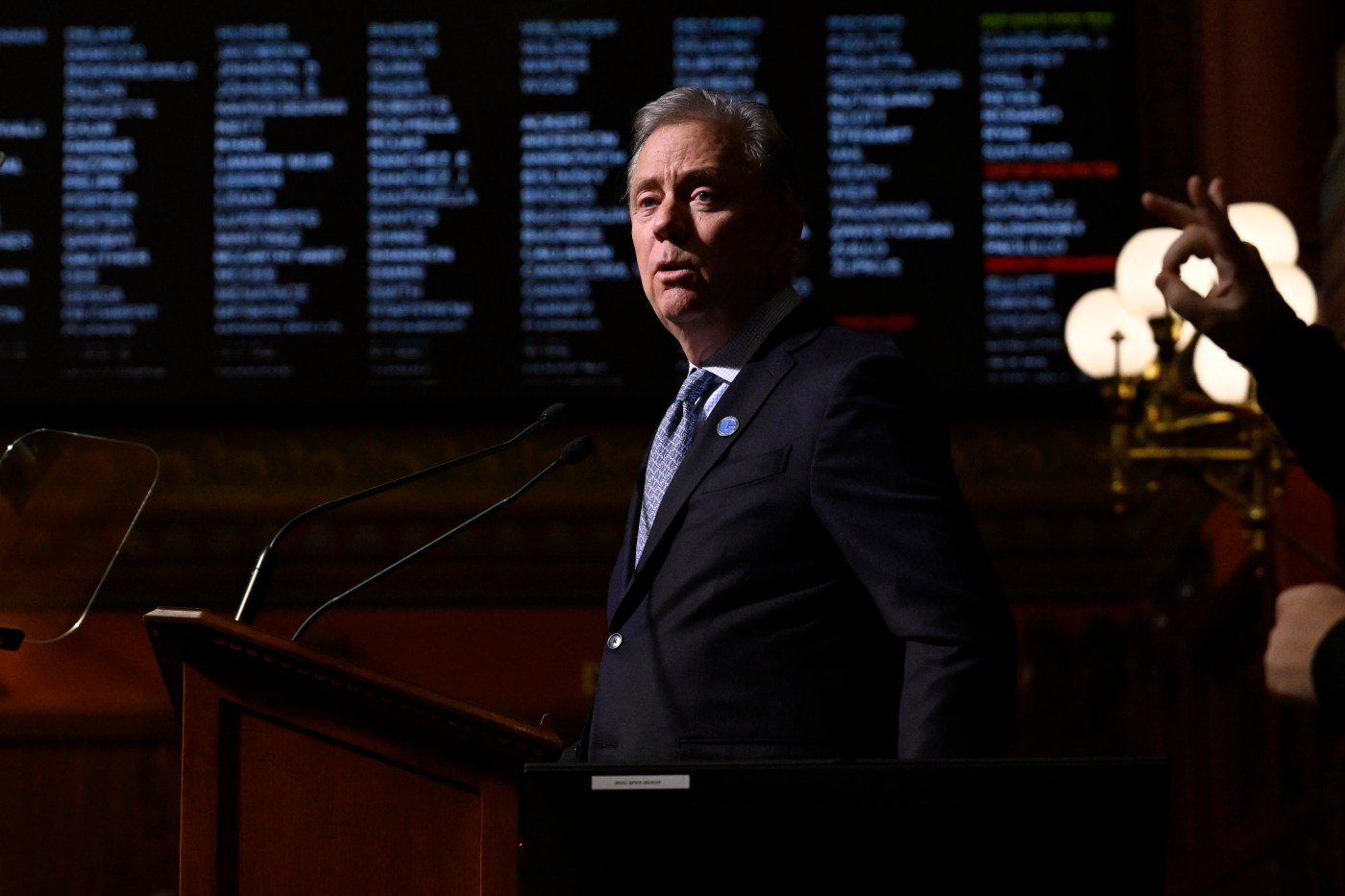
These days, as U.S. citizens die at the hands of federal agents and federal cuts threaten families’ access to food, shelter and health care, “are times that try men’s souls,” Gov. Ned Lamont said, quoting Thomas Paine in opening his State of the State speech Wednesday.
Lamont addressed the Connecticut legislature on the session’s Opening Day noting that despite the “chaos in D.C.,” he feels fortunate to be in Connecticut, “a birthplace of freedom,” where four signers of the Declaration of Independence penned “the words that we live by: ‘All men (and women) are created equal.’
“These words should still be our north star 250 years later,” Lamont said. “I live by these founding words as I think about our values and our budget.”
Lamont previewed his budget, presented Wednesday, including an emergency fund to fill in gaps from federal cuts to health insurance aid, food, heating and more. Of the $500 million allocated, $169,188,046 has been appropriated so far.
Still, he said, the state cannot continue to make up all the losses of federal funds, which he painted as the Trump administration pulling out support and leaving states to make up the difference.
He touted the state’s steady finances and increasing stability, including a seventh balanced budget in a row, delivered on time, and a $4 billion rainy day fund, while the state has paid down over $10 billion in pension debt. He noted the recently increased minimum wage, an expanded income tax credit and the largest in history income tax cut, adopted in 2023.
But while hailing a strong state economy, Lamont signaled he would hold to the fiscal guardrails he has said got the state to that point, saying “Many of you over here want to add $500 million in tax cuts and over here $500 million in tax credits, leaving deficits in future years. “We’ll figure out how to pay for it later.” Oh no, not again.”
Lamont is expected Wednesday to propose his own tax cut plan of a $200-per-person rebate.
He took a shot at social media, called for getting cell phones out of schools and to make progress on housing and electric rates. Lamont touted his approach to energy prices, including commitment to nuclear power and energy efficiency. He also took a shot at Republicans who have called for removing the public benefits costs from residents’ energy bills.
“The answer isn’t just more subsidies or moving costs from ratepayers to taxpayers,” he said. “No more rearranging the deck chairs.”
Lamont noted health care costs as an increasing challenge and hailed his “Connecticut option,” saying we will finally move to “universal, affordable healthcare.”
His plan for state employees, retirees, and small businesses in partnership with UConn.
“We will be able to offer you healthcare with no co-pays or deductibles if you sign up to the Connecticut Option, saving you money, saving the state money, and making sure our top-line healthcare is affordable for you,” he said.
Moving on, Lamont commended Connecticut’s police in contrast to U.S. Immigration and Customs Enforcement agents.
“We have perhaps the best trained police force in the world, making Connecticut one of the very safest states. ICE is just the opposite,” he said. “They see the world as us versus them. They are not trained to deescalate – they are barely trained at all. They hide behind a mask, they come to Connecticut – and Minneapolis – to arrest people outside of schools or courthouses, often based upon the color of their skin.”
He circled back to Minnesota, mentioning Renee Good who was shot and killed by federal agents, and Hispanic children in Connecticut who are fearful of going to school. Instead of bowing to racism, Connecticut celebrates its diverse residents, Lamont said, noting the state’s first Sikh mayor, Swarnjit Singh of Norwich, and the legislature’s first Native American member, Rep. Larry Pemberton, who was sworn in recently.
“That’s the Connecticut I love and the America we fight for,” he said in closing.
Opening Day
At the Capitol Wednesday, the chambers buzzed Opening Day with great optimism and enthusiasm – kind of like opening day at Fenway Park or Yankee Stadium. The Capitol was crowded with family members who sometimes arrive on only one day each year.
Opening Day is also among the biggest days of the year for photographers, including caucus staff photographers who were taking pictures of legislators and their family members.
“It is wonderful to be here on opening day,” House Republican leader Vincent Candelora of North Branford said on the House floor. “I had a dream last night that my television set had broken, and PURA came to my house to fix it. Maybe I have been here too long. … We certainly are a family in this House.”
Candelora’s remarks drew laughter from some lawmakers as he has been one of the biggest critics of the Public Utilities Regulatory Authority, which oversees electric rates.
After a day of greetings and backslapping, lawmakers know that there will be partisan fights over policy in the short session that ends on May 6.
House Majority Leader Jason Rojas of East Hartford said that lawmakers agree on about 80 to 85% of issues, but clash sharply on others.
“We’re going to disagree. We have fundamental disagreements on policy,” Rojas said, noting that there are only 62 days remaining in the session.
The House held a moment of silence to mark the passing of some former legislators and others, including the late Rep. Kevin Ryan of Norwich, who was first elected in 1992 as “some of you were not born then,” Ritter said.
Ritter delivered a brief lecture to legislators who have complained in the past, and will again, that the Speaker had “killed” their bill. The session, he noted, will move quickly before ending in May.
“I didn’t write the constitution to make it 62 days,” Ritter said. “We warned you. … You don’t have a lot of time. … The short session is sort of a cruel joke that the framers have put on us.”
Federal emergency fund
The Senate is expected to vote later Wednesday on extending a financial emergency to transfer $330 million to a special “Federal Cuts Response Fund” to fill the gaps from cuts by President Donald Trump’s administration. The state has already allocated about $170 million of the original $500 million fund that was created in a special session in November.
After getting the green light from the legislature, Lamont called for spending nearly $168 million for health insurance, food, and other needs. The money includes health insurance subsidies for more than 150,000 Connecticut residents because the federal Affordable Care Act tax credits were cut off on Jan. 1. The state subsidies are planned to be provided for the entire year, depending on the situation in Washington, D.C.
Lamont’s plan also calls for supplying food to more than 35,000 residents after eligibility changes in the federal Supplemental Nutrition Assistance Program, known as SNAP. The totals also included $8.5 million for Planned Parenthood of Southern New England for lost federal reimbursements, plus another $1.9 million to cover a federal grant that had been frozen.
Some Republicans have objected, saying that the money for Planned Parenthood and other programs was not an emergency and should have waited for a fuller debate during the regular session.
The state House of Representatives is expected to vote on the plan Thursday.
Gov. Ned Lamont Wednesday morning signed a “declaration of the existence of extraordinary circumstances” to enable the legislature to adopt legislation allowing the Emergency State Response Reserve to continue functioning through the end of the 2027 fiscal year.
Christopher Keating can be reached at [email protected]