
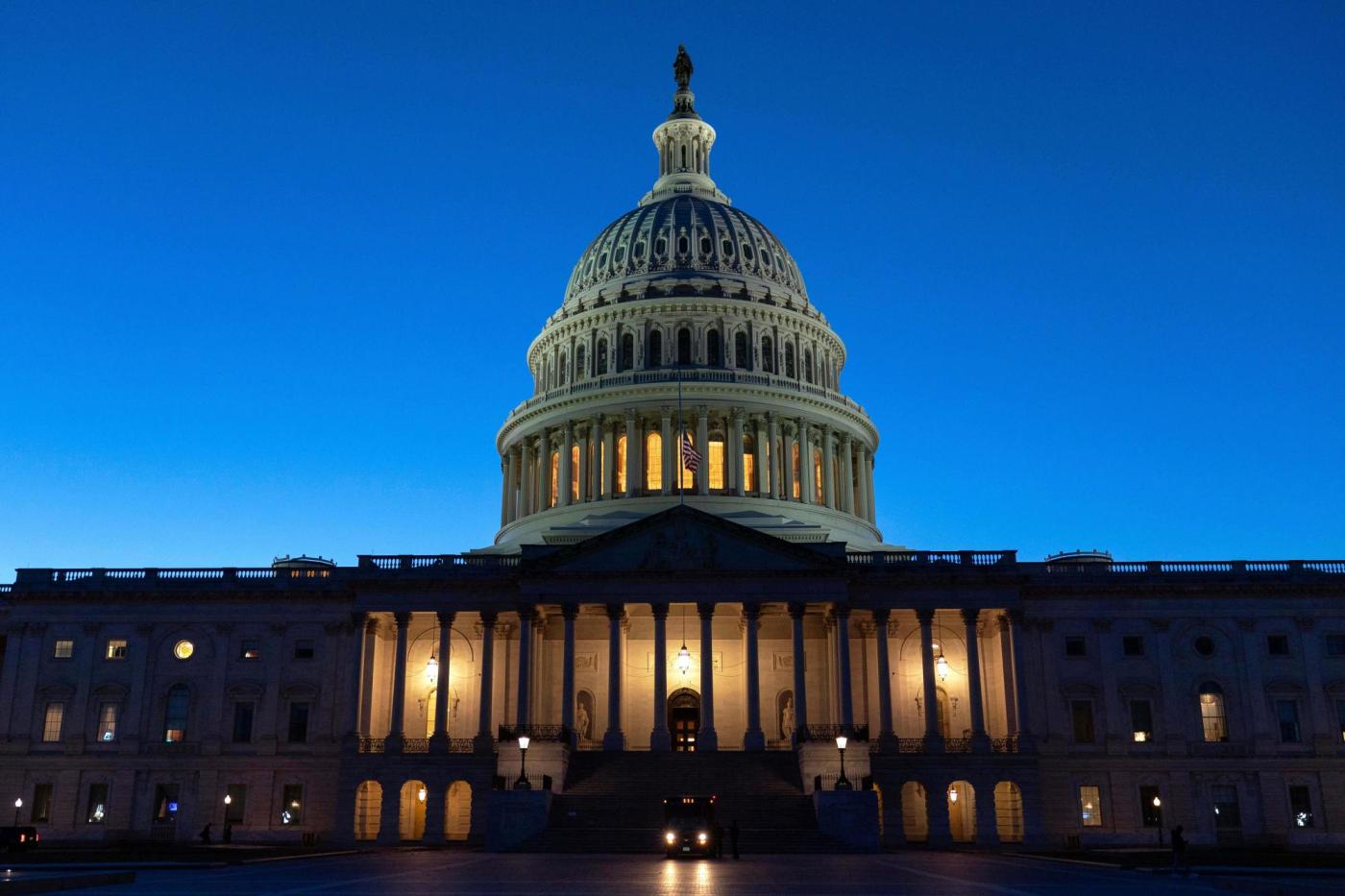
Connecticut’s congressional delegation split over a government funding deal that ended the brief partial shutdown on Tuesday and starts the clock for Congress to negotiate reforms to U.S. Immigration and Customs Enforcement in less than two weeks.
After a couple of weeks of back-and-forth in Congress, the House took its final vote on a broader government funding package Tuesday, sending it to President Donald Trump to become law. That ends the days-long shutdown of a half-dozen agencies that were waiting for fiscal year 2026 funding. The issue will come back up again in a couple of weeks, but only for new funding for the U.S. Department of Homeland Security.
The bill narrowly passed the House, with only 21 Democrats supporting it. That included three of the five members of Connecticut’s delegation: U.S. Reps. Rosa DeLauro, Joe Courtney and Jim Himes.
The other 193 House Democrats opposed the legislation, including two Connecticut lawmakers, U.S. Reps. John Larson and Jahana Hayes.
The House passed the other government funding bills in late January. Lawmakers were able to take separate votes on a package to fund five agencies and a bill to fund Homeland Security, which oversees ICE. All five in Connecticut’s delegation opposed the DHS bill but voted for the larger package.
But the House needed to take up the bills again on Tuesday after the Senate reworked it last week. A deal between Senate Democrats and Trump funded the five government agencies through the end of fiscal year 2026 and kept flat funding for DHS through a short-term continuing resolution for the next 10 days.
When it came up in the Senate late last week, there was a similar divide among Connecticut’s two senators: Richard Blumenthal voted for the funding package, while Chris Murphy opposed it.
Tuesday’s vote divided House Democrats writ large, even among leadership.
U.S. Rep. Rosa DeLauro, D-3rd District, got behind the spending package that she helped craft, arguing its passage would take a prolonged partial shutdown off the table and give Democrats the leverage they need to keep negotiating longer-term funding for Homeland Security over the next week and a half.
“That gives us time and that gives us leverage to secure the protections that we need for our communities. For if we do not do that, we will not be able to bring the kinds of pressure that is necessary to make sure that ICE does not continue to terrorize our communities,” DeLauro said at Monday’s hearing before the House Rules Committee.
DeLauro, the ranking member on the House Appropriations Committee, said Democrats were able to secure an increase in funding for the National Institutes of Health biomedical research, reject some Trump administration cuts to public services and get a boost for Head Start child care centers.
Democratic lawmakers in Connecticut and elsewhere have signaled they will not vote to fund DHS when short-term funding expires on Feb. 13 unless they secure enough provisions with accountability for ICE and Border Patrol agents.
“If we are not satisfied with where we are in those 10 days — six legislative days — we can withhold our votes without jeopardizing all of the important Democratic priorities I just laid out and more. We will be in the strongest possible position to fight for and win the drastic changes we all know are needed to protect our communities,” DeLauro said Tuesday from the House floor, before the vote.
Larson said he couldn’t support a bill that continued to fund ICE, even temporarily.
“While I commend my colleagues’ efforts to negotiate real wins for the American people in this funding bill — including new investments in affordable housing, special education, and medical research — I cannot in good conscience approve one more penny for Donald Trump and Kristi Noem’s secret police force,” Larson said in a statement, noting he was recently denied entry into an ICE facility in Massachusetts.
“If a federal agency would rather break the law than show us what is behind their doors, we have a responsibility to act,” he continued. “ICE needs to be torn down and replaced with humane enforcement that is actually bound by our laws and the United States Constitution. This moment demands nothing less.”
Like DeLauro, Courtney believes supporting the government funding package puts Democrats in a better position to negotiate guardrails for ICE with Republicans. The eastern Connecticut congressman said he won’t vote for full-year funding for Homeland Security without more comprehensive reforms for the enforcement agency, including a ban on masks for federal agents and changes to arrest warrant policies.
“Passage of this bill, which provides full-year funding for 70% of the federal government — except the Department of Homeland Security, which is handcuffed with only 10 days — is our best and only chance to stop ICE agents’ lawless actions that have trampled on the rights of thousands of individuals, resulting in injury and in some cases, loss of life,” Courtney said in a statement.
Congress had appeared on track earlier this month to pass fiscal year 2026 funding ahead of the deadline to keep much of the government open. But two fatal shootings of U.S. citizens by federal agents upended the plan. Congressional Democrats came out forcefully against funding ICE, which is part of Homeland Security, without more comprehensive reforms. And that clash raised the odds of a partial shutdown.
Now all eyes will be on Congress for the next 10 days to see whether they can hammer out a deal on guardrails for ICE to provide new funding for Homeland Security through the federal fiscal year, which lasts through the end of September.
Democrats have a list of demands for full-year funding of the Department of Homeland Security, including tightening rules around arrest warrants, ending roving patrols, ensuring independent investigations, and new protocols for ICE agents like banning face coverings, wearing body cameras and displaying proper identification.
Republicans, who didn’t want to see DHS taken out of the funding package, also have their own set of priorities, including a crackdown on so-called sanctuary cities.
Negotiators, however, are already starting at a bit of a disadvantage. House Speaker Mike Johnson, R-La., has already suggested Republicans won’t get behind some of the main demands of Democrats, like arrest warrants and a ban on face coverings for federal agents.
“Because unlike your local law enforcement in your hometown, ICE agents are being doxxed and targeted,” Johnson told reporters Tuesday on why he doesn’t support a ban on masks. “If you unmask them and put all of their identifying information on their uniforms, then they will obviously be targeted.”
“We want immigration enforcement to be smart balanced, strategic and efficient,” Johnson continued.
That could complicate getting a deal through in the next 10 days and raise the odds of a lapse in funding for the Department of Homeland Security, which also oversees TSA, FEMA and the U.S. Coast Guard.
“If there is no reform,” Blumenthal told reporters ahead of the Senate’s vote in late January, “we need to shut down the DHS until there is reform.”