
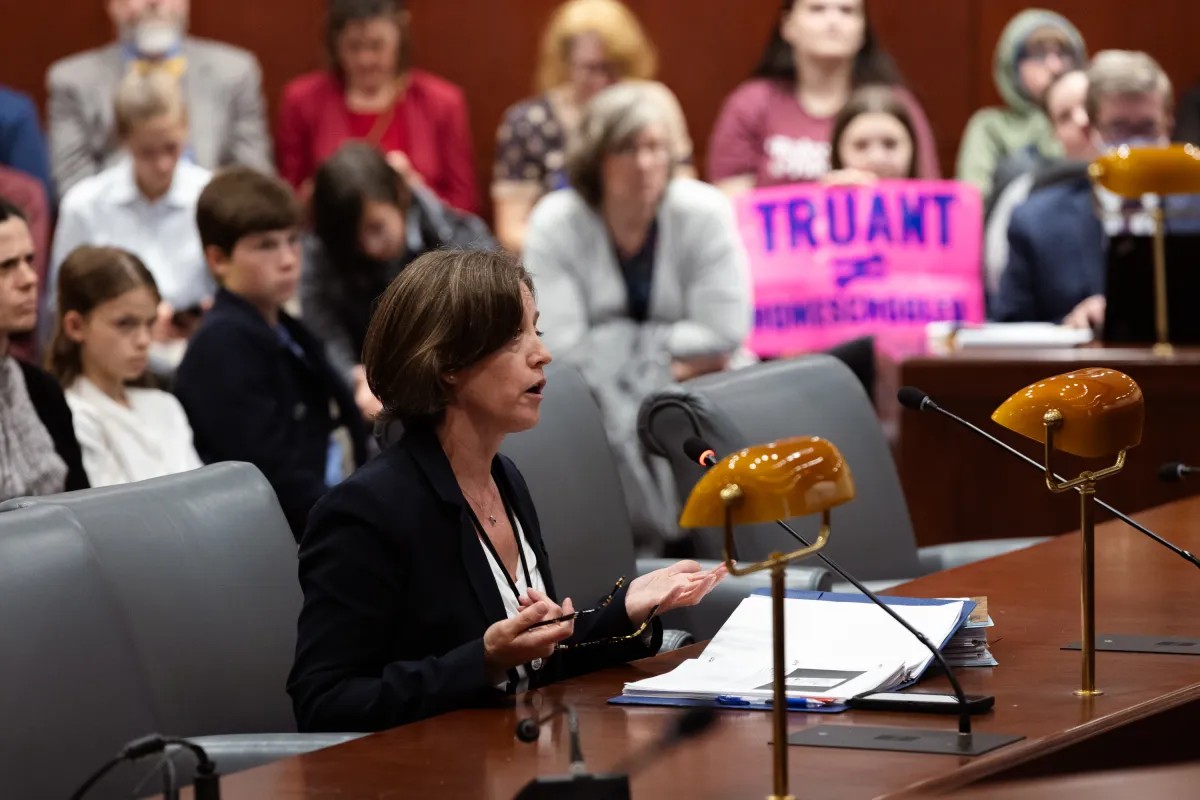
After a report filed by the Office of the Child Advocate last year recommended tightening state oversight for homeschoolers, several advocacy groups and parents are now criticizing the report as misleading and pushing a political narrative.
In a report released on May 5, titled “A Review of Children Withdrawn from School for Equivalent Instruction Elsewhere,” the Office of the Child Advocate recommended several policy changes, including requiring that a homeschooling parent and their child appear annually to state officials to provide enrollment documentation.
Other recommendations cited in the report include that a homeschooled child be “independently evaluated annually” for academic progress, and that a parent provides initial and periodic assurances to the state that the child is in good health. For children receiving instruction in a private school, the OCA said annual proof of enrollment is sufficient, according to the report.
The report was released following the arrest of Kimberly Sullivan, who is accused of locking her stepson away in their Waterbury home for two decades, with little food or water. In February 2025, police found the man after they allege that he intentionally set a fire to escape the home. The Office of the Child Advocate said that the case renewed discussions around homeschooling, since it was discovered that Sullivan withdrew her stepson from school and started homeschooling him around fifth grade.
However, homeschooling advocates have pointed to failures within the state’s Department of Children and Families, rather than blaming homeschooling for the abuse. According to a DCF review of the case released in July, the agency reportedly received six reports of concern for the boy over nine years but found at the time that “the interviews resulted in no disclosure of abuse or neglect.”
The report filed by the OCA says that Connecticut’s lack of statutory and regulatory oversight for homeschooled children can lead to neglect.
“Some parents and guardians withdraw their children from school, isolate their children, shield themselves from reports to our child welfare agency, and neglect or abuse their children. We, as a state, have enabled this to occur through our lack of statutory requirements and regulations. OCA recommends that the state adopt several basic statutory requirements that would ensure that children who are withdrawn from school receive an education while also ensuring that parents continue to have the right to choose to educate their children outside of public school,” the report says.
“Currently, parents who wish to withdraw their children from school need do nothing more than assert that they are homeschooling or sending their children to private school. Once a parent does that, there is no further interaction with the public school system required. There is no verification of enrollment in private schools. There is no verification that a child is, in fact, being homeschooled,” the report adds.
The report also alleges that over a three-year period, 5,102 Connecticut children under the age of 18 were withdrawn from school for homeschooling and 1,547 children aged 7 to 11 were withdrawn from school. Of the children aged 7 to 11, 31% were chronically absent and 19% were children identified as students with special education needs prior to their withdrawal from public school.
From the list of 1,547 children aged 7 to 11, the OCA then said it randomly selected 50% of those children to cross reference with DCF records to understand the prevalence of contact with DCF. OCA said it found that of the 774 children, 22.9% of the children lived in families with at least one accepted DCF report and 7.9% lived in families with four or more accepted reports to DCF.
But now parents and homeschool advocates are pushing back on the report’s findings. The National Homeschooling Education Legal Defense, an advocacy and legal group dedicated to defending the rights of homeschoolers, filed a Freedom of Information Act request for data supporting claims made in the report. According to attorney Deborah Stevenson, who representsNHELD, the Office of the Child Advocate refused to release the records, asserting confidentiality.
“In past years, the Office of Child Advocate has refused to release information, so I was not surprised by this,” Stevenson said. “What they claim is that they don’t have to release information in ongoing investigations. But the point that I am arguing is that the report they released had nothing to do with an investigation. The OCA admits that (it is) involved in an investigation of the Waterbury case and that (it) would release a second report later. So it’s clear that the May 5 report was just a compilation of stories and statistics. We want to see the data for the information she cites because we believe it is misleading.”
In December, just days before a FOIA hearing, the OCA attempted to block review by arguing the state’s Freedom of Information Commission lacked jurisdiction. A FOI hearing officer ruled that it is not apparent the records are confidential and that the OCA has not justified withholding them. The Freedom of Information Commission has scheduled a full hearing on Feb. 24 to decide if the OCA violated FOIA laws, according to a spokesperson with the commission.
“Homeschooling is the safest place for a child,” said Diane Connors with the Connecticut Homeschool Network. “The data we have shows a very different picture from the report filed with the Office of the Child Advocate. It is obvious data was manipulated for a political narrative. The state’s statute is clear that it holds parents 100% responsible for instructing their child. If parents don’t do that, all of the child protection laws still cover them. We get away with nothing. Homeschoolers do get reported, but reports are rarely substantiated because homeschool parents are not doing all of these illegal things we’re being accused of.”
Connecticut statute 10-184, the state’s homeschool education law, mandates parents provide “equivalent instruction” in core subjects like reading, writing, math and history for children aged 7 to 16 years old, and allowing homeschooling as a legal alternative to public school. The statute also says that homeschooling is permitted if it provides instruction “equivalent” to public school, though the state doesn’t accredit homeschool programs.
“We have serious doubts about the report since it is not a professional study and should have no bearing on legislation,” Connors said. “The report mentions that Connecticut has weak or minimal oversight of homeschooling. But that is false. Connecticut law imposes a mandatory, enforceable duty on parents under statute 10-184 to educate their children in specified subjects. Homeschooling is fully governed by statute.
“Further, the report says it took a random sampling of homeschooled children with DCF records over three years. But what the report doesn’t say is that many of those reports are unsubstantiated: 65,000 people get reported to DCF each year in the state, many of them are for unsubstantiated or for trivial reasons,” she said. “Often, parents get reported to DCF just because they don’t file a notice of intent to homeschool their child. This can happen frequently. Parents who are simply fighting for their child can get reported if they disagree with special education plans or school services. Those parents get reported to DCF. So twisting the data to somehow cast homeschool parents as monsters is not accurate and very misleading.”
The Connecticut Homeschool Network sent out a newsletter to lawmakers this past week addressing its concerns with the OCA report ahead of the legislative session in February. Connors said that she hopes lawmakers don’t just use the report as a justification to impose further regulations on homeschooling.
“Children in public schools are not safe. They are not physically safe, emotionally safe, and they’re academically being failed,” Connors said. “In past years, the state has tried to heavily regulate homeschooling, and they have failed to do so. So here we are again. But this time, the OCA is driving this discussion with a report that is misleading. We hope that lawmakers will continue to respect homeschooling in Connecticut and allow parents to make decisions that are best for their children.”
The Courant reached out to the Office of the Child Advocate but did not hear back in time for the story to be published.
Stephen Underwood can be reached at [email protected].