
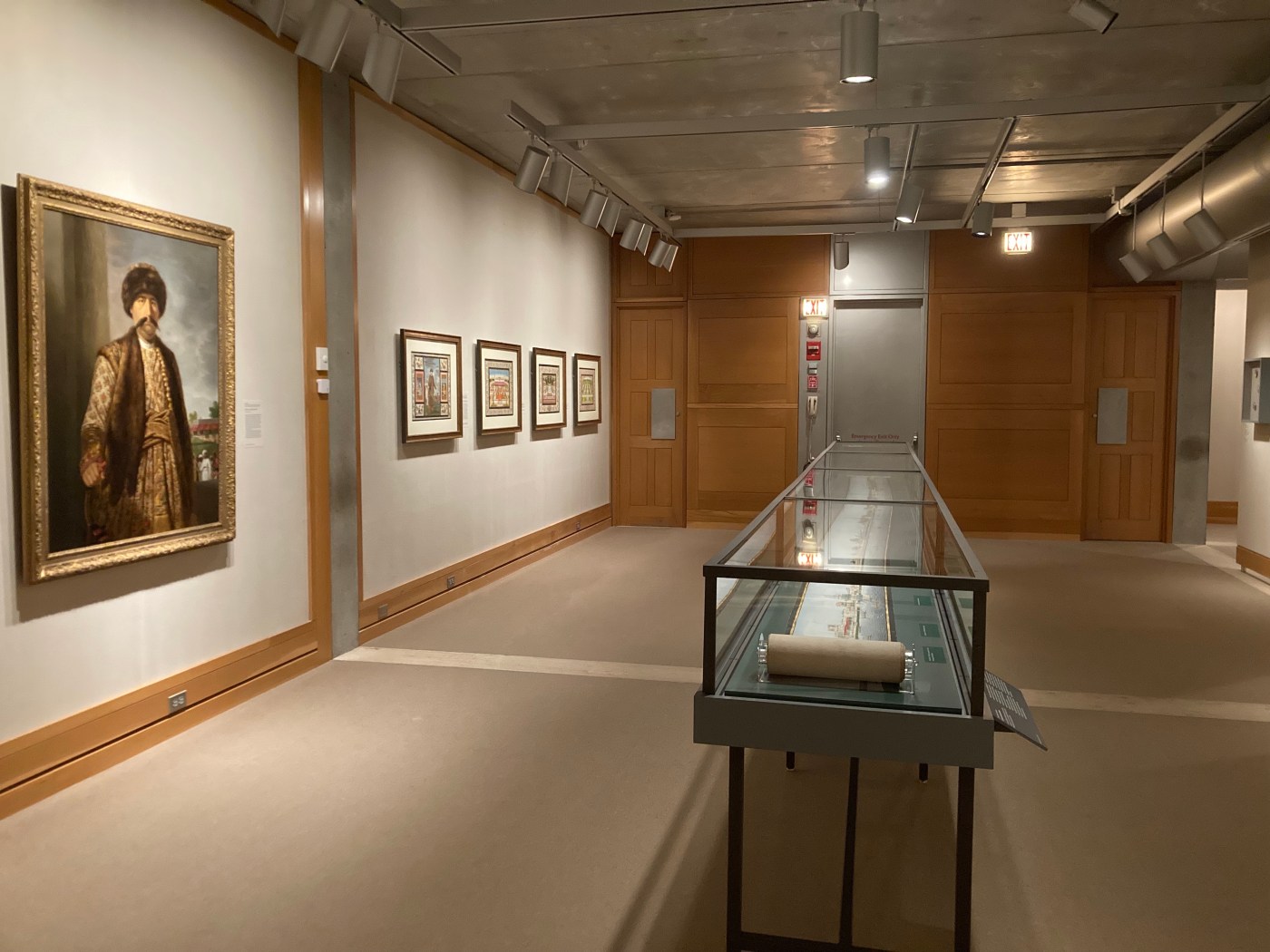
After eye-opening exhibits on Tracey Emin and Hew Locke and fresh, expansive looks at J.M.W. Turner and William Blake in the year since its grand reopening, the Yale Center for British Art is going back to familiar territory for a relatively staid but nonetheless fascinating look at “Painters, Ports, and Profits: Artists and the East India Company, 1750-1850.”
What makes the exhibit work is its new perspective on a loathsome period of world history, one in which the resulting artworks aren’t allowed to suffer just because of the corporate culture that begat them.
As some introductory text emblazoned on the gallery walls explains, “This exhibition tells the story of artists from India, Britain and China who worked in the era of one of the most powerful corporations in history.” Elsewhere is discussion of the “tension” between art and commerce and of how a lot of native Indian art has been suppressed and underappreciated. Curators Laurel O. Peterson, the assistant curator of prints and drawings at the Yale Center for British Art, and Holly Shaffer, associate professor in the department of the history of art and architecture at Brown University, clearly went through a deep period of reassessment and rethinking in honor to create an exhibit that places this work in a palatable contemporary context.

A detail of the 27-foot long painting of Lucknow, contained in a scroll on display at the Yale Center for British Art. (Courtesy of the Yale Center for British Art)
The East India Company existed from 1600 to 1874. The company — which basically ran India before England did, owning huge areas of the country outright — commissioned artworks, the text explains, “to support its commercial and imperial goals.” At one point, the British East India Company accounted for half the trade being done in the entire world. It dealt in spices, silk, precious stones, opium and more. It was British East Indian tea that the Sons of Liberty dumped in the harbor during the Boston Tea Party protest of 1775, adding a nice 250th anniversary of the U.S. footnote to this exhibit.
“Painters, Ports, and Profits” is drawn from the Yale Center for British Art’s own extensive collection of art and documents from India in the 17th and 18th centuries. It’s very open about how the company put profits over people. As abhorrent as that perspective can be, the focus on commerce allows the Yale Center for British Art to sidestep some other problematic issues of past exhibits it has done over the decades, like the tyranny of colonization, cultural appropriation and just plain misrepresentation. A 2003 exhibit was titled “Traces of India: Photography, Architecture and the Politics of Representation,” openly acknowledging the prejudicial and colonial attitudes built into the artworks. “Adapting the Eye: An Archive of the British in India, 1770-1830,” drawn in part from the Yale Center for British Art’s collection of papers from the East India Company, was assembled to complement an exhibit of neoclassical paintings by German artist Johan Zoffany, who hobnobbed with royalty and whose depictions of Indian culture ran to cockfights.
Both the “Adapting the Eye” exhibit 15 years ago and the current “Painters, Ports, and Profits” have a fondness for Gangaram Chintaman Tambat’s 1790 drawing of “A Rhinoceros in the Peshwa’s Menagerie at Poona” and both highlighted the work of Thomas Daniell, who negotiated with the East Indian Company to travel and create engravings and paintings in India. “Painters, Ports, and Profits” goes further by displaying work by Daniell’s brothers William (who also liked to draw rhinoceri) and Samuel (who had an interest in plants and fruit).

A behind-the-scenes object in the “Painters, Port and Profits” exhibit: a paint kit designed by a British firm to be used to paint scenes and objects in India. (Christopher Arnott/Hartford Courant)
The Yale Center for British Art has also done exhibits of Indian landscapes by awestruck artists such as Edward Lear, which have an out-of-touch, touristy feel to them. This exhibition, as uncomfortable as it sometimes gets, concentrates on business and social realities of what is essentially a company that encompasses whole countries. The Yale Center for British Art describes it in promotional materials as a study of “the beauty and range of the extraordinary artwork produced within the context of one of the most powerful and ruthless corporations in history.”
While not as imaginatively displayed as other recent Yale Center for British Art exhibits, the variety and scale of the media in “Painters, Ports, and Profits” creates its own interesting opportunities and juxtapositions. There are nature studies and realistic depictions of rare foods and animals like the
mangosteen or the Great Indian Fruit Bat. There are miniature portraits. Wealthy businessmen and governors are shown, but so are tradesmen and natives. There are long, wide landscapes and illustrated books. There are before and after paintings by Lam Qua of 23-year-old Po-A-Shing, who underwent extensive surgery to have an extremely large tumor removed from his arm. A 37-foot scroll is devoted to a depiction of the city of Lucknow.
The wall text notes that “The art in India was shaped by the company’s growing dominance. In the mid-18th century, after weakening the Mughal empire in battles across northern India, the company became more than a trading business; it emerged as a major military and industrial power.”

Before and after paintings by Lam Qua in the “Painters, Ports and Profits” exhibit of the tumorous growth on the arm of 23-year-old Po-A-Shing and how he looked after its removal. (Christopher Arnott/Hartford Courant)
Just as “Painters, Ports, and Profits” argues that the East India Company used art to explain and understand the country it had commercially and industrially conquered, the exhibit itself behaves not just like an art exhibit but like a warts-and-all history book and even a cautionary tale about how commerce can overrun culture and community. You only imagine what Indian art would look like if the East India Company never existed.
Special events connected to the exhibit include a “community day” on March 7 from 11 a.m. to 4 p.m. and a “Hindustani Airs: Bridging Cultures Through Music” concert on April 16 at 5 p.m. There are curator-led tours at 4 p.m. on Jan. 22, March 26, April 16, May 21 and June 18. The Yale Center for British Art has also published a new book edited by co-curators Peterson and Shaffer and distributed by Yale University Press containing essays and insights not found on the gallery walls.
“Painters, Ports, and Profits” is on view through June 21 at the Yale Center for British Art is at 1080 Chapel Street, New Haven. Visiting hours are Tuesday through Saturday from 10 a.m. to 5 p.m., and Sunday from 11 a.m. to 5 p.m. Closed on major holidays. britishart.yale.edu.