
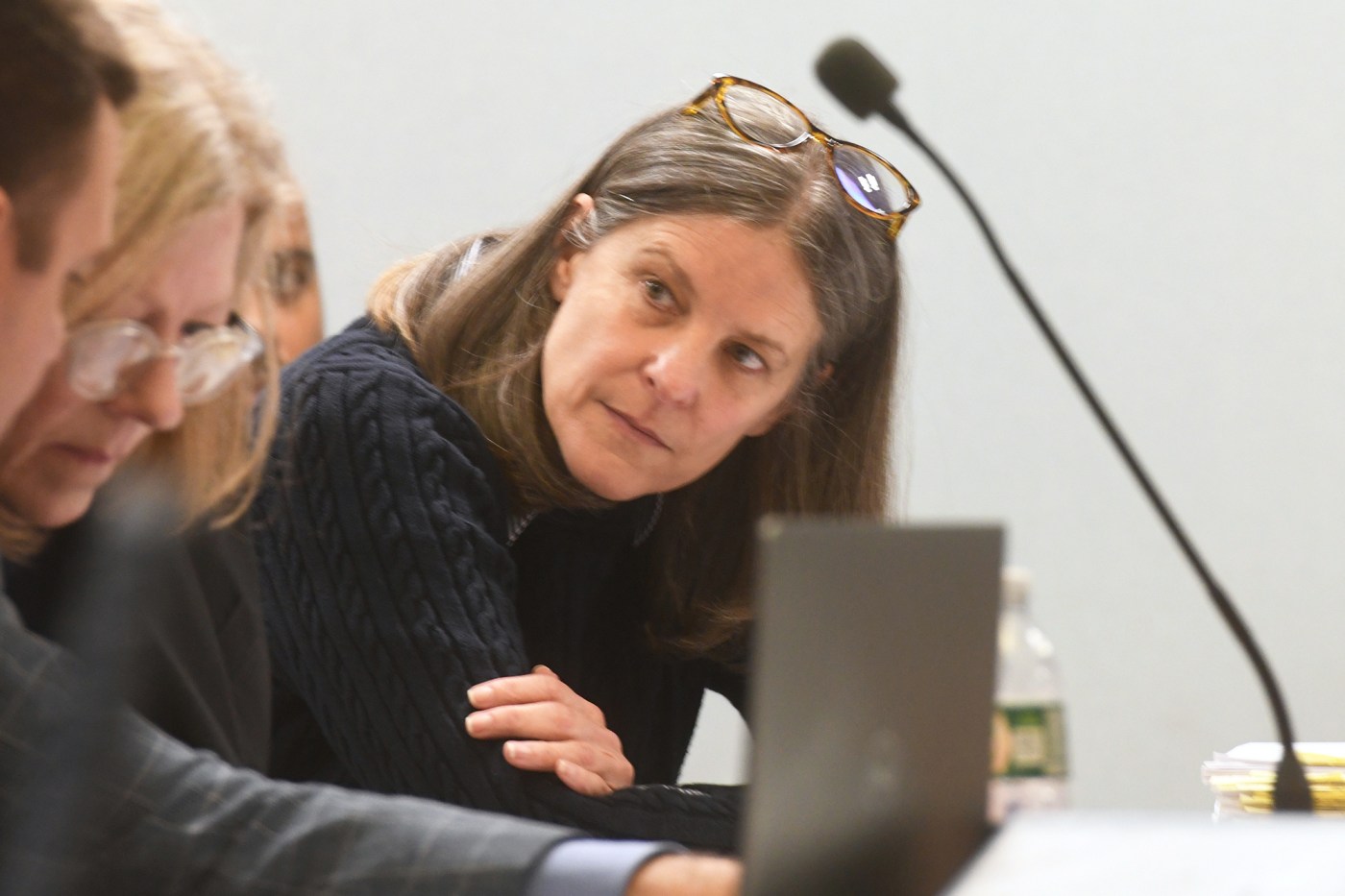
The state has elected not to call any witnesses to rebut Michelle Troconis’ claim in a habeas petition trial that she was given ineffective counsel when her lawyer allowed her to speak to police three times in connection with the disappearance and death of Jennifer Farber Dulos.
Senior State’s Attorney Russell Zentner had until midday Thursday to decide whether he wanted to put anyone on the stand, but a court filing submitted Wednesday indicated he opted to let the habeas petition rest after Troconis’ lawyers called three witnesses to help establish claims that attorney Andrew Bowman gave her “no meaningful advice” when she made the decision to speak with police without an immunity agreement.
The decision effectively ends the habeas hearings, which took place during three proceedings over the course of a little over a week in Rockville Superior Court. Troconis’ lawyers rested their case on Tuesday.
The petition is seeking her release from prison and to overturn her conviction in the death of Farber Dulos on the grounds that she was deprived of her rights to effective counsel under the Sixth and Fourteenth Amendments.
Judge Carl Schuman, who is overseeing the petition, will set a deadline for both sides to argue their positions in briefs that will be submitted to the court. They will then have the chance to file rebuttal briefs before Schuman will have 120 days to make a ruling. On the final day of testimony, Schuman said he does not expect to need the entire 120-day period.
If Troconis’ conviction is overturned, prosecutors would then have to decide if they want to bring her to trial again.
Michelle Troconis’ lawyers rest in bid to overturn her conviction after hours of cross examination
Throughout the habeas petition, Troconis’s attorneys called Bowman to the stand and questioned his decision to advise her to speak to investigators who were attempting to pin Farber Dulos’ disappearance on her estranged husband, Fotis Dulos, who was dating Troconis and living with her at his mansion in Farmington. Dulos and Farber Dulos were embroiled in heated divorce and custody battle proceedings over their five children.
During about 1½ days of testimony, Bowman said police were zeroing in on Dulos after his estranged wife went missing on May 24, 2019. Investigators believe she dropped off her kids at school and returned to her New Canaan home where Dulos was lying in wait.
Police found Farber Dulos’ blood in the home and evidence of a cleanup. After seizing Dulos’ cell phone, authorities were led to Albany Avenue in Hartford where video surveillance showed Dulos dumping bags of bloody clothes and other items with Troconis.
Bowman said he initially made it clear to investigators that they were not to talk to Troconis, who he represented from May 2019 until January 2020. His decision changed, he testified, when he received a phone call on June 2, 2019, from Richard Colangelo, then-State’s Attorney for the Stamford Judicial District.
“If we find the body, we’ll charge her with accessory to murder,” Colangelo said, according to Bowman’s testimony.
Bowman said he took the “aggressive” phone call as a “threat” and that it changed his mindset about Troconis sitting down with investigators.
“They were looking everywhere for her,” Bowman testified. “It was an intense investigation. I thought there was urgency. I thought they could find that body at any minute.”
Attorneys agree: Michelle Troconis ‘had everything to lose’ in interviews with CT investigators
Hours after she and Dulos were arrested on tampering with evidence and hindering prosecution charges in connection with stops in Hartford, Troconis gave her first interview with police. Bowman testified that he advised her to speak with investigators, though he said it was ultimately her decision. He said he hammered home numerous times that she had to be truthful if she decided to speak with investigators.
Bowman testified that he felt speaking with police was the best way to establish Troconis as a cooperating witness. He said he believed it gave her the best chance at receiving an immunity deal down the road.
After investigators indicated they believed Troconis was lying in her first sit down with police, Bowman advised her to undergo another interview at his law office on June 6, 2019, to help “rehabilitate” her credibility, he testified. But during the interview she maintained that she was with Dulos the morning Farber Dulos went missing despite police saying they had evidence to prove otherwise.
Bowman arranged a final interview with police on Aug. 13, 2019, when Bowman said Troconis “destroyed” Dulos’ alibi by admitting that he was not with her the morning authorities believe Farber Dulos was attacked and killed. He followed up the interview with a letter to Colangelo outlining why he believed Troconis could be a valuable cooperator for investigators.
Bowman said his strategy appeared to be working until it took a devastating hit in January 2020 when Dulos died after attempting to commit suicide at his home in Farmington.
“Quite simply, she had no one left to cooperate against,” he said.
On the second day of testimony, Colangelo took the stand and confirmed police were looking to use Troconis as a cooperator against Dulos. He also testified that he was not prepared to offer Troconis any kind of immunity deal until he knew what information she had.
To help establish that Bowman’s strategy was flawed, Troconis’ lawyers retained Bridgeport-based attorney Michael Fitzpatrick — who notably served as an expert witness and helped overturn the Michael Skakel murder conviction. Fitzpatrick took the stand over the course of two days and testified that he believed the legal advice Bowman gave Troconis was “not reasonably competent.”
Expert says Michelle Troconis shouldn’t have talked to police in Jennifer Farber Dulos disappearance
Fitzpatrick said he believes Troconis never should have been allowed to speak with investigators unless there was an immunity deal in place. He said Bowman could have relayed what information she had to Colangelo until an agreement was reached, which would have protected her from incriminating herself.
Fitzpatrick also testified that Bowman should have pushed for an immunity agreement and fought back against Colangelo’s threat to charge her as an accessory.
“The problem is he didn’t push back,” Fitzpatrick said. “He didn’t ask what’s that based on.”
Fitzpatrick testified that Bowman’s legal advice to Troconis fell “below the standard” a lawyer should provide a client. He also described it as “silly” and “ludicrous” to have a client sit down with police in an attempt to establish their innocence.
Fitzpatrick said investigators made it clear they were only interested in learning what happened to Farber Dulos and where her body was, which has never been found. When it became clear Troconis could answer those questions, there was nothing to gain by having her speak to police, Fitzpatrick testified.
Fitzpatrick also said Troconis should have had a Spanish interpreter, as her first language is not English, and that Bowman should have shut the interviews down the moment police indicated they thought she was being untruthful.
During cross examination, Zentner questioned multiple aspects of Fitzpatrick’s opinion. He pointed out that Troconis had a Spanish interpreter during multiple pretrial proceedings and throughout her trial, but that she sat in on the habeas hearings without one.
Zentner also presented standard immunity agreement forms used in federal and state courts and suggested the answers Troconis gave during her interviews would have rendered an agreement “null and void” even if Bowman was able to arrange a deal.
He also played an NBC Connecticut news segment where Fitzpatrick served as a legal observer as the interviews were dissected. During the segment, Zentner said he had the chance to say Bowman should have cut the interrogations off but didn’t.
Alluding to the more than $30,000 Fitzpatrick said he would be billing the Troconis family for his work on the habeas case, Zentner questioned his apparent change of opinion since the time he served as an NBC legal observer without any compensation.
Throughout her trial in January and February 2024, the police interrogations were played for the jury and presented as evidence. Prosecutors argued that Troconis’ conflicting statements showed that she was deliberately trying to provide Dulos with a false alibi.
A jury found her guilty of conspiracy to commit murder, tampering with evidence, hindering prosecution and other conspiracy charges. She was sentenced in May 2024 to 14½ years in prison.
Troconis also has a separate appeal pending alleging there was insufficient evidence to convict her and that several errors were made during the trial.