
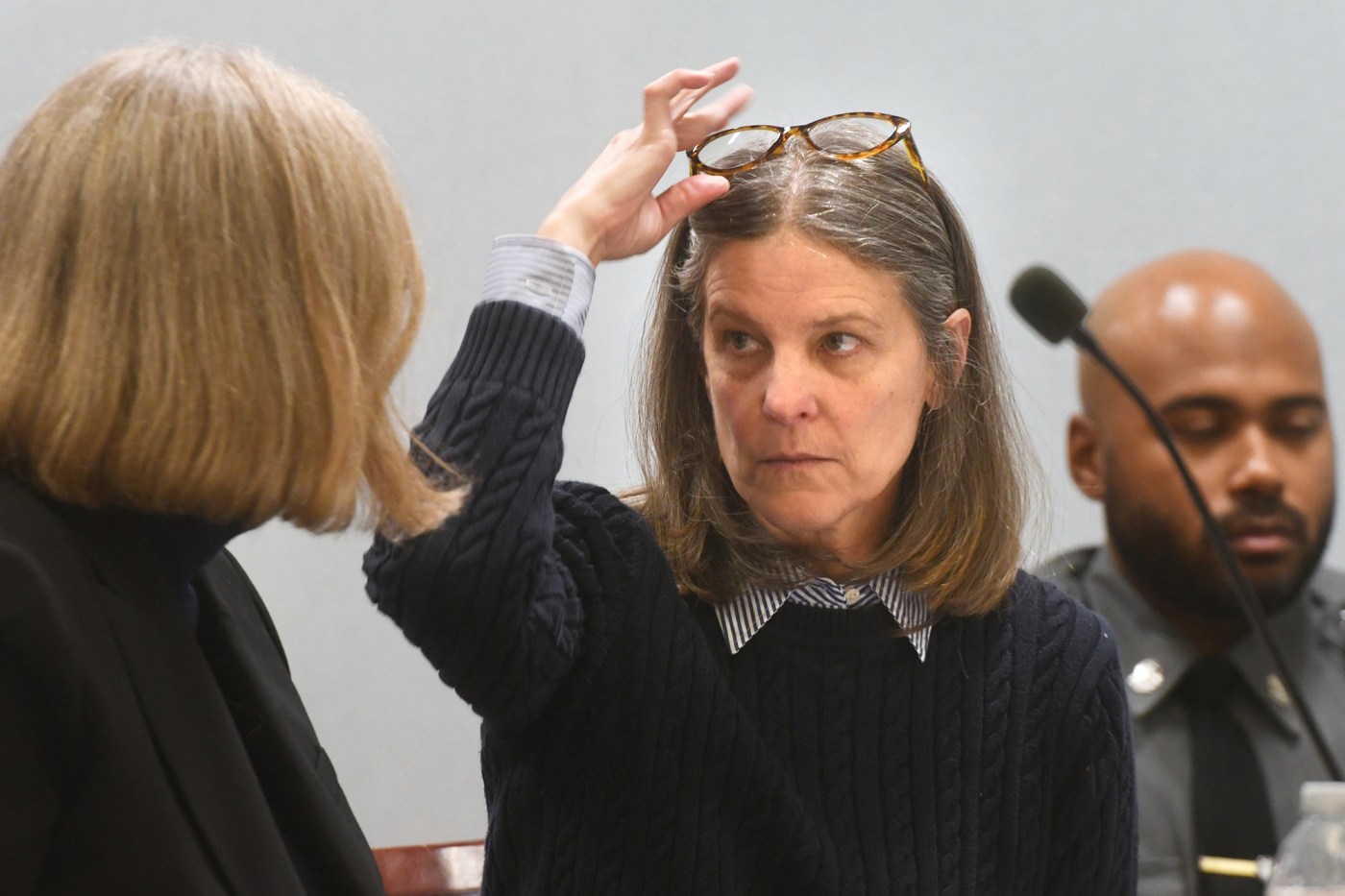
Michelle Troconis’ habeas petition trial fighting to overturn her conviction in the disappearance and death of Jennifer Farber Dulos rested on Tuesday after the state’s attorney challenged the grounds of an expert witness who said her lawyer erred when he allowed her to speak to police.
Senior State’s Attorney Russell Zentner spent hours in Rockville Superior Court trying to pick apart the legal opinion of Michael Fitzpatrick. Fitzpatrick, a Bridgeport-based attorney, testified last week saying the lawyer who represented Troconis for about eight months before she faced conspiracy to commit murder and related charges gave her legal advice that was “not reasonably competent.”
The petition filed by Troconis’ attorneys contends that attorney Andrew Bowman gave her “no meaningful advice” when she made the decision to speak with police without an immunity agreement. It further alleges that she was deprived of her rights to effective counsel under the Sixth and Fourteenth Amendments.
Troconis’ attorneys rested their petition late Tuesday after Fitzpatrick spent nearly four hours on the stand. Zentner must decide by midday Thursday whether he will present any evidence in response to the petition arguments.

Fitzpatrick took issue with Bowman’s decision to first allow Troconis to be interviewed by police without any legal protections on June 2, 2019, as investigators were attempting to build a case against Fotis Dulos, Troconis’ then-boyfriend and Farber Dulos’ estranged husband, in connection with Farber Dulos’ disappearance. At the time, Dulos and Farber Dulos were in the midst of a divorce and custody battle over their five children.
Some of the factors Fitzpatrick took issue with involved his assertion that Troconis was “fatigued” and “exhausted” during the first interview, as she had been taken into custody hours earlier on tampering with evidence and hindering prosecution charges. Those charges came after police found video of Dulos dumping bags on Albany Avenue in Hartford with Troconis. The bags had bloody items and other evidence connected to the killing in them.
Fitzpatrick testified that he believes it was also a mistake to allow Troconis to be interviewed in English, as Spanish is her first language, he testified.
During cross examination of Fitzpatrick — who was retained by Troconis’ lawyers as an expert witness — Zentner contested the grounds of his opinion that Bowman’s counsel fell below “the standard of care” a client should receive. Zentner cited a “memo of decision” written by Judge Kevin Randolph, who oversaw Troconis’ trial and suppression hearing where her attorney who put on her trial defense, Jon Schoenhorn, tried to have her interviews with police tossed. Three times in his memo, Randolph noted that Troconis appeared “alert” and able to understand the questions from investigators, Zentner said.
Zentner also took issue with Fitzpatrick’s assertion that Bowman should have ensured Troconis had a Spanish-speaking interpreter when speaking with investigators. He noted that she had interpreter services during the suppression hearing, throughout the lengthy trial and during sentencing.
“In this proceeding here, do you see a Spanish interpreter?” Zentner asked.

Throughout the first three days of the habeas petition, Troconis did not have the services of an interpreter.
Fitzpatrick contends that Bowman multiple times during the police interviews should have cut them off when it was clear that they were not going well. He also said the second interview, which took place four days after the first, should not have happened given that Troconis maintained that she could not answer the thing investigators were most interested in: What happened to Farber Dulos?
“It never should have happened,” Fitzpatrick said, adding that he believed it was “ludicrous” to think she could suddenly produce that information. “It got off to a terrible start and it should have been shut down.”
During cross examination, Zentner pointed to multiple instances during the second interrogation where it appeared as though Bowman’s strategy to establish her as a cooperator was working. In one instance, a police sergeant said he believed Troconis may have been telling investigators everything she knew.
Michelle Troconis’ bid to overturn her conviction begins with lawyer who OK’d police interrogations
Fitzpatrick conceded that portions of the interview went well for Troconis, but he maintained that the totality of it worked against her.
Zentner played a video clip during the proceedings of Fitzpatrick serving as a legal observer during an NBC Connecticut segment where he was asked about Bowman’s role as he sat in on the interview and police confronted Troconis with untruthful information. In the interview, Fitzpatrick said Bowman must have believed that his “client could handle it” and that it would be “advantageous” for her to continue the interview, he said in the clip.
“That would be my best guess or my best estimate as to why he allowed that to occur,” Fitzpatrick testified.
The reporter who hosted the segment questioned whether Bowman should have shut things down. Zentner noted that Fitzpatrick remained silent in response.
During testimony, Zentner also questioned Fitzpatrick’s decision to form an opinion on Bowman’s decisions without reaching out to him.
“His thoughts and opinions weren’t important?” Zentner asked.
Zentner also took issue with Fitzpatrick’s decision not to reach out to Richard Colangelo, the State’s Attorney for the Stamford Judicial District during the investigation, or interview Troconis.
Bowman testified last week that his decision to have Troconis sit down with police came after he received a phone call from Colangelo where he issued a “threat” to charge her as an accessory to murder if investigators found Farber Dulos’ body. Bowman said he felt a sense of urgency and wanted to establish her as a valuable cooperator before investigators could find the remains.

Fitzpatrick has asserted that Bowman should have pushed for a deal or refused to allow his client to speak to police. He also said he should have challenged Colangelo’s ability to bring an accessory charge and should have pushed to learn what evidence could have supported such a charge. To protect Troconis from incriminating herself during the interviews, Fitzpatrick testified that Bowman could have relayed what information she had to Colangelo until they agreed on an immunity deal.
Colangelo testified last week that he told Bowman during their initial call “now’s her time to get on the bus or get run over by the bus.” He also testified that he was not in a position to offer Troconis an immunity agreement until he knew what information she had.
The hours-long interviews in June and a final sit-down with police on Aug. 13, 2019, were played during Troconis’ trial in January and February 2024. After Troconis maintained in the first two interrogations that Dulos was with her the morning Farber Dulos disappeared on May 24, 2019, she admitted in the final interview that that was untrue. Prosecutors during the trial used the conflicting statements to point to what they contend was an effort to provide Dulos with a false alibi.
Investigators believe Dulos drove to New Canaan and parked before using a bike to get to Farber Dulos’ home. Authorities believe he was lying in wait and attacked her when she returned home from dropping her children off at school.
Police found blood in the home, evidence of a cleanup and Dulos’ DNA. Farber Dulos’ body was never found.
Michelle Troconis’ bid to overturn her conviction begins with lawyer who OK’d police interrogations
Bowman testified last week that his strategy to establish Troconis as a cooperator against Dulos took a devastating hit when Dulos died after attempting to commit suicide in January 2020.
According to his testimony, Fitzpatrick has been involved in nearly a dozen habeas petition cases alleging ineffective counsel. In the high profile case of Michael Skakel, he served as an expert witness who helped overturn his murder conviction.
Once Zentner decides if he will respond to the petition, both sides will submit briefs arguing their points to Judge Carl Schuman, who is overseeing the habeas petition.
Schuman will have 120 days to decide whether Troconis’ counsel was ineffective once the petition has concluded, though he said he does not expect it to take that long. She could be retried if the conviction is overturned and she is released from prison.
“I obviously will have a lot to consider,” Schuman said.
Troconis was sentenced to 14 ½ years in prison in May 2024 after a jury found her guilty of conspiracy to commit murder, tampering with evidence, hindering prosecution and other conspiracy charges.
Her attorneys who filed the habeas petition wrote that the issues they have raised were not allowed to be heard during her trial. She also has a separate appeal pending alleging there was insufficient evidence to convict her and that several errors were made during the trial.