
With a series of increases in recent years, the average salaries and pensions for Connecticut state employees have been rising steadily.
The average salary has now reached nearly $95,000 per year after combined pay increases of more than 30% since Democrat Ned Lamont was elected governor in 2019.
Besides the salaries, pensions have also been increasing with annual cost-of-living increases that recently pushed the pension of a retired state employee to more than $400,000 per year for the first time in state history.
For 2025, nearly 50,000 state employees earned a combined payroll of $4.67 billion that translated to an average of nearly $95,000 each, according to an actuarial report of the state employees retirement system that closely tracks salaries and benefits. As of June 30, 2014, the average salary had been slightly less than $70,000.
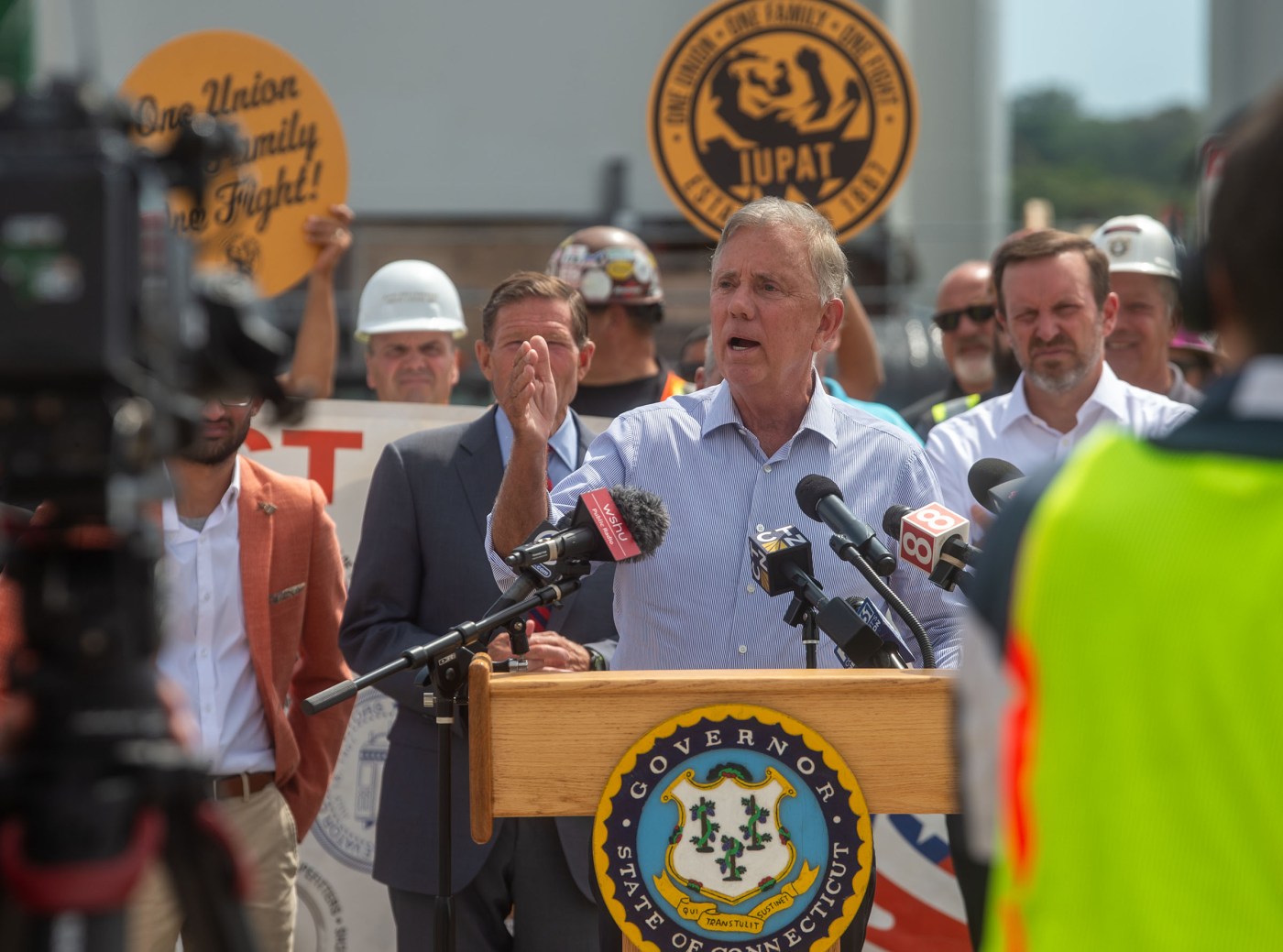
For years, Lamont has been a proponent of higher wages across the board, calling for everything from increased salaries for state employees to an increased minimum wage that under state law now goes up every year based on inflation. Rejecting the opponents’ criticism, Lamont said that higher wages help the economy because workers can afford to buy more goods and services.
“One way to make life a little more easy for people is to pay them a little more,” Lamont said in Hartford last week. “Paying people a decent wage is a show of respect for them. They have a little more money in their pocket. It keeps our economy going. We have one of the fastest-growing economies in the country over the last year or so, making progress there. Our unemployment rate is a lot lower than the national average. Connecticut can’t often say that.”
As salaries increased, the state has rolled up operating surpluses for the past seven years as capital gains on Wall Street has generated billions of dollars that are largely paid by millionaires and billionaires in Fairfield County. The latest budget forecast by the state comptroller’s office predicts surpluses of $136 million in the general fund and $50 million in the special transportation fund in the current fiscal year that ends on June 30.
But House Republican leader Vincent Candelora of North Branford said the increases for state employees have been too high in recent years at a time when many state residents are struggling financially.
“I think it’s been a little bit reckless,” Candelora said in an interview with The Courant. “It has far outpaced private-sector employment. I continually hear from nonprofits who are providing health care services that their biggest competitor is the state of Connecticut for jobs.”
Another problem, he said, is that many state employees in the post-COVID era still do not work five days a week in offices in Hartford and its suburbs.
“What I find troubling is that we’re seeing 35% wage increases and our state employees are still working from home,” Candelora said. “I think the combination of the two is egregious. To me, it is unconscionable that you’re paying people, on average, $100,000 a year, and you’re not requiring them to come to work. If you talk to people who have to interface with government, their biggest frustration is they can’t get anybody on the phone.”
Referring to the state Department of Children and Families, Candelora added, “I was just talking to a judge who was telling me how if you want to get a DCF case worker to come into court and be a witness, it’s very difficult because they’re working from home and you have to track down their cell phone numbers.”
Lamont himself has been concerned about remote workers, saying that he wants more employees in the office but does not have the power over unionized employees to make them return.
Lamont’s administration lost a case in arbitration, and the issue is subject to negotiations. In a long-running issue, an arbitrator issued a 38-page ruling in favor of the State Employees Bargaining Agent Coalition in December 2021 that said “the determination of an agency to refuse to grant telework above an amount that would provide one day per workweek at the worksite shall not be subject to arbitration under this policy.”
The arbitrator noted that SEBAC “argues that telework is not just a common good, but also, a bargained-for benefit.”
SEBAC officials have said that remote work has been successful for the state and employees because it has “strengthened workforce retention, reduced costs and ensured uninterrupted public services.”

State employees have received raises in recent years that have pushed the average salary to nearly $95,000 per year. Here, personal care attendants speak in 2021 during a rally by some of the more than 40,000 state workers represented by the State Employees Bargaining Agent Coalition (SEBAC) outside the Connecticut state Capitol. (Courant photo)
Overtime
Beyond salaries, the overall compensation for state employees includes overtime and pensions as part of the costs in the $27 billion annual budget.
In 2024, state employees made $378 million in overtime in 2024. The highest amounts were in the state prison system, which paid $113 million, followed by the Department of Mental Health and Addiction Services at $62 million and the state police at $60 million, according to statistics from the state comptroller’s office.
About 20 employees were paid more than $200,000 each in overtime alone. Nearly 1,700 state employees across multiple departments were paid more than $50,000 in overtime each, while nearly 2,600 employees earned more than $40,000 in overtime in 2024 in addition to their salaries, according to the records.
Among the top 25 individuals with the most overtime in 2024, 17 work for the state police, while six work in mental health facilities. Three of the top five earned more than $230,000 each for overtime alone, working at the Whiting Forensic Institute, an inpatient psychiatric facility for those in the criminal justice system who require 24-hour care.
Including their base salaries, the top five overtime employees in 2024 received total compensation of more than $380,000 each. The highest-paid was a state police dog handler who received $439,000 overall, including the highest amount of overtime at $303,000. Through the years, he has handled dogs who search for fleeing suspects and missing persons at all hours of the day and night.
A record state pension
As the state seeks to trim costs and balance its budget, state statistics show that hundreds of retired state employees are collecting six-figure pensions, with the number growing each year with cost-of-living increases.
The top six retired state employees are currently receiving more than $300,000 each in annual pensions. The statistics also show that, with cost-of-living increases ranging from 2.5% to 6% every year, the payments have been increasing at a steady pace, for them and for thousands of other retirees.
For the first time, the COLA increases have allowed a state employee to receive an annual pension of more than $400,000 per year.
That total goes to John F. Veiga, a former University of Connecticut business professor whose pension has been increasing annually. State records show that Viega received nearly $382,000 during the 2023 calendar year and another $193,000 for the first half of 2024. The COLA eventually pushed his total beyond $400,000.
Veiga served as chairman of the management department at UConn’s school of business for 26 years and spent a total of 37 years teaching at UConn.
The second-highest pensioner is Dr. Jack N. Blechner at $364,000 per year. He is a former professor at the UConn Health center in Farmington and the former chairman of the department of obstetrics and gynecology.
Unlike many workers in the private sector, state employees are not paid at a fixed rate for the rest of their lives; annual COLA increases have a major impact on the payments. Blechner, for example, received more than $157,000 more in 2024 than he did 19 years ago in 2005.
The pensioners above $300,000 per year include Dr. Edward A. Blanchette, the former clinical director at the Department of Correction; longtime UConn psychology professor Jeffrey D. Fisher; former UConn president Harry J. Hartley, and Richard L. Judd, the former president of Central Connecticut State University in New Britain.
Hartley previously defended his pension in an interview with The Courant, saying that he was opposed to any changes to eliminate the annual cost-of-living increases that increase the pensions.
“No, no, no,’’ Hartley said by telephone from his retirement home. “Remember, I’m the former president of the union, the AAUP. Those kinds of threats from right field caused people to join unions.’’
Hartley blamed the state legislature for failing to adequately provide funding for the pensions in the past in a well-documented practice that dates back about 70 years.
“The problem wasn’t the pensions,’’ Hartley said. “The problem was they didn’t fund them properly.”
When asked for his view of his pension, Hartley responded that it is “well deserved.”
In recent years, the state has made major strides toward improving the pension funds, pouring more than $8 billion in supplemental payments into the funds as the state rolled up budget surpluses that were partly due to the boom on Wall Street that generated major capital gains for millionaires and billionaires in Fairfield County. That pace has accelerated as the S&P 500 and Dow Jones Industrial Averages reached all-time highs on Jan. 9 as the bull market continued.
The annual increases will likely boost more retirees beyond the $300,000 mark soon because there are four additional retirees currently being paid more than $286,000 each, according to statistics from the comptroller’s office. Overall, state statistics show that 3,244 retirees during the 2023 fiscal year were paid more than $100,000 each, a sharp jump from only 378 retirees who were receiving more than $100,000 in 2010.
The average pension is now $44,961, according to the comptroller’s public records. Many employees with lower salaries and shorter tenures in state government have lower pensions, including thousands that are less than $10,000 per year. About 59,000 retirees or their beneficiaries currently receive about $2.7 billion annually in payouts from the pension funds, which in late December reached about $68 billion, a number that goes up and down each day with the stock market.
Republicans have pushed for various reforms in the past, including capping the pensions, that have been dismissed in the Democratic-controlled legislature. But lawmakers are not giving up.
“Let’s pick a number and cap it,” Candelora said. “You cap it at $100,000 or $150,000. It would have to be forward-looking.”
Anyone currently receiving a pension would not be affected because the policy would not be made retroactive.

Pension reforms to control costs
Lamont and lawmakers have noted that the legislature has made various bipartisan reforms that make the system different from the highly lucrative Tier 1 pensions that are paid to state employees who were hired before 1984.
The first key reform was that employees hired after July 31, 2017 now have a hybrid system of a traditional pension and a 401(k)-style plan. That is the least lucrative of the multiple state retirement tiers and far less generous than the Tier 1 plans.
Another key reform that was made under then-Gov. Dannel P. Malloy was a change in the long-running practice that state troopers and other employees could work large amounts of overtime in their final three years in order to boost their lifetime pensions. Now, the employees hired since 2017 have their overtime calculated based on a 25-year rolling average, rather than based on only the final three years of employment. As such, the employee would have to work large amounts of overtime throughout an entire career, rather than simply in the final three years to impact a pension.
But a state audit in 2020 said that some troopers had doubled and nearly tripled their salaries through overtime.
In an audit of the Department of Emergency Services and Public Protection over two fiscal years, the state’s bipartisan auditors found that 56% of troopers in the various barracks surveyed had earned more money in overtime than in their base salaries. The base salaries ranged as high as $83,000, and the amount of overtime ranged as high as $190,000 per year, the audit said. The overtime effectively equaled 100% to 244% of their base salaries, the report said.
While the overtime is highly lucrative for the troopers, the report said that too much work can lead to fatigue and lower performance. The report showed more than 3,000 instances when troopers worked 15 hours per day and nearly 400 instances when they worked 10 days in a row with no days off. The work ranged as high as 84 consecutive days that spanned nearly three months with no days off, the report said.
Christopher Keating can be reached at [email protected]