
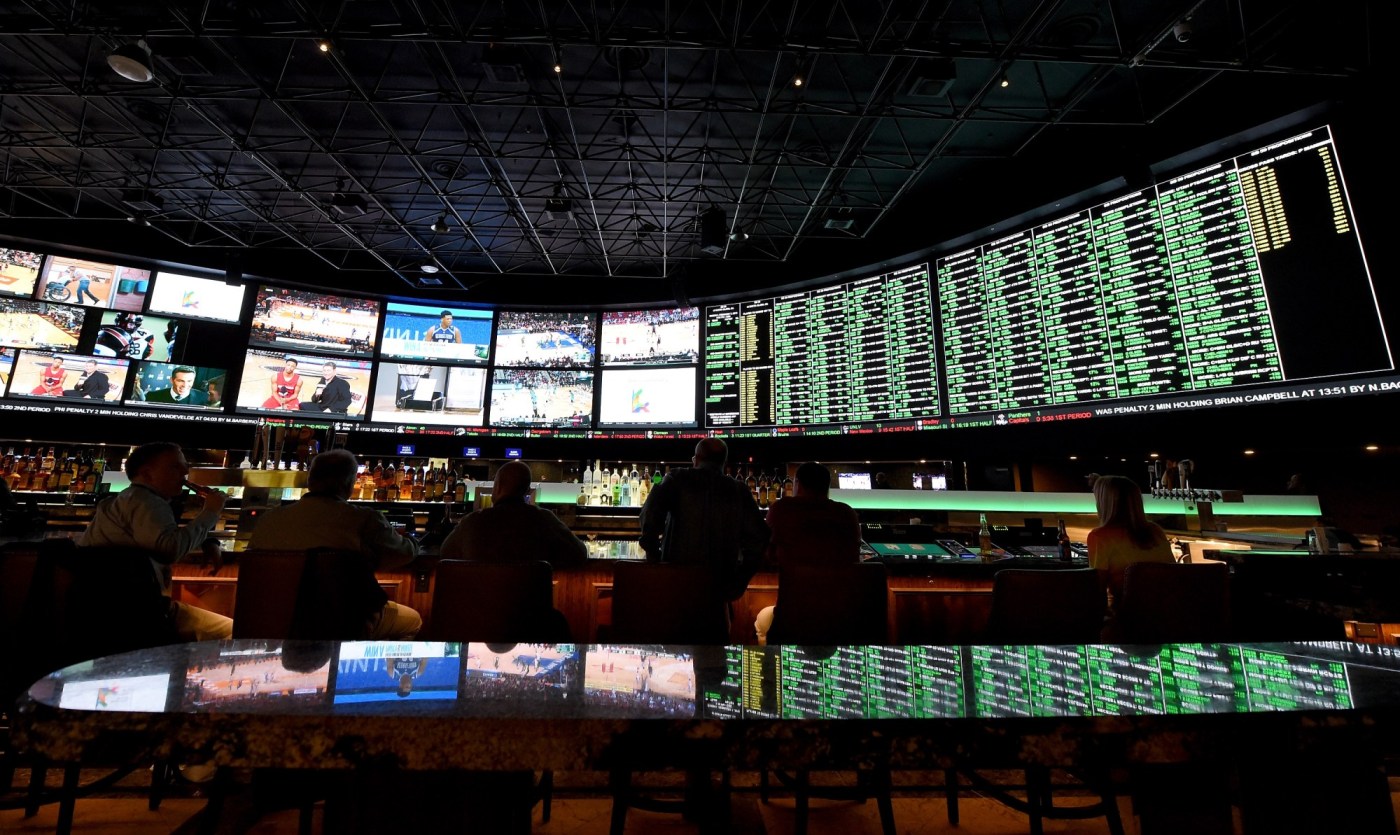
As someone who enjoys being in a football pool, and who plunks down $50 on his March Madness basketball bracket every year, I’m no stranger to betting on sports. But lately I have the gloomy sense that betting is ruining American sports.
To see how, take a recent Monday Night Football game. I was betting Denver, 6.5-point favorites over Washington — an exciting game that went down to the wire. When regulation ended in a tie, I had one and only one fixation: that Washington would win the coin toss for OT.
Why? Because if they did, they would choose to kick off, giving Denver the chance to score first in OT. And if Denver scored the first TD, the extra point would be kicked — since OT would continue — giving me my margin of 7 points. But if Washington got the ball first, even if they ended up punting and Denver went on to score a TD, it would be lights out for me, because the game would end right then and there, with no extra point. Denver would win by six… and I’d lose my bet.
In other words, the only chance for me to win was if Washington won the coin toss. So come on, baby, tails!
My agonizing over a coin toss illustrates the basic distortion that gambling exerts on spectating. Betting on the point spread creates a kind of parallel, phantom game that changes the plot points of the drama. Thus, moments that are humdrum in the real game – like a coin toss — become intensely important, while moments that are huge in the real game become completely irrelevant.
There’s nothing new in this, and gamblers have long accepted this distortion as the cost of wagering. What’s new is how the distortion has metastasized and spread. I’m talking about the proliferation of so-called “prop bets” – wagers not on a game’s outcome, but on a specific “proposition” within the game. Will Saquon Barkley rush for 30 yards in the first quarter? You can bet on that. How many of Bo Nix’s first ten pass attempts will be completions? You can bet on that too. You can bet on pretty much anything.
These are micro-bets that happen in real time, as the action unfolds, facilitated by smartphones and by enormously profitable betting platforms like DraftKings and FanDuel.
Though it has only been seven years since online sports betting was legalized, the American Gaming Association estimates that Americans wagered $35 billion on the NFL during the 2024 season – an explosive growth driven by the massive popularity of prop bets. I think of it as saturation betting.
In my view, the rise of wall-to-wall, saturation betting poses an existential threat to sports.
And I’m not even talking about the obvious danger to gambling addicts, or the scandals involving players accused of criminally altering their performances to facilitate certain outcomes for prop bets. I’m talking about the way in which saturation betting changes the very nature of spectating. The traditional point-spread bet I made in the Monday Night game is still a whole-game kind of wager. But the person who spends the entire game making prop bets on his phone is experiencing a drama whose shape is fundamentally unrelated to the game and its outcome, consisting instead of a patchwork of mini-dramas centering on this pitch, that run, that pass play.
The result is that what used to be a mass, collective experience has now been drastically individualized. There are now as many games as there are phones; what used to be a feast that everyone devoured together has been divvied up into a gazillion little snacks gobbled down willy-nilly. Does it seem strange that fans everywhere now erupt in joy or sorrow, euphoria or rage, at seemingly random moments during a game? Prop bets are the gambling distortion on steroids.
The role of the smartphone in all of this is a textbook illustration of the concept of moral hazard, or a setup that makes damaging behavior all but inevitable. I love brownies, and I have shown an ability to continue eating them until they are gone, no matter how many are put in front of me. Having them in the house is a moral hazard for me. I can’t help myself.
Saturation betting in sports is a pantry with shelves stocked floor to ceiling with brownies. The gambling gluttony that it enables has distorted the experience and even the meaning of watching a game. More ominous still is the thought of the FanDuel mentality extending into other areas of American life. What’s the over/under on tomorrow’s temperature? How many seats will Democrats pick up in the midterms?
I wonder what the chances are of this pathology coming to dominate life beyond sports. We could bet on it. But that way lies madness.
Hartford resident Rand Richards Cooper is a contributing editor for Commonweal Magazine.