
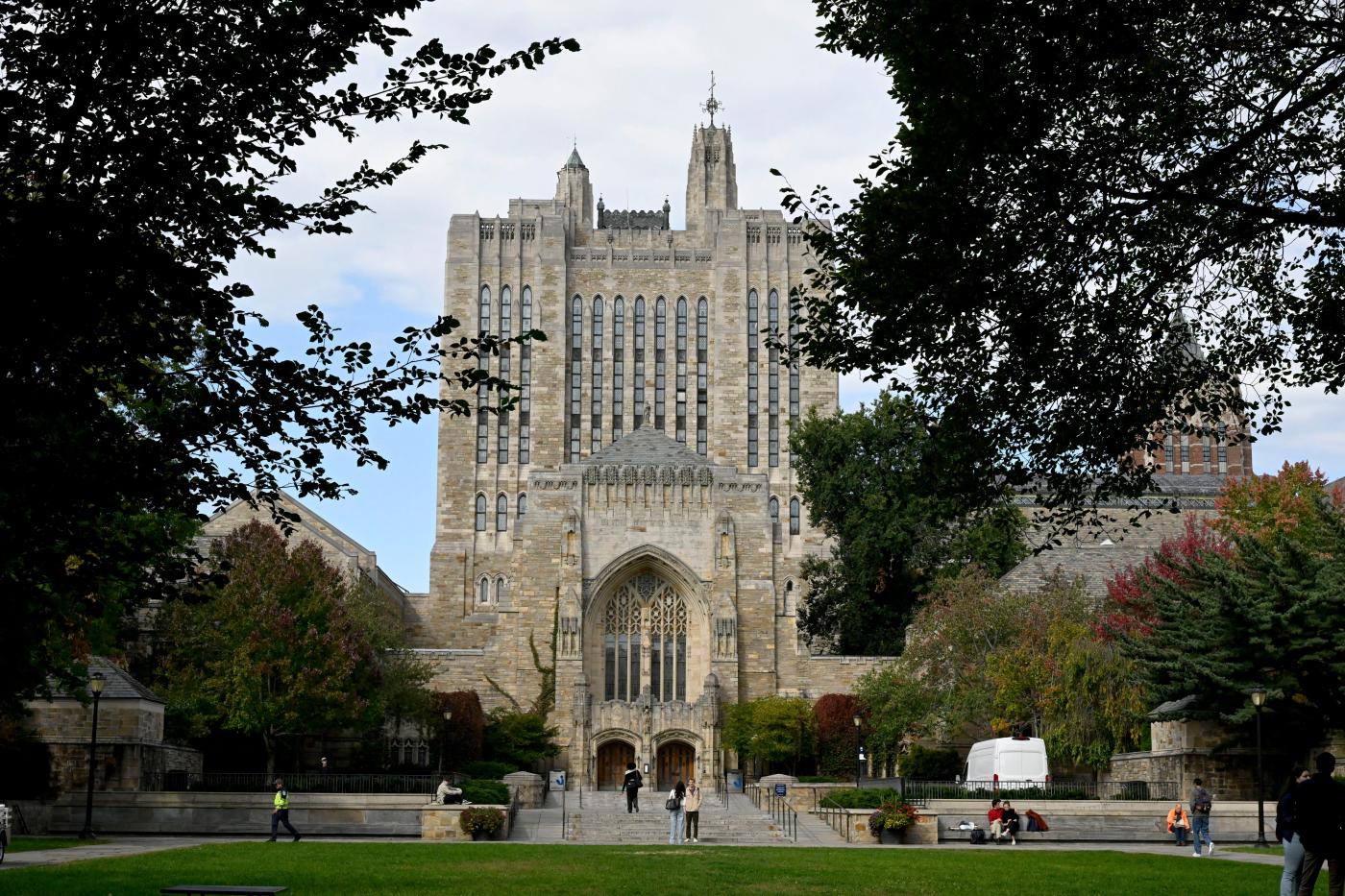
A conservative group at Yale says a comprehensive study shows the university has no Republican faculty members in 27 of 43 undergraduate academic departments.
The Buckley Institute, which is named after conservative icon and Yale graduate William F. Buckley Jr., says it checked the voter registrations and political affiliations of 1,666 faculty members in its annual survey of professors.
The group reports that “82.3% of faculty are registered Democrats or primarily support Democratic candidates. By contrast, only 15.4% are independent and 2.3% are Republicans. 27 of 43 undergraduate departments had no Republicans at all.”
In addition to covering undergraduate departments, the report covered Yale Law School and the graduate school of management, which has many well-known graduates including Gov. Ned Lamont and former PepsiCo chief executive officer Indra Nooyi.
While the report said that there are currently few Republican faculty members, numerous Yale graduates have gone on to become prominent Republicans and nationally known conservatives after graduation. Those include Vice President J.D. Vance, Florida Gov. Ron DeSantis, U.S. Sen. Josh Hawley of Missouri, former presidential candidates Vivek Ramaswamy and Ben Carson, former national security adviser John Bolton, and four of the most conservative members of the U.S. Supreme Court, Clarence Thomas, Samuel Alito, Neil Gorsuch, and Brett Kavanaugh.
The report by the Buckley Institute also stated that Yale’s numbers are out of sync with the overall Connecticut population.
“Among the general public, annual data put independents at around 40% of the electorate for the last 15 years, while Democrats and Republicans have hovered around 30%,” the report said. “In Yale’s home state of Connecticut, independents (44%) and Republicans (21%) likewise outstrip their shares of the Yale faculty. By contrast, only 35% of Connecticut voters are registered Democrats.”
Lauren Noble, a 2011 Yale graduate who is the Buckley founder and executive director, said that the survey has brought attention again to the faculty.
“For the third year in a row, our research has highlighted the significant political and ideological imbalance among Yale’s faculty,” Noble said in a statement on Facebook. “Yale has committed repeatedly over decades to fostering an environment conducive to open debate and discussion but has all but excluded diversity of opinion through its hiring process.”

Yale University students arrived with a cardboard cutout of Yale alumnus Dr. Benjamin Carson, President Donald Trump’s pick for secretary of the U.S. Department of Housing and Urban Development, as Carson spoke at Yale in December 2016 as a guest of the William F. Buckley Jr. Program at Yale.
Yale responded by saying that the university does not consider political views when hiring faculty.
“Yale hires and retains faculty based on academic excellence, scholarly distinction, and teaching achievement, independent of political views,” the university said in a statement. “The university also considers faculty members’ ability to mentor the next generation of scholars and leaders. The university’s emphasis on faculty mentorship and educational rigor has helped produce scholars and leaders who have made positive contributions across the country and in all sectors of society.”
The university referred to its longstanding Woodward Report, which encompasses Yale’s principles of freedom of expression and was adopted in 1975 by a committee of faculty members and students that was led by chairman C. Vann Woodward, a history professor.
“Yale does not track or comment on the political affiliations of individual faculty members,” Yale said in a statement. “The university is, however, deeply committed to fostering open debate, preserving freedom of expression, and creating an environment in which a wide range of ideas can be expressed and heard civilly — principles articulated in Yale’s landmark Woodward Report and advanced through a wide range of campus initiatives.”
Regarding its methodology, Buckley said that it checked public records for the voter registrations of 1,666 faculty members, “but not all Yale faculty were registered to vote in the United States or had identifiable voter registration records.”
Out of the total, 1,335 faculty members were identifiable as tenure-track professors. At Yale, they are often known as “ladder faculty.” Adjunct professors were not included in the survey.
In a fundraising email this week to supporters, Noble noted that Yale has not been targeted by President Donald Trump’s administration in the same way that fellow Ivy League universities like Columbia and Harvard have.
“At the same time, this year we have heard repeatedly that Buckley may be a reason that the federal government hasn’t made Yale a top target,” Noble wrote. “As Yale’s Ivy League peers have come into conflict with the federal government, Yale has been able to avoid a crackdown. The Buckley Institute has held Yale accountable on free speech for years, creating a campus expectation that dissenting views will be accepted.”

The Buckley Institute at Yale is named after longtime Stamford resident William F. Buckley, Jr., an author, erudite Ivy Leaguer. conservative herald and TV talk show host of “Firing Line.”
Christopher Keating can be reached at [email protected]