
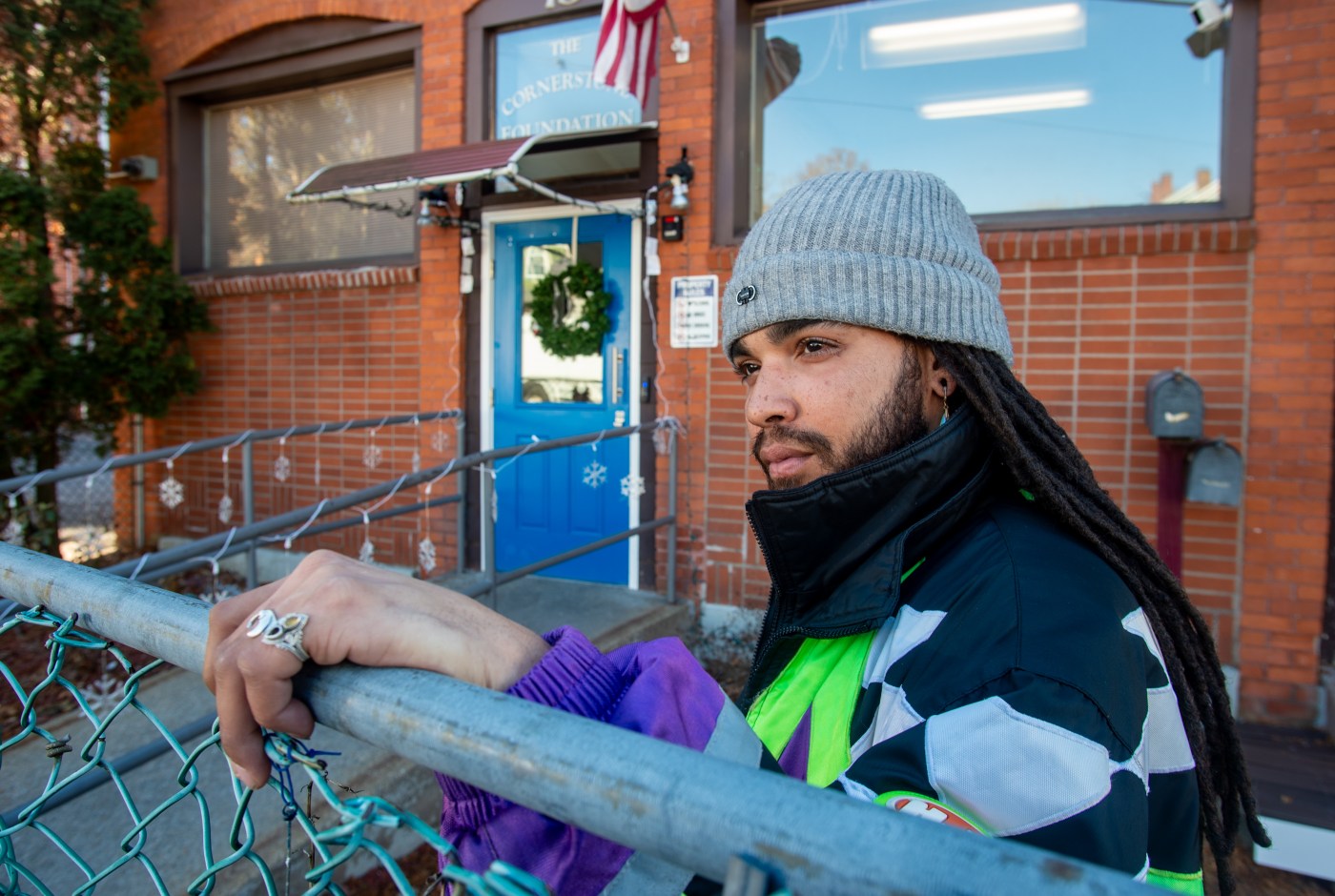
Nearly a year has passed since Adrian Jackson Gilbert acted in a film.
The 29-year-old actor and model began a career in the film industry in 2016 and his biography includes numerous commercials and short and long films.
One of his most recent films, Luminous, an action short film about a group of young adults trying to navigate a new world without guidance, won numerous awards from the Hollywood Gold Awards and the Black Swan International Film Festival.
But now Gilbert is sitting in the Cornerstone Community Kitchen for the unhoused in Vernon with no options: a place he never imagined he would be at the end of 2025.
A perfect storm of events, the Worcester, Mass., native said, brought him to the shelter and put his life at a standstill. He became injured in a car accident this past May, breaking his ankle and his teeth, causing stress followed by challenges with his roommate that led to him being evicted. He also lost his job at Safelite, a temporary job he kept as he had been looking for permanent work for some time. Prior to that he spent years at Olive Garden working as a server. He had reached out to his sister for the first time in years and she provided a place for him for awhile until friction between the two brought him to the warming shelter where he has now slept for the past three weeks.
“It has been the weirdest year of my life,” he said, pausing as he reflected on the twists and turns that led to his being unhoused.
“What gives me hope is looking forward to the future,” he said, his neck adorned with necklaces and his dark eyes lighting up as he stood in the community kitchen.
Gilbert said he fought a battle to keep his former residence, which made it difficult to find a job at the same time.
“I have been searching with the eviction looming over my head and trying to figure out where I am going to go,” he said. “Too much stress.”

Gilbert is among thousands in Connecticut who have found themselves unhoused, with the numbers expected to rise. There are 3,735 people recorded as unhoused in the state — that is those who have sought help. The shelters and soup kitchens are full, with the Coalition to End Homelessness stating that homeless services have to turn away 1 in 5 people because there is so much need.
The warming shelters that provide a place to sleep at night for some also offer a way to find connection and hope, according to several men who spoke with the Courant about their experiences in the shelter.
Cornerstone opens a men’s warming shelter during the winter months that includes room for 15 men and is currently full, according to Grace Boucher, executive director at Cornerstone.
Boucher said the need has increased at the shelter.
“For a lot of people they are living right on the edge,” Boucher said. “They come from houses that they owned and were evicted and couldn’t make their mortgage. We have gotten more than 10 women who came to us from the hospital delivering their babies who had no place to go.”

Gilbert said he received numerous resources when he entered the shelter and he met other men around his age who were facing similar challenges.
“All these things have given me hope that I am not in this alone and other people are in the same predicament,” he said. “It gives me hope to get back on my feet and actively look for a job and an apartment.”
Above all, Gilbert said, it is his 9-year-old daughter who is inspiring him to keep moving forward.
He chokes up when he talks about her, saying that life’s challenges have made it difficult to see her.
Growing up, Gilbert was put into the foster care system at the age of 3 with his two younger siblings. He was later adopted and raised on a farm in Massachusetts.
Moving forward day-by-day
Another man in the warming shelter, who wished to remain anonymous, said he returned to the shelter at the beginning of 2025 when he was evicted from the condo he lived in with his father whom he cared for until he passed away in 2023.
He had spent a brief time in the warming shelter in 2017, he said.
The man said he spends his days in the car and his evenings in the warming shelter. (Most shelters require residents to leave during the day.) This year he recovered from his second bout with cancer — a myriad of troubles hitting him all at once.
He said he has always been the person that people lean on and that this time has become no different for the 57 year old who served as a plant manager for an asphalt management company for 22 years before losing his job in 2017.
From 2018 to 2023 he took care of his father full time until he passed, the man said. He was diagnosed with bladder cancer near the end of 2022 and continued to care for his father. He got sepsis one month before his father died.
Through the ongoing battles, the man, sitting in a chair at the Community Kitchen, said he also remained optimistic and found a connection with those he spends time with in the shelter.
“You can talk to people about their day and find out a little bit more about how they became homeless,” he said. “There is always a story. It doesn’t matter how much money you make. It is something that happens in life. You are out of options.”
He said it comes down to being humble and not being afraid to ask for help or someone to talk to. The warming shelter provides that opportunity for people, he says.
“They need someone to talk to,” the 57 year old said.
Asked how he has made it through his trials, the man smiled, saying simply a positive mindset.
“If you don’t have a positive mindset with cancer you are not going to win the battle,” he said. “You have to overcome every adversity you get.”
He said that he gets along with just about everyone and he doesn’t mind the many rules in the shelter.
The men must arrive by 6 p.m. every night to line up to enter the shelter. They are required to take a shower every night, according to Gilbert.
The men all sleep in one room with numerous beds lined up, Gilbert said.
Gilbert agreed it has been helpful to connect with older men who can provide him guidance, with many sharing helpful phone numbers and other resources.
He said it took time to get used to the shelter at first, with men snoring and no privacy.
But he said overall it has proved beneficial in helping him to navigate the unknowns and the uncertainty that surround him from job applications to looking for housing. He says he has a voucher for housing in Massachusetts, but has found it hard to find a landlord who would take it.
A shortage of housing, particularly for the lowest-income renters, is a challenge in Connecticut, too, that both leads to homelessness and makes it difficult for people to escape it. State legislators passed a bill in the last legislative session that aimed to increase housing in the state but Gov. Ned Lamont vetoed it due to objections from Connecticut’s suburbs. A revised version was passed and signed by the governor in the fall special session but critics say the bill will not provide an immediate solution.
Lamont signs H.B. 8002 into law, finalizing controversial housing bill
State Sen. Saud Anwar, co-chair of the Public Health Committee, who has been advocating for more funding and resources for the unhoused, said there is a need for more resources for 211.
“The time for people calling for 211 is still very long and 211 is not available like it had been in the past 24/7 to be able to address people’s needs,” Anwar said. “On a working day at evening time if somebody needs a place there is no place for them to have an intake about their issue and even if there is an intake they don’t have enough places for giving them the space they need, and that is part of the challenge we are seeing.”
And with the state seeing a 45% increase in unsheltered homelessness, Anwar said there is no extra funding and support system for individuals to get shelter and a place.
“During the winter months we need to have an immediate disaster response of giving them hotel rooms and support so people will be able to be where they need to be so they are not freezing,” the senator said. “We can do better and we have the resources to do better.”