
AMSTERDAM — In a diary entry in the summer of 1943, Anne Frank wrote that she had lost all sense of time. The bells in Amsterdam’s tallest church tower, the Westertoren, right next to her own attic hiding place in a canal house, had stopped ringing.
“For a week already we’ve all been a little confused about the time, ever since our dear and precious Westertoren bell has apparently been hauled away for factory use,” she wrote on Aug. 10, 1943, “and we don’t know precisely what time it is, neither day or night.”
News had reached the young diarist in her terrified seclusion that the Nazi occupiers in Holland were confiscating church bells across the country, to melt them down for weapons and ammunition. “I still have some hope that they will invent something that will remind the neighborhood a bit of the clock,” she added.
During World War II, Hitler’s Germany requisitioned some 175,000 church bells from across Europe, so that they could extract their metal components, mostly copper and tin.
The vast majority of those, some 150,000 bells, were never returned to their churches. Many others were destroyed in the removal process, smelted and converted into munitions, and thousands ended up in so-called Glockenfriedhöfe, or bell cemeteries.
The destruction of church bells, viewed as a war crime during the 1945 Nuremberg War Tribunal and as an act of sacrilege by the Roman Catholic church, is a lesser-known aspect of Nazi looting. Many cities and towns that had for centuries measured out their lives by the quotidian chiming of church bells fell silent.
‘Psychological Significance’
The confiscation had an immediate impact on the lives of ordinary Europeans, who kept time by church bells that typically chimed once every quarter of an hour, and played melodies on the hour.
“It marks the rhythm of people’s days, the rhythms of their lives,” said Kirrily Freeman, a history professor at St. Mary’s University in Halifax, Nova Scotia, who has written extensively about military use of metals, including bells, during World War II. “It’s something that calls people together for major life events, weddings, baptisms, funerals.”
Church bells in European countries had “personal, familial, community and maybe even psychological significance” for a large part of the churchgoing public, Freeman added. “To lose that, not voluntarily, and especially because it was often done violently and in the context of occupation, well, the consequences would be enormous.”
The musical loss, according to historian Carla Shapreau, a senior fellow with the Institute of European Studies at the University of California, Berkeley and the founder of the Lost Music Project, left “a sonic gap in the European landscape.”
It took nearly two decades for most of these bells to be replaced, said Rainer Schütte, a historian and curator of bells at the Klok and Peel Museum in Asten, Netherlands, a museum devoted to the history of bells and carillons (a more intense keyboard-played musical experience).
“In many places, they engaged in getting new bells made and also sometimes adding carillons,” Schütte said. “Often the carillons were introduced as a kind of memorial for victims of the war.” Commemorative bells were also given as gifts, like the Netherlands Carillon in Arlington, Virginia, which the Dutch sent as a token of gratitude for American aid during and after World War II.
The wartime destruction of bells also had a silver lining, giving campanologists an opportunity to study Europe’s bells, and propelling bell foundries to improve their quality and timbre. By 1960, when “almost all the bells had been returned to their towers,” said Schütte, “the foundries managed to increase their production level, both the quantity of the bells and their quality.”
A postwar “bell quality race,” he added, led to major advances in campanology. “They were looking at questions like, ‘How can we make the bells better, do we need to change the profile, or the shape of the bell, and what are the conditions best to hang the bells — open towers or closed towers?”
Losses Date to 1700
Church bells of varying quality had been created in Europe since the early Middle Ages by foundries that alternated between two types of production: cannons during wartime, and bells in periods of peace. Because both required copper and tin, metal shortages often meant bells were smelted for weaponry.
The Nazi seizure of bells within Germany, and later in occupied Europe, began with a decree from Hermann Göring, Hitler’s second-in-command, titled “Reclaiming All Bells for War Purposes” on March 15, 1940. Later, Nazi-occupied countries were required to inventory their bells and categorize them by date, with “D” being the oldest — made before 1740 — and “A” being the most recent.
Bells cast before 1450 were not ordered to be taken, but those from 1700 onward were removed and shipped to smelting locations in Germany. Regions within the Third Reich’s new domains, such as the Protectorate of Bohemia and Moravia (occupied Czechoslovakia) and Alsace-Lorraine, which the Germans annexed after the defeat of France, were the earliest targets of the bell removals.
After the invasion of the Netherlands and Belgium in May 1940, the two countries, renowned for their carillons, were instructed by Berlin to hand over 75% of their bells. The Dutch objected to the measure, and won some concessions.
But the enactment of a new national regulation in the autumn of 1942 kicked off the mass confiscation of Dutch church bells, which was carried out under the direction of P.J. Meulenberg, a member of the Dutch Nazi party, the NSB.
He soon got the nickname “Bell Peter.” By early 1944 he had removed thousands of bells from church towers across the country, according to archival records at the NIOD Institute for War, Holocaust and Genocide Studies in Amsterdam.
Until then, bells had been a key fixture of community life in Dutch cities, said Wouter Iseger, a Dutch musician and historian who wrote a book about bells looted from his city, Utrecht: “The church bells were important for when there was a fire or a storm coming, or when some guilds were called to meet. In Utrecht, we had a bell that rang every day when the gates of the city would open and close.”
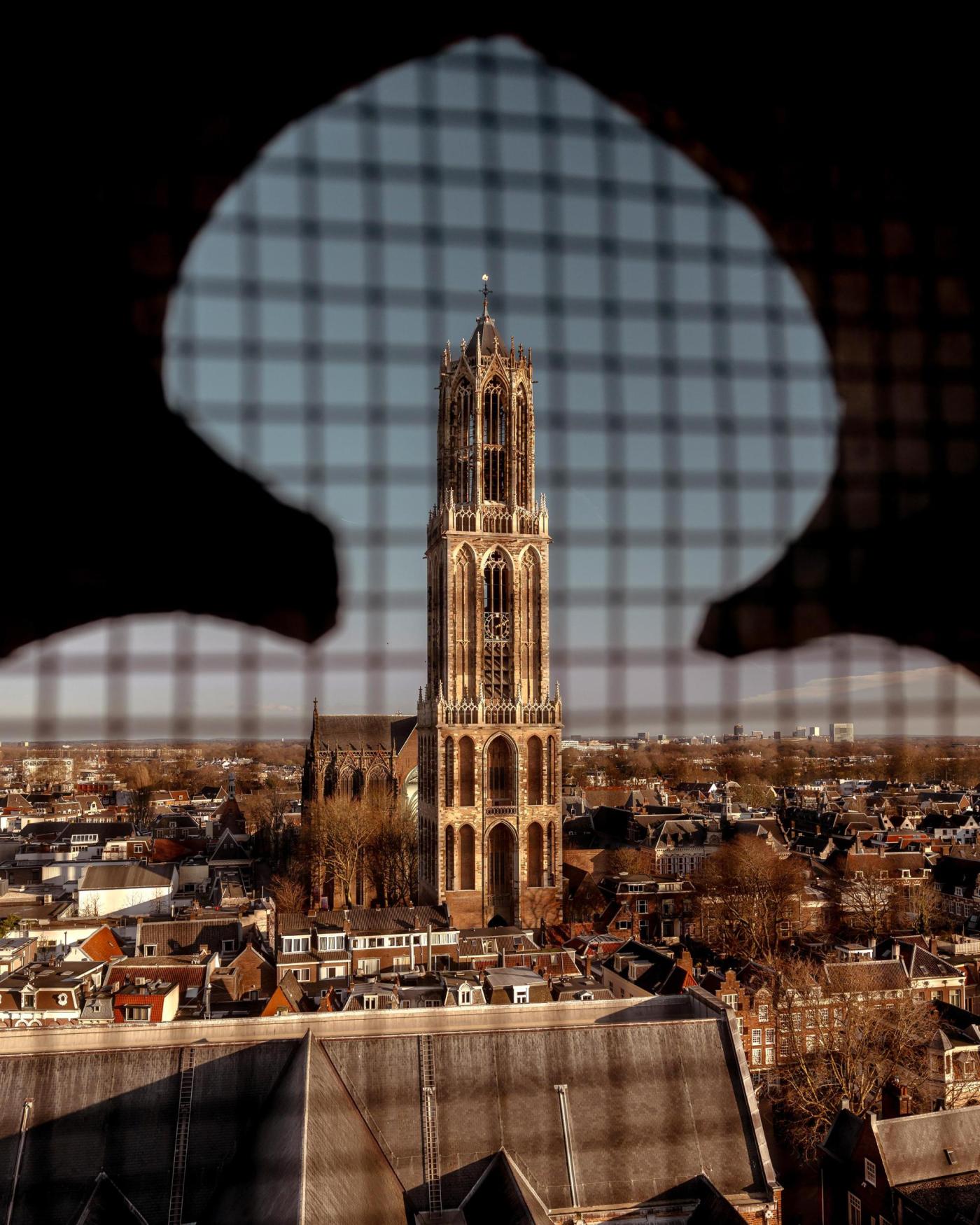
When the Nazis invaded the Netherlands, the largest church in Utrecht, Dom Tower, lowered the 1505 and 1506 church bells and covered them with sandbags to protect them. They were marked with an “M,” which is still visible today. For the entire war, that tower remained silent, Iseger said.
Percival Price, a Canadian-born musician, composer and campanology expert from the University of Michigan, found that Germany lost 102,500 bells to the war effort, of which 90,000 were “not recoverable as bells.”
Among Nazi-occupied countries, Poland had an estimated 20,800 church bells destroyed.
After the war ended in 1945, the Allies discovered the largest bell cemetery in the harbor of Hamburg, where some 10,000 bells remained on the quay. Price saw the assemblage of bells from all over Europe as a “unique opportunity for controlled conditions of research.”
His subsequent report and analysis “created a database of the tonal properties of the surviving bells, using electronic oscillator instrumentation,” said Andrea McCrady, an adjunct professor of music at Carleton University in Ottawa, Ontario, where she serves as the Dominion Carillonneur of the Peace Tower Carillon. “The quality of modern tuning,” and other adjustments that made playing easier, she added, led to “more expressive performances.”
Keeping Their Craft
Similarly, European campanologists like Bert van Heuven and Dutch bell makers Tuur Eijsbouts and André Lehr revived a tradition of bell making that had been largely dormant for centuries.
The new bells were more precisely tuned, Schütte said, “so that they could play a wider range of music.
“The bell landscape or soundscape would have been richer in 1960 than in 1940 because of the growth of bells, but also the number of towers and churches,” he said.
Anne Frank wrote about the church bells from the Westerkerk a few times in her diary, according to Dutch World War II scholar David Barnouw. In February 1944, she described hearing “a bell” playing “Erect of Body, Erect of Soul,” and a month later, she could feel as if she were part of a wedding by the sound of the bells next door.
Gertjan Broek, a researcher at the Anne Frank House, said that the Westertoren bells never went totally silent during the war. Frank may have added that element for dramatic effect, he said, drawing from news reports she had access to from the underground resistance press.
The Westerkerk’s largest swinging bell was confiscated in early 1943 and returned by July, but did not start ringing again until that November. The church’s 1658 carillon was never removed.
According to Price’s records, of the 9,000 bells in the Netherlands before the war, 4,660 were never returned to their church towers. Frank, along with her family, was discovered on Aug. 4, 1944, and deported to a Nazi death camp, where she died.
When Holland was liberated in May 1945, Amsterdam residents gathered around the Westerkerk, as the Dutch flag was hoisted up the tower, and the national anthem played on the old carillon.
This article originally appeared in The New York Times.