
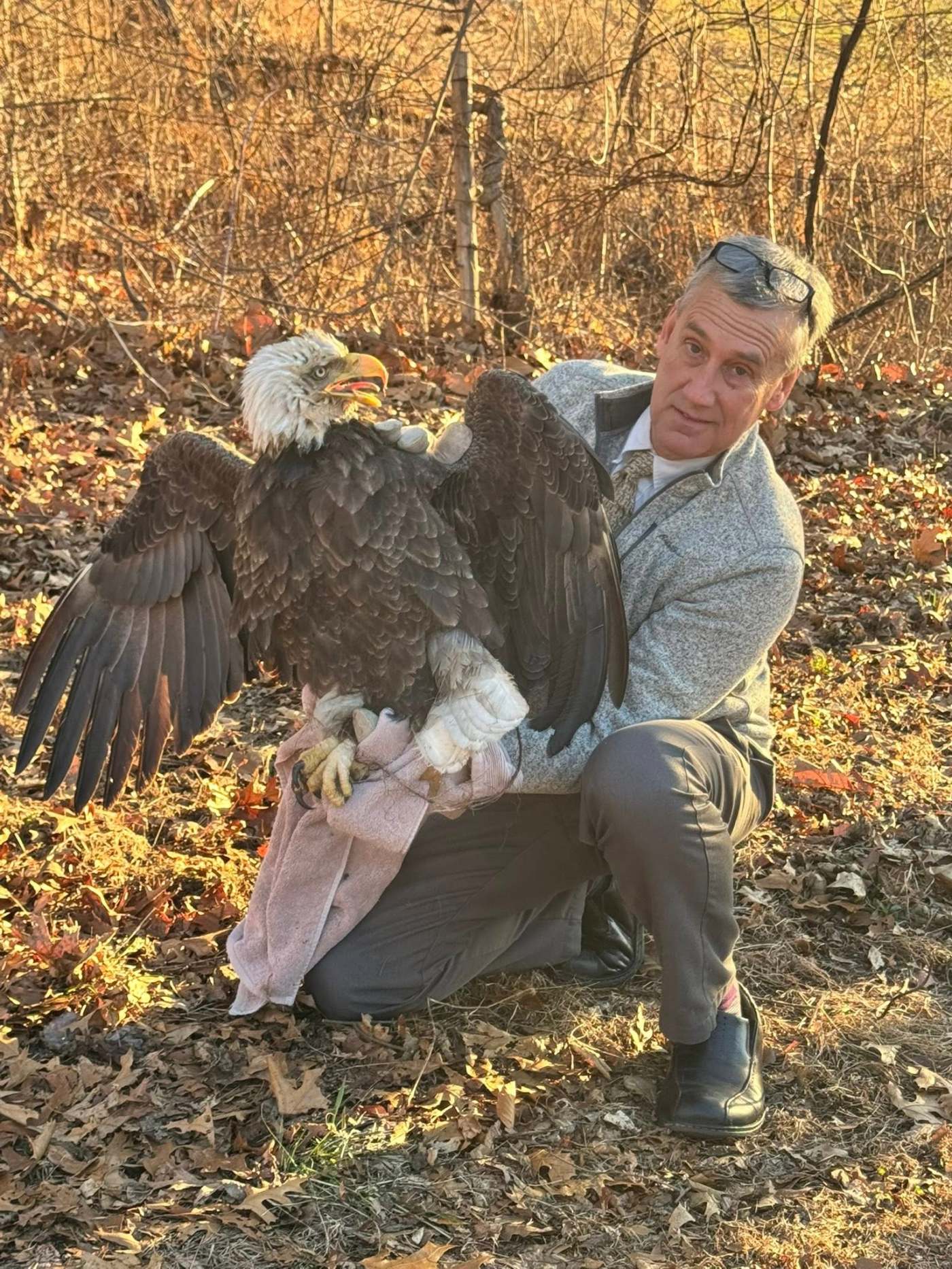
A bald eagle is recovering after being rescued in Mansfield on Monday after striking power lines, officials said.
In a Facebook post by Connecticut State Police, early Monday morning a bald eagle was seen in the area of Ravine Road and Route 32 in Mansfield, when witnesses say that it flew into power lines and fell straight to the ground.
State police said several vehicles stopped and confirmed the bird of prey was still alive. According to state police, one person immediately stopped and stayed to help protect the bald eagle from traffic until officers arrived, likely saving it from getting hit by a car.
A Mansfield resident trooper with Troop C in Tolland, along with a Connecticut-licensed falconer, stopped to assist.
“Together, the eagle was safely contained and kept calm until transport arrangements were made. The bald eagle was then transported by Horizon Wings to Tufts Wildlife Clinic for evaluation and care,” state police said.
The bald eagle, once considered an endangered species rarely seen in Connecticut, is now widely spotted across the state, according to the Connecticut Audubon Society.
The bald eagle was first declared an endangered species with the passage of the federal Endangered Species Act in 1973, according to the state’s Department of Energy and Environmental Protection. Populations eventually began to recover over the years due to the ban on DDT use, successful reintroduction programs of fostered chicks and fledglings, and habitat and nest protection measures.
In 2007, the bald eagle was taken off the federal Endangered Species List, showcasing its comeback.
DEEP estimates there are now around 185 bald eagles in the state with around 72 active eagle territories.
“In 1999, only two nesting territories were active in the state. That season, neither pair was successful, and no chicks were produced. A decade later, the eagle population was climbing,” according to DEEP. “In 2009, Connecticut saw 19 nests produce 31 chicks. By this point, the Wildlife Division requested the assistance of volunteers to help collect the data necessary to monitor the state’s population. Fast forward to 2025, and this season is off to a great start, as many eagle pairs are now incubating eggs.”
Stephen Underwood can be reached at [email protected].