
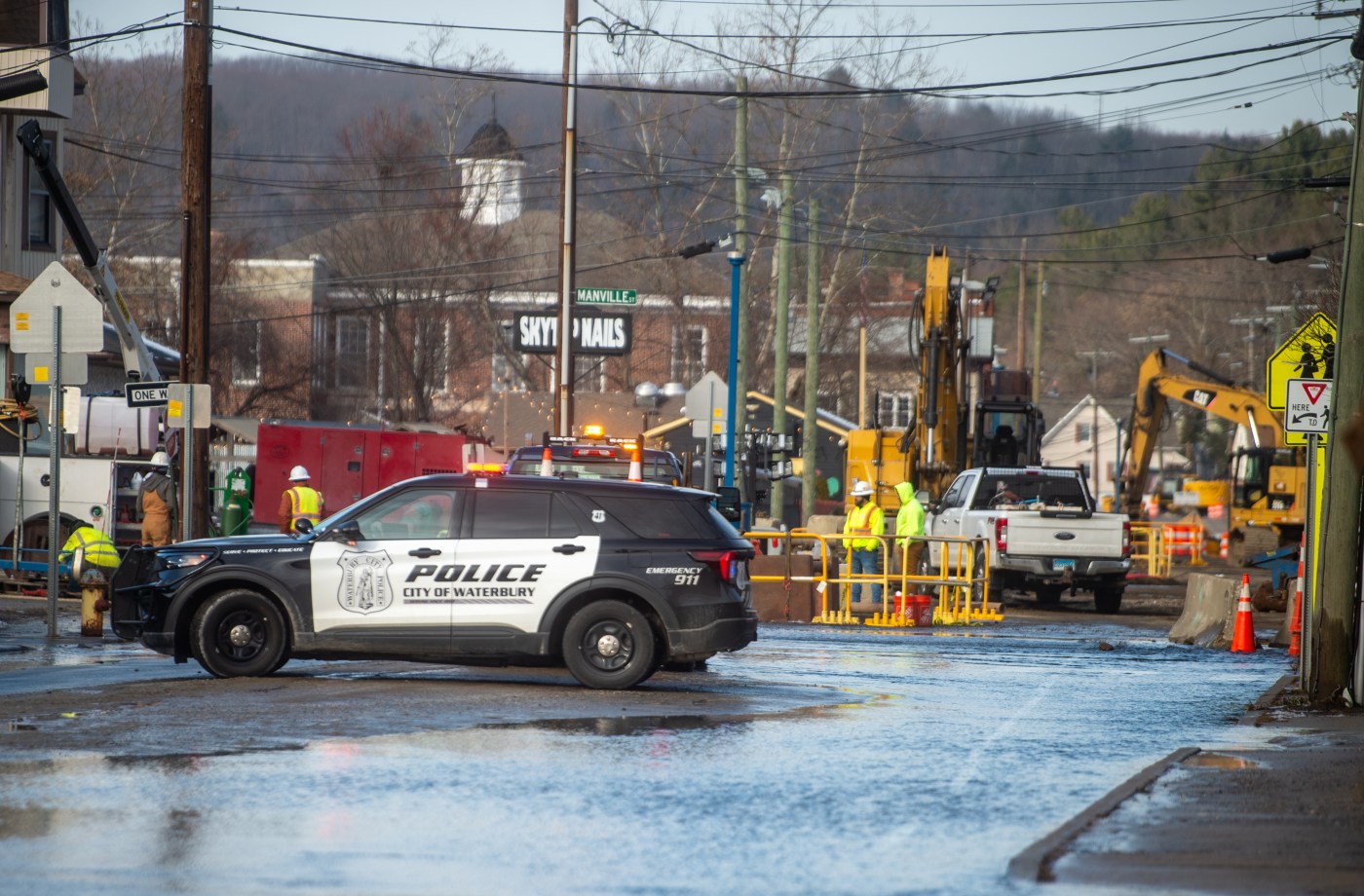
A recent major water main break in Waterbury put the city at a standstill for four days, closing restaurants and schools, affecting hospitals and people’s day-to-day lives from the simple act of brushing one’s teeth to taking a shower.
The city could not contain the scope of the incident due to its aging infrastructure — a problem that is common throughout Connecticut, experts said this week.
Local and national experts in civil engineering said that aging infrastructure and climate change are causing problems in water infrastructure systems across the country, making them vulnerable to water main breaks similar to what happened in Waterbury. More investment in those systems is critically needed, they said.
“The drinking water infrastructure is old and it is likely approaching its useful life,” said Darren Olson, chair of the American Society of Civil Engineers and a water resources engineer. “There is no place that is immune from having what happened in Connecticut happen now.”
The American Society of Civil Engineers, with the aid of 160,000 civil engineers, issues a report card evaluating the country’s infrastructure including its roads, bridges, rail transportation, drinking water systems and wastewater systems. Overall, the state of Connecticut’s water infrastructure received a C while the country as a whole received a C-.
“There are roughly 2.2 million miles of underwater pipes” in the country, Olson said. “The network is huge and it is aging. It was put in a long time ago and on the east coast those communities are centuries old. We have not had the funding and the investment to maintain it like we should.”
Maura Fitzgerald, chief marketing officer for the state Department of Public Health, said in an email that “aging water infrastructure is a common challenge throughout Connecticut and across the entire nation.
“It affects water systems of all sizes, whether they’re run by municipalities or private companies,” she said. “The problem is made worse by rising costs for maintenance and repairs along with water rates that haven’t kept pace with these needs.”
Fitzgerald said every year the Environmental Protection Agency surveys the country’s water infrastructure needs, with the most recent assessment completed in 2021 finding that the state needs “approximately $4.9 billion over the next 20 years to address its aging water infrastructure.
“The largest portion of this, about $3 billion, is needed for the pipes and equipment that deliver water to homes and businesses throughout the state,” she said.
Gov. Ned Lamont said this week that the state’s infrastructure including its roads, bridges and trails is aging. He said that water companies are responsible for the piping and the water infrastructure.
“There is always a back and forth,” he said. “They are looking for money to do this.”
But the governor said, “We are going to pay special attention and work with the companies so this is less likely to happen in the future and target where things are most vulnerable. At least we can limit the disaster that befell the people of Waterbury.”

A perfect storm
Waterbury, which typically responds to 30 to 40 water main breaks per year, had never experienced such a break of such magnitude before, according to Waterbury Superintendent Brad Malay.
In an interview with the Courant, he referred to it as the perfect storm.
Malay said it all began with a small break on a 12-inch main on Dec. 11.
“When we started construction, the 12-inch line let go and washed out the road and all the bedding and everything that existed on the asphalt,” he said.
Malay explained that the leak washed out another water main, causing the pipe to cave in on itself.
While water main replacements are integral, Malay said what is most needed for the city is to replace 10 to 12 of its valves, which function to control the flow of water through pipes.
Mayor Paul Pernerewski agreed.
“Whenever we have a break in the pipe we can’t contain it to a particular area because the shutoff valves in the system currently don’t work so we end up with larger areas that have to be shut down and the problems have been recharging a system,” Pernerewski said. “The 10-12 valves would be a critical investment to try to make in the next year to be able to control when a break happens.”
The valves are expected to cost around $5 million, the mayor said.
Pernerewski said more funding is needed and that there has not been enough to maintain some parts of the system.
“We have been replacing underground utilities as we have been doing road projects,” the mayor said.

Aging infrastructure and funding needs
The state Bond Commission approved $157 million Thursday for the Clean Water Fund Program that could be allocated to cities and towns to improve water infrastructure, according to state Rep. Ron Napoli, D-Waterbury, co-chair of the Bonding Subcommittee.
“This important program helps provide low-cost financing for much-needed water infrastructure upgrades,” Napoli said. “These investments will strengthen public health and support economic growth by improving essential infrastructure across our state.”
The Drinking Water State Revolving Fund, a federal program created in 1996 to help communities afford critical water system improvements, has, according to Fitzgerald, invested more than $541.9 million in 341 water infrastructure projects statewide.
Olson said the overall infrastructure of the country improved with the Infrastructure Investment in Jobs Act, which invested roughly $1.2 trillion in the nation’s infrastructure in 2021.
But now, Olson said, cuts to the Drinking Water State Revolving Fund could set back the process of improving water infrastructure.
“One of the things with water infrastructure is there is maintenance and there is also the capital improvements and replacing water mains,” he said. “That requires a lot of planning and planning for that type of work doesn’t happen if the funding is uncertain.”
Ari Perez, associate professor of civil engineering at Quinnipiac University, said these conventional distribution systems are vulnerable and “more investment and maintenance is needed to reduce the vulnerability of water main breaks.
“Water is one of the most essential things we need to survive,” Perez said. “The amount of water that a person consumes is fairly large. When we design these water systems, we calculate 65 gallons of water per person per day.”
Nandan Shetty, assistant professor in civil and environmental engineering at University of New Haven, agreed there needs to be more funding invested in water infrastructure.
“We need to replace these cast iron pipes that are nearly twice their lifetime,” he said.
Malay explained that most of Waterbury’s water infrastructure is not cast iron, but is made of concrete.
Nick Salemi, spokesperson for the Metropolitan District or MDC, which provides water supply, water pollution control and household hazardous waste collection to Bloomfield, East Hartford, Hartford, Newington, Rocky Hill, West Hartford, Wethersfield and Windsor and parts of other towns, said there are approximately 18 breaks a month over the last several years with more occurring in the cold months.
“Water main breaks typically affect one street and a few properties and are isolated and fixed by our 24/7 repair within a few hours,” said Salemi.
Water companies such as the MDC look to state and federal grants to help fund planned capital improvements on an annual basis.
Salemi said there is $68 million in planned water system improvements, the majority of it water main replacements scheduled as part of MDC’s 2026 Capital Improvement Budget.
In the last six years MDC has invested $274 million in water infrastructure improvement projects, he said.
“This includes improvements to water mains, distribution system, treatment plants, reservoirs and more,” he said.
Olson said most people do not realize how big and complex the national drinking water system is in the country.
“We don’t invest in it like we should because most of it is out of sight and out of mind,” he said. “You don’t realize how complicated and interrelated our drinking water infrastructure is. What happened in Waterbury is not a unique situation. It is a very common occurrence. There are water main breaks daily and we lose a tremendous amount of water from our system in water main breaks.”