
This was the year that Connecticut theaters finally found their footing again following the shutdowns during the COVID pandemic.
Audiences began returning in droves, in some cases setting attendance or sales records. After an understandable period of cautious programming, artistic directors started to take chances with new works or brash interpretations of classics. Many of these choices were undeniable successes, both artistically and commercially, boding well for the future of Connecticut theater.
As I’ve done for the last decade or so, I’ve dug through my playbills and reviews of the last 12 months and pulled out some pristine moments that enthralled me. They range from big tours at The Bushnell to one- or two-person shows at TheaterWorks.
A reminder: These are not necessarily the favorite theater experiences of 2025. It makes a lot more sense to recall and relive magical moments from important productions, whether or not the whole shows lived up to those precious little pieces.
Another caveat. I don’t see everything. My New Year’s resolution is to get to more college theaters and community-based theaters in 2026. But this past year was extremely hopeful and heartening. There were some true triumphs.

The cast of “About Time” at the Terris Theatre. The show completes a trilogy of revues that began with “Starting Here, Starting Now” and “Closer Than Ever.” (Diane Sobolewski)
The intended audience in ‘About Time’ at Goodspeed’s Terris Theatre
It’s an age-old canard in regional theater that the “audience is literally dying” – meaning the average theatergoer is concerningly old and that younger theatergoers aren’t leaping into the fray to keep the art form alive. Never mind that this complaint has been around since at least the 1960s, meaning that the elderly audiences of that time could have died of old age, been reincarnated as babies and would be senior citizens all over again around now.
Say you do buy the concept that theater audiences are old and set in their ways. Then why aren’t more people writing shows for them? That’s what the venerable songwriting team of Richard Maltby Jr. (lyrics) and David Shire (music) attempted with “About Time,” which had a workshop at Goodspeed Musicals’ Terris Theatre in Chester in May/June.
The show wasn’t just about aging, it was done in an outdated musical revue format that had largely faded out in the 1980s. The whole thing felt like a time warp except that many of the numbers had fresh modern situations and contemporary references. You expect a show like this to have jokes about how old people can’t understand computers, and there were certainly a few of those. What you didn’t expect were situations like a same-sex couple who’ve been together 30 years, or a British music hall performer finding, through his corny century-old comic dancing, that he’s gender fluid.
There was unexpected wackiness to “About Time” as well as heartfelt life lessons, yet the biggest attraction was the show’s unexpected unpredictability.

Richard Thomas in character as the wily Mark Twain in “Mark Twain Tonight!” The revival of the show, originally created by Hal Holbrook, is having a pre-tour run at TheaterWorks Hartford through Aug. 24. (Julieta Cervantes)
The Hartford Courant in ‘Mark Twain Tonight!’ at TheaterWorks Hartford
Given that the first new production of “Mark Twain Tonight!” in decades — and the first not to feature Hal Holbrook, who’d crafted the show in the 1950s and performed it himself for 60 years or so — was getting its pre-tour shakedown in Hartford, you really hoped that the city would come up somehow. The producers had chosen to do it at TheaterWorks Hartford on Pearl Street, mere yards from where Twain himself took frequent walks in the late 19th century.
Richard Thomas played Twain at 70 years old, just a few years after the writer had left his beloved house on Farmington Avenue in his favorite city of Hartford due to a family tragedy and had embarked on a years-long speaking tour. Those hoping for local content in “Mark Twain Tonight!” were not disappointed. Thomas reeled off a list of multiple Hartford landmarks. But the crowning moment was when he waved around a (strangely modern) edition of the oldest continuously published newspaper in the United States, the Hartford Courant.
Twain was a neighbor of, and collaborated on a novel with, legendary Courant editor Charles Dudley Warner. Twain contributed op-eds to the Courant. The gesture of unfurling a newspaper, one of the few props in a very verbose show, livened things up but was full of deeper meaning.
The tour is currently in the southern U.S. and ends in the midwest in February 2026. Some of those cities have their own special relationship to Twain, but nothing like what Hartford meant to him in his 50s and 60s. This was a banner year for Twain fans with the long-awaited Ron Chernow biography finally being published. Can we get more theater about him now?

Beau Gravitte and Sharon Catherine Brown as Older Noah and Older Allie in “The Notebook” at The Bushnell. The musical, based on the romantic novel and movie, uses three couples to dramatize the stages of an epic romance. (Roger Mastroianni)
The hospital bed in ‘The Notebook’ at The Bushnell
There are plenty of easy laughs in a romantic musical like “The Notebook,” which came to The Bushnell on tour in September. There’s the giddiness of young love, the goofy behavior of good friends, the awkwardness of dating, the culture clash of townies and tourists and the over-the-top behavior of parents. “The Notebook” kept the mirth gentle, worked hard at making the audience weep instead and succeeded.
Yes, there was a Nicholas Sparks novel and a Ryan Gosling/Rachel McAdams movie to prime theatergoers for this tale of a summer romance and its long-lasting aftereffects. But the musical’s creators Bekah Brunstetter (book) and pop star Ingrid Michaelson (music and lyrics) created a rich dramatic framework to make sure heartstrings were tugged, from the ethereal choir-like supporting ensemble to having the two main characters played by a different pair of performing for each of the three key phases of their lives together.
The show culminates in an emotionally devastating yet tranquil and poetic death scene in a hospital room which segues into “Coda,” a touching song about memory and community. I’m not sure when I’ve ever seen so much sobbing in a theater. Folks were rushing down the aisles clenching handkerchiefs. Heck, I just put the soundtrack on while I wrote this and am tearing up now.

The Baroness (Sarah Street) and Rolf (Nick Apostolina) in a clinch in Jacques Lamarre’s “The Baroness” at Playhouse on Park through June 22. (Meredith Longo)
The back scratches in ‘The Baroness’ at Playhouse on Park
Hartford-area playwright Jacques Lamarre has a quick wit that has served him well in the many routines he’s co-written for drag performers or in the scenes he’s contributed to TheaterWorks Hartford’s holiday staple “Christmas on the Rocks.” It was fascinating to see him extend a “Christmas on the Rocks”-style riff on two supporting characters in “The Sound of Music” that went waaaaaaay further than Rodgers & Hammerstein ever could have imagined.
The big turning point in the show was after a steamy hook-up between title character Elsa von Schraeder (whose engagement to Captain von Trapp has been scuttled by the problematic Maria) and uniform-wearing Nazi youth Rolf (whose brief relationship with 16-going-on-17 Liesl is also over) results in bleeding welts and bondage imagery. From that point on, the one-line gags ended and “The Baroness” got weird, dark and twisted, though Lamarre still found a way to wrap it up tidily.
West Hartford’s Playhouse on Park should be commended for premiering a play that really needed a live audience to test its limits with, and Lamarre should be encouraged to let his longform freak flag fly more often.

The “Friends Forever” number from the new version of “Peter Pan.” From left: Nolan Almeida as Peter Pan, Kenny Ramos as Acoma, Raye Zaragoza as Tiger Lily plus several members of the ensemble. (Matthew Murphy)
‘Friends Forever’ in ‘Peter Pan’ at The Bushnell
One of my favorite showtunes of all time is “Comes Once in a Lifetime” from the underrated, though admittedly embarrassingly outdated and out-of-touch, 1961 musical “Subways Are for Sleeping” created by composer Jule Styne with book writers/lyricists Betty Comden and Adolph Green. It’s a jaunty, positivist tune about finding small joys in everyday life.
When the bracing new adaptation by playwright Larissa Fasthorse of another Styne-composed musical, “Peter Pan,” came to The Bushnell in February, it was overloaded with welcome departures from the original — cultural diversity, deep respect for the indigenous characters in the show previously maligned as “Indians,” no room for a canine nanny, a modern American setting rather than a Victorian England one, etc. But the change that affected me the most was the newly added song that becomes the frantic, playful finale of this version’s first act.
“Friends Forever,” featuring new lyrics by Adolph Green’s songwriter daughter Amanda Green, is a rewrite of “Comes Once in a Lifetime.” Hearing that wonderful melody played by a live theater orchestra then danced to by Peter Pan, Tiger and their Neverland playmates felt like a dream.

One of many snowy moments in the tremendous ensemble piece “The Inspector” at Yale Rep this past February. (Joan Marcus)
The snowstorm in ‘The Inspector’ at Yale Repertory Theatre
The Yale Repertory Theatre had an exceptional year. It resurrected plays by major writers Steve Carter (“Eden” from 1976) and Zora Neale Hurston (“Spunk,” receiving its world premiere 90 years after it was written) and gave those lavish productions a sharp contemporary relevance that made you upset that these scripts weren’t better known or done more often.
But Yale Rep also took an exceeding well known international theater classic Nikolai Gogol’s “Revizor” — often translated as “The Inspector General” but called just “The Inspector” this time — and gave it the same degree of immediacy, significance and quality design.
Adapted and translated by Yura Kordonsky (who was born in Ukraine, practiced theater for decades in Russia and now teaches at the David Geffen School of Drama at Yale), “The Inspector” had a cast of 12 youngish actors, a wild energy and a wide open snowy playground of a set that suitably captured the desolate look of an impoverished Russian town.
Scenic designer Silin Chen and the other designers collaborated ingeniously to create huge swirling snowstorms on the stage. The effect wasn’t just awesome to behold, but the way it blew across the entire stage underscored what a believable small community these actors had created. Kordonsky, his cast and designers demonstrated how “The Inspector” is not really about the Inspector, it’s about the community this deceitful interloper upsets when he arrives from nowhere accepting bribes and favors. This was a consummate ensemble piece, exquisitely framed by bad weather.

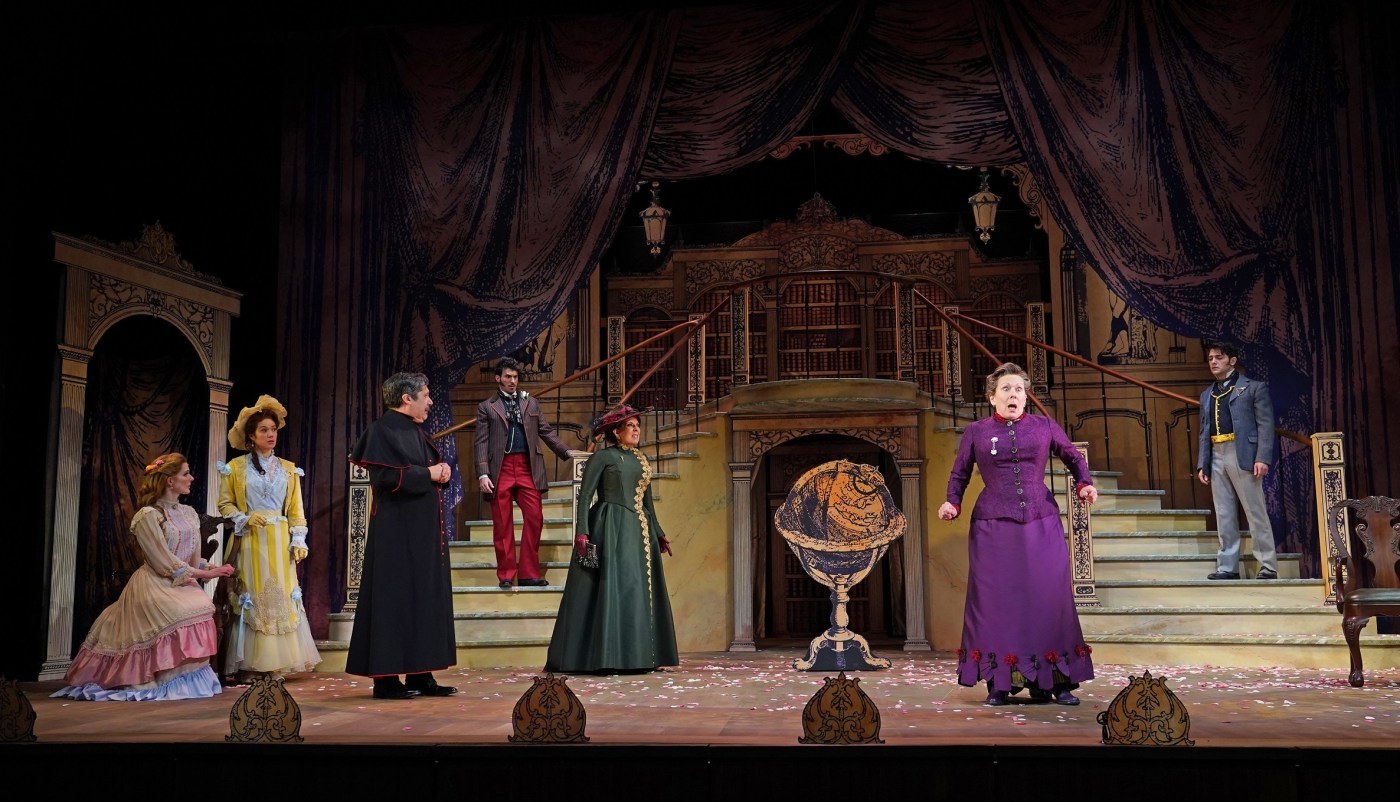
Both these characters assume the title role in “The Importance of Being Earnest”: Michael Raver as Jack Worthing (left) and Anthony Michael Martinez as Algernon Moncrieff. (Carol Rosegg)
Algernon’s flat in ‘The Importance of Being Earnest’ at Westport Country Playhouse
While the most you could say of Westport Playhouse’s “The Importance of Being Earnest” was that it was a very good, very traditional production of one of the most famous stage comedies of all time, the set design by James J. Fenton lifted the whole enterprise to a different level.
Taking cues from a popular toy from the time when Oscar Wilde’s comedy of status and deception takes place, England in the mid-1890s, Fenton created a life-size “paper theater” model to contain the action. It was breathtaking to look at and also suited the artifice that activates Wilde’s play.
The playhouse, soon to begin its third season under artistic director Mark Shanahan may be cautious in the plays it selects — a lot of crowd-pleasing comedies, at a theater founded on new works and later known for vivid new interpretations of classics — but it has not stinted on design. The Westport productions of “Native Gardens” and “Theatre People” were also dazzling to look at, but “Earnest” was magnificent.

Godfrey L. Simmons Jr. (left) as restaurant owner Memphis and Postell Pringle as Wolf in August Wilson’s “Two Trains Running” at Hartford Stage. (T Charles Erickson)
Wolf at the phone booth in ‘Two Trains Running’ at Hartford Stage
“Two Trains Running,” which had its world premiere at the Yale Repertory Theatre in 1990, sprawls more widely than some of the other plays in August Wilson’s unparalleled “Century Cycle” of plays about Black life in 20th century America. Most of Wilson’s plays form naturally around a core of related characters — a family, a band, co-workers. The group in this one are habitues of a neighborhood diner and it takes a while to see how they are emotionally connected.
The director of the Hartford Stage production of this underproduced Wilson work in January/February, Gilbert McCauley, found a smart way to convey how stand-offish and independent most of the characters in this ensemble drama can be by giving them their own clear territories in the spacious diner.
For Wolf, the neighborhood numbers-runner played by Postell Pringle in this production, the natural habitat was the phone booth at the side of the stage. Pringle had a great way of wearing flashy clothes in an unassuming natural manner, and he came in and out of that phone area as if he was a harried executive emerging from a board meeting instead of running an illegal lottery.
McCauley’s careful staging ultimately allowed all Wilson’s characters to get seen and heard vividly. Some of those chairs and tables might as well have been soapboxes for these street orators to speechify from. But Pringle’s Wolf also kept the background atmosphere lively and colorful.

The Goodspeed production of “A Chorus Line.” (Diane Sobolewski)
‘One’ in ‘A Chorus Line’ at Goodspeed Opera House
Director Rob Ruggiero and choreographer Parker Esse’s production of “A Chorus Line,” a musical that the Goodspeed Opera House has wanted to produce for many years, took a largely traditional approach, adhering to the show’s 1970s setting and maintaining the expected looks and attitudes of its main characters.
There are a lot of details about these people and their time period in the script, so it’s understandable. Where Ruggiero and Esse brought a truly refreshing new outlook was in the final dance number, the one where we see what these harried dancers had worked so hard toward, the splashy number that they were learning during the audition process that “A Chorus Line” is all about.
The “One” number is often presented as an old-school kickline routine with sequined top hats and tight dance outfits. At the Goodspeed, it was re-envisioned so it really seemed exciting. Adding to the exhilaration were flowing loose shiny costumes designed by Joseph Shrope that brought a fashionable new look to the chorus line. The dance was a marvel, and it made the end of the show look like these dancer characters had really accomplished something besides landing a job.

Sara Koviak as a robotic caregiver in “Your Name Means Dream” at TheaterWorks Hartford in July. (Mike Marques)
The robot glitch in ‘Your Name Means Dream’ at TheaterWorks Hartford
A humanoid robot breaks down in José Rivera’s “Your Name Means Dream” and erupts in spasms of rapid verbiage that contain poetry, technical phrases, emotional rants and more, in multiple languages and tones and tempos. The production of “Your Name Means Dream” at TheaterWorks Hartford in July, directed by Rivera himself and incorporating fresh rewrites for this still-developing piece, was a tour-de-force for actor Sara Koviak, who was pretty convincing as an animatronic device. It was also just an intoxicating piece of write to hear spewed aloud like that.
You can imagine some writers conveying a broken machine through silence or weird noises. Rivera did it through words, lots and lots of them. I felt like I was witnessing what the European Dadaist or Futurist performance artists of the 1920s and ‘30s must have been like: unhinged on the surface perhaps but with complexity and expression and voice.
It should be said that Koviak’s robot role was deftly matched by Anne O’Sullivan’s ultra-human and highly vulnerable performance in the play’s other role, as the beneficiary of the robot’s caregiving ability. A dynamic, neatly balanced two-hander with that fabulously frantic breakdown in the middle.