
By DARLENE SUPERVILLE
WASHINGTON (AP) — The president of the National Trust for Historic Preservation said Friday she trusts the Trump-appointed chairman of a federal planning commission to do his job and give serious review to President Donald Trump’s proposal to add a ballroom to the White House.
Carol Quillen said in an interview that she takes Will Scharf, chairman of the National Capital Planning Commission, “at his word” after he said at the panel’s December meeting that the review process would be treated seriously once the White House submits the plans.
Scharf said at that meeting that he expected to receive the plans sometime this month, and the panel’s review process would happen at a “normal and deliberative pace.”
Quillen said she trusted that would be the case.
“I take him at his word that the process will be conducted as it always is, deliberately and seriously, and that the commission will do its job,” she said.
The White House has not responded to multiple queries about when the ballroom plans will be shared with Scharf’s panel as well as the Commission of Fine Arts. The planning commission on Friday released the agenda for its January meeting and the “East Wing Modernization Project” is listed for an “information presentation,” often the first step in its review of a project.
The National Trust last week asked a federal court to halt the ballroom construction until it is subjected to multiple independent reviews, public comment and wins approval from Congress. The government argued in court that the lawsuit was premature.
A federal judge this week denied the National Trust’s request for a temporary restraining order but scheduled a January hearing on its motion for a preliminary injunction. Such a step would halt all construction until the reviews, which could take months, are completed.
Quillen said her private nonprofit organization was not asking for the Republican president’s proposal to go through reviews just for the sake of doing so. She said the process inevitably leads to a better project because multiple independent parties get to comment on it.
The National Trust was chartered in part to ensure the public participates in decisions that affect the country’s historic resources, she said, “and the White House is arguably the nation’s most iconic building.”
She said the organization did not sue earlier because legal action is “our last resort” and because of its history of working with administrations.
In Trump’s first term, the administration submitted plans to the National Capital Planning Commission for new fencing for the White House perimeter and a tennis pavilion on the south grounds.
Quillen declined to speculate about why Trump had not already done so for a White House ballroom he has long desired and has moved quickly to build since he returned to office. He complains regularly that the East Room and State Dining Room — two of the largest public spaces in the White House — are too small and has criticized the practice of hosting foreign leaders at state dinners in tents on the south grounds.
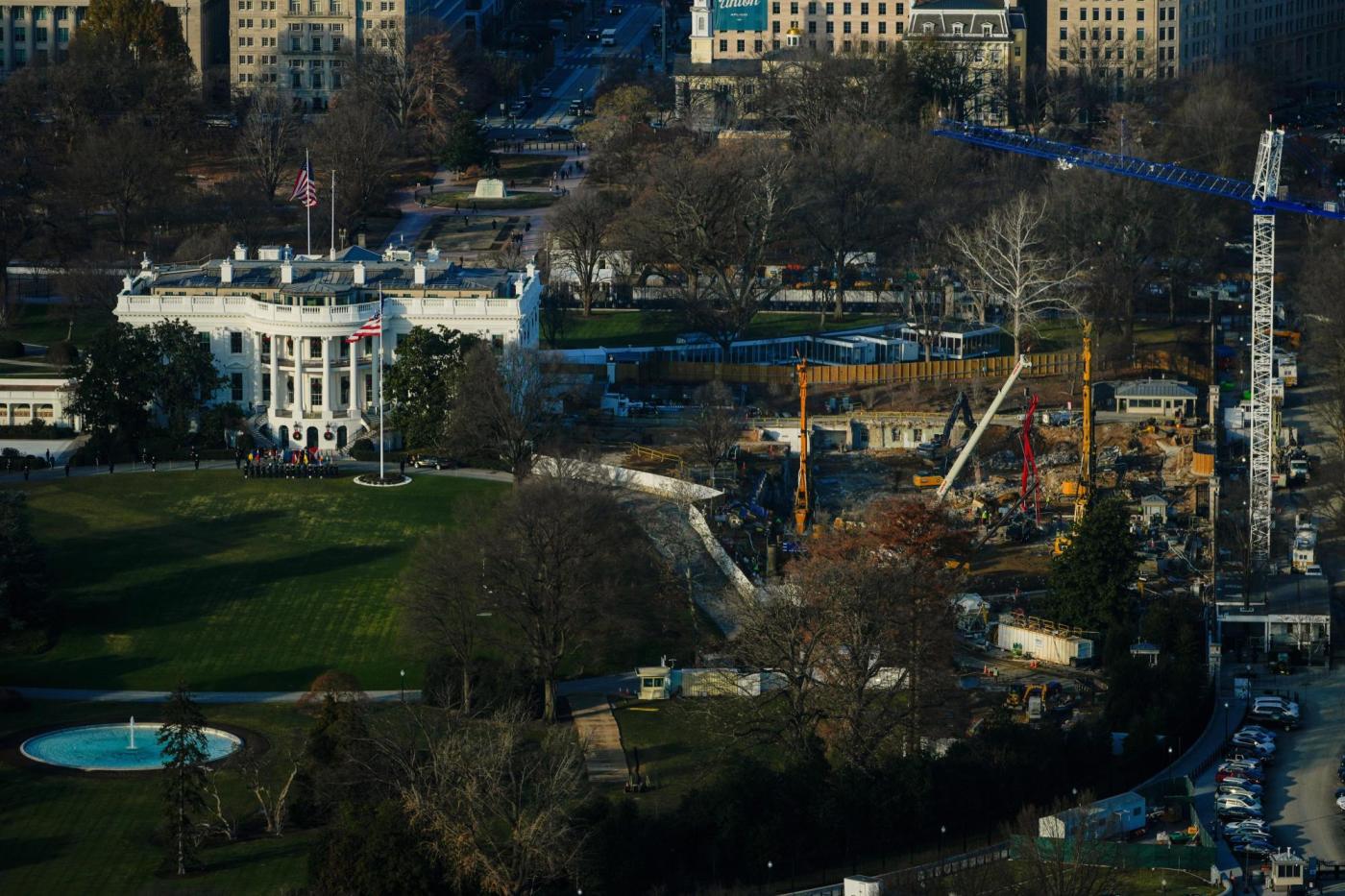
Trump has proposed building a 90,000-square-foot ballroom, big enough to accommodate 999 people, where the East Wing of the White House stood for decades until he had it torn down in October in a move that “caught us by surprise,” Quillen said.
He recently upped the construction cost estimate to $400 million, double the original $200 million price, and has said no public money will pay for it. The White House has said the ballroom will be ready before Trump’s term ends in January 2029.
The National Trust asserted in its lawsuit that the ballroom plans should have been submitted to the National Capital Planning Commission, the Commission of Fine Arts and Congress before any action.
The lawsuit notes that the organization wrote to those entities and the National Park Service, which oversees the White House grounds, on Oct. 21, after the East Wing demolition began, asking for the projects to be paused and for the administration to comply with federal law. It received no response, the lawsuit said.
The government said in its written response that the ballroom plans have not been finalized despite continuing demolition and other work to prepare the site for eventual construction, which is not expected to begin until April 2026, at the earliest.
The administration also argued that Trump has authority to modify the White House and included the extensive history of changes and additions to the Executive Mansion since it was built more than 200 years ago. It also asserted that the president is not subject to statutes cited by the National Trust.