
Gov. Ned Lamont announced more than $41 million to aid residents losing nutrition assistance and offset vanishing federal funding for reproductive health services.
The governor also expanded his own recent commitments to fight homelessness and provide relief for thousands losing federal assistance for health insurance.
“It is a shame that the federal government is cutting back on these services that provide a safety net for those who are most in need and which ultimately support the health and safety of our entire country,” Lamont said. “These are services that must continue to be supported, and here in Connecticut we will stand behind them.”
The Democratic governor now has committed nearly $168 million from a special $500 million reserve the General Assembly established last month to blunt the worst of federal human service cutbacks ordered in July by President Trump and Congress.
Lamont notified the legislature’s six highest-ranking leaders of his proposals by letter early Thursday. The Democratic-controlled panel, which has authority to block the initiatives but cannot modify them, is expected to endorse the full plan.
A big investment in Connecticut’s food banks and pantries
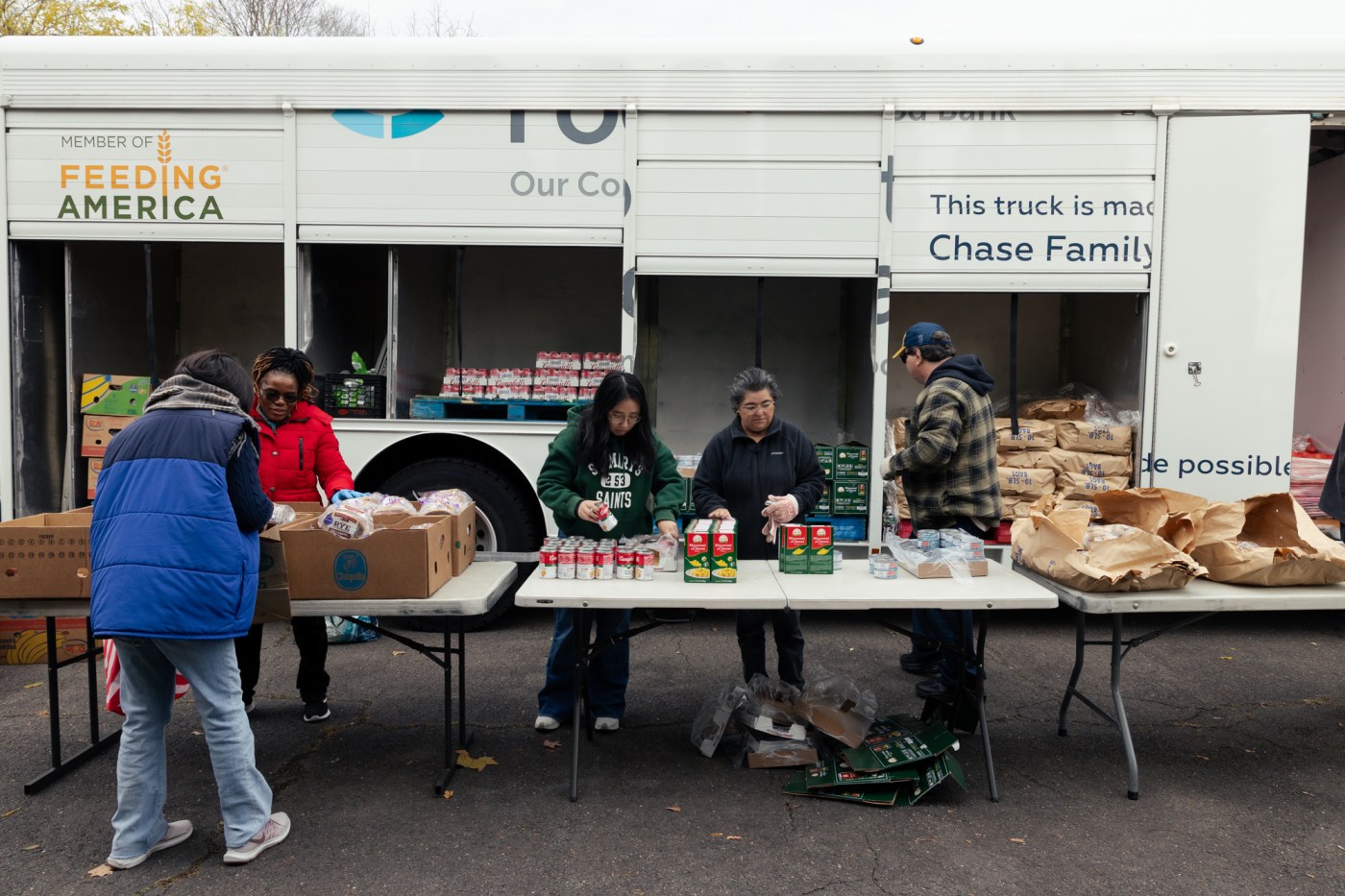
One of Lamont’s largest proposals would allocate $24.6 million over the next 18 months for food pantries — which provide free and discounted groceries to low-income households, and the food bank services that help stock these facilities.
Legislators, advocates for nutrition assistance and others have pressed the governor particularly to aid about 36,000 immigrants, young adults, veterans and people experiencing homelessness at risk of losing Supplemental Nutrition Assistance Program (SNAP) benefits between Dec. 1 and March 31 because of new work requirements and other changes Congress ordered in July.
Jason Jakubowski, president and CEO of Foodshare, said his organization will use the funds to help more people access food, but pantries won’t be able to offset all lost SNAP benefits.
“Additional appropriations are always appreciated,” he said. “That amount, over 18 months, will help. It’s definitely not going to solve the problem created by the One Big Beautiful Bill Act.
“SNAP is the first line of defense against hunger in this country, period. We’re intended to be a supplement,” he added. “There is not enough food at our food bank, or every food bank in the country put together, to make up for the number of meals that SNAP provides.”
With as many as 36,000 residents having lost or at risk of losing SNAP benefits in the coming months, “It doesn’t take a rocket scientist to figure out that lines at our mobile trucks and our local pantries are going to increase,” Jakubowski added. “By how much? I don’t know, but they’re definitely going to increase.”
To further help households in need find local nutrition assistance, Lamont also committed $4.7 million from the reserve to the state’s 2-1-1 information line service and to the network of regional, nonprofit community action agencies, which steer hundreds of thousands in need toward a wide array of social services.
“This is a really positive start on how to better support those families,” said Lisa Tepper Bates, president and CEO of the United Way in Connecticut, which runs the 2-1-1 service and is affiliated with a major food bank serving pantries in southeastern Connecticut.
The 2-1-1 service, which hasn’t received a funding increase for its main referral program in 15 years, has seen inquiries surge dramatically since the federal government shutdown in October and early November stalled federal funding for SNAP and other programs.
Though the state shares a portion of SNAP’s administrative costs, benefits are funded entirely by the federal government.
But the United Way, New Haven Legal Assistance and 15 other nonprofits, labor and business organizations and policy groups recently urged state officials to create a state-funded nutrition assistance benefit for those displaced by last summer’s congressional changes.
“What we really need is to give people a choice in what they’re eating and what they’re going to be spending money on so they can feed their families in the way they need to,” said Sara Parker McKernan, policy advocate for New Haven Legal Assistance.
“Having your own ability to pay for food, which you get when you have food stamps — that autonomy is key for people. We need to have a state-funded food assistance program so people can make those choices for themselves.”
The governor’s plan also includes $1.5 million for the state Department of Social Services to help residents comply with work requirements and other new eligibility rules and thereby preserve their SNAP benefits.
More funding to fight homelessness, blunt premium hikes
Lamont also stepped up his own recent proposals to assist households facing steep hikes in health insurance costs and individuals and families facing homelessness.
The governor last week proposed $70 million to assist tens of thousands of households that are losing the enhanced federal tax credits and subsidies that help them purchase health insurance on the state’s exchange.
Lamont now wants to invest almost $120 million through June 2027.
That includes $50.8 million to replace lost subsidies and another $64.1 million to temper expiring tax credits and to reimburse some carriers facing increased claims for healthcare services.
The governor also would channel $5 million to Connecticut’s federally qualified health centers to reflect increased demand for services there, particularly from patients with incomes less than 100% of the Federal Poverty Level. For a family of four, the current FPL is less than $32,150 annually.
Lamont also wants to upgrade a plan he announced just three days ago to commit $5.2 million to counter shrinking federal support for programs to combat homelessness.
But the plan the governor sent Thursday to legislative leaders would instead dedicate $6.9 million for grants to organizations fighting homelessness and to maintain previously federally funded vouchers for supportive housing.
Aid for Planned Parenthood could spark partisan debate
A final element of the governor’s proposal likely will spark objections from some Republicans in the Democratic-controlled General Assembly.
The governor would send $10.4 million to Planned Parenthood of Southern New England to offset shrinking federal reimbursements and family grants frozen by the Trump administration.
These and other proposals in the $168 million in funding commitments Lamont recommended would be drawn from $500 million — one-fifth of last fiscal year’s $2.5 billion surplus — that state legislators set aside during last month’s special session.
Most of that surplus is being used to shrink Connecticut’s hefty pension debt and to build reserves, two efforts that generally enjoy bipartisan support.
But when the $500 million reserve was established, many minority Republicans argued Connecticut shouldn’t spend local dollars to temper or reverse ongoing federal cutbacks.
Many Republicans here also have objected over the years to sending state dollars to Planned Parenthood, arguing Connecticut shouldn’t invest public dollars in an organization that provides abortion services.
Jenna Carlesso is a reporter for the Connecticut Mirror. Copyright 2025 @ CT Mirror (ctmirror.org).