
Researchers at the University of Connecticut are hoping that new grant money will help coastal communities across the Northeast become more resilient to rising sea levels and intense storms.
Flooding is a major issue for communities along Connecticut’s coastline and across the Northeast. Researchers say that more frequent intense storms and rising sea levels brought on by climate change are having a costly impact. The projected cost of flood-related damage in the U.S. is around $32.1 billion a year. By 2050, the cost is expected to rise to $40.6 billion, according to the UConn-based Connecticut Institute for Resilience and Climate Adaptation.
In addition, flood costs for homeowners are soaring, with a recent study by the National Resources Defense Council finding that Connecticut homeowners are paying the most for flood repair costs compared to other states. The report shows Connecticut homeowners can often expect to pay an average of more than $283,000 in repairs over the course of a 30-year mortgage on homes with prior flood damage.
Now researchers with the Connecticut Institute for Resilience and Climate Adaptation have been awarded a two-year grant from the National Science Foundation for $500,000. The project — Identifying Community Need-Based Adaptation and Resilience Priorities in the U.S. Northeast — aims to ensemble a network of academics, researchers, policy experts, engineers, scientists and municipal leaders to identify challenges and accelerate climate resiliency in coastal communities from New Jersey to Maine, according to the project proposal.

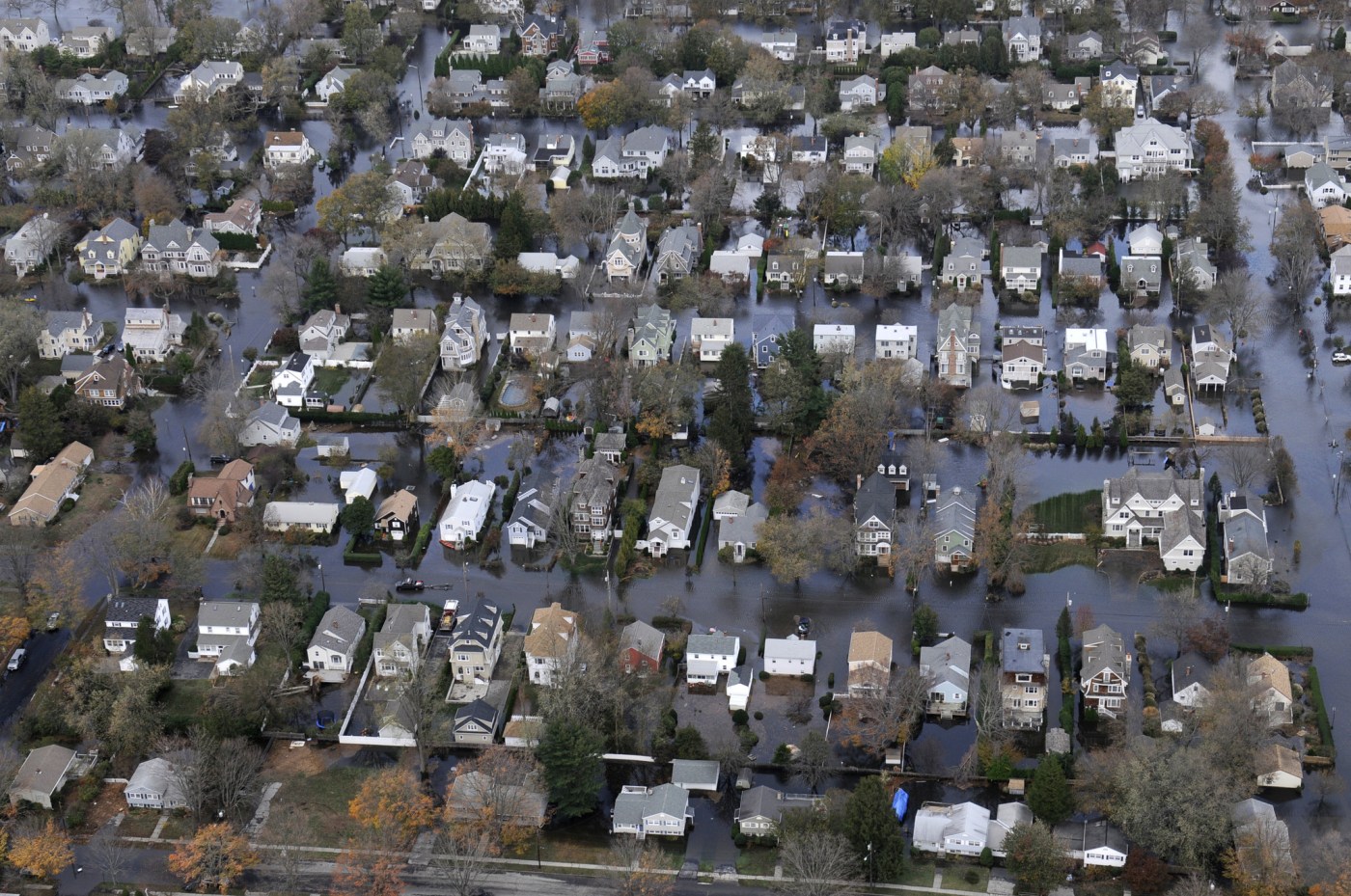
Superstorm Sandy slammed into Connecticut in October 2012, hitting the shoreline with a tremendous storm surge that flooded many low-lying roads., including in Milford. (Courant file photo)
“We could be dealing with up to a 20-inch rise in sea level by 2050, now that’s the upper band of what’s likely, but it most likely won’t be less than 20 inches by the year 2100,” said CIRCA executive director James O’Donnell. “So things we build now should anticipate the worst case scenario by 2050. Between now and then, we will have some time to assess whether the projections I made are still on track, or if we need to revise them a bit. In Connecticut, we need to update that projection every 10 years.”
Based on O’Donnell assessment, Connecticut has adopted a requirement that coastal municipalities include an increase in mean sea level of up to 20 inches by 2050 into their plans. O’Donnell said that coastal communities in other states like New Jersey and Maine should be implementing long-term planning with this assessment in mind.
“There’s been a lot of attention to the catastrophic storm events like Superstorm Sandy and the Hurricane of 1938,” O’Donnell said. “But a more important thing to recognize is that smaller events are occurring more frequently, causing damage and economic dislocation as well. They don’t receive the press or attention, but smaller events occurring with greater frequency can add up to be very substantial. In Mystic alone, there have been four days of flooding events in just two years. Those flooding occurrences add up to big costs for towns and homeowners.”
Other partners that are part of this project include the University of Maine, Stevens Institute of Technology and Brooklyn College, according to the proposal.
O’Donnell said that often times academia and research can live in a bubble without directly impacting municipalities and local leaders. But he said that this project aims to directly foster collaboration between earth and climate science and local planning and decision-making. The goal is to provide communities with data, improved models and technical standards to develop and implement climate-resilient policy and strategies.
Challenges like rising sea levels, coastal erosion and regulatory barriers will be addressed at meetings and working groups with municipal leaders, engineers, scientists and UConn researchers. CIRCA was created in 2014 to foster collaboration between researchers, scientists and policy makers.
O’Donnell said the $500,000 grant will only be applied to Phase I of the project. The first phase will create the framework for a separately funded Phase II proposal focused on implementation. Sixteen groups across the country will compete for the Phase II projects which will have a duration of up to five years and budgets of approximately $10 million, according to the National Science Foundation.
“Phase I is a two-year initiative to foster collaboration and really develop a product for a second proposal,” O’Donnell said. “The Phase II award is a $10 million grant to implement our ideas over five years. Our interest right now is in creating a team that is competitive to win the $10 million award to do something much more substantial for communities from New Jersey to Maine. This is about helping towns become more resilient to the impacts of severe weather and climate change.”
Stephen Underwood can be reached at [email protected].