
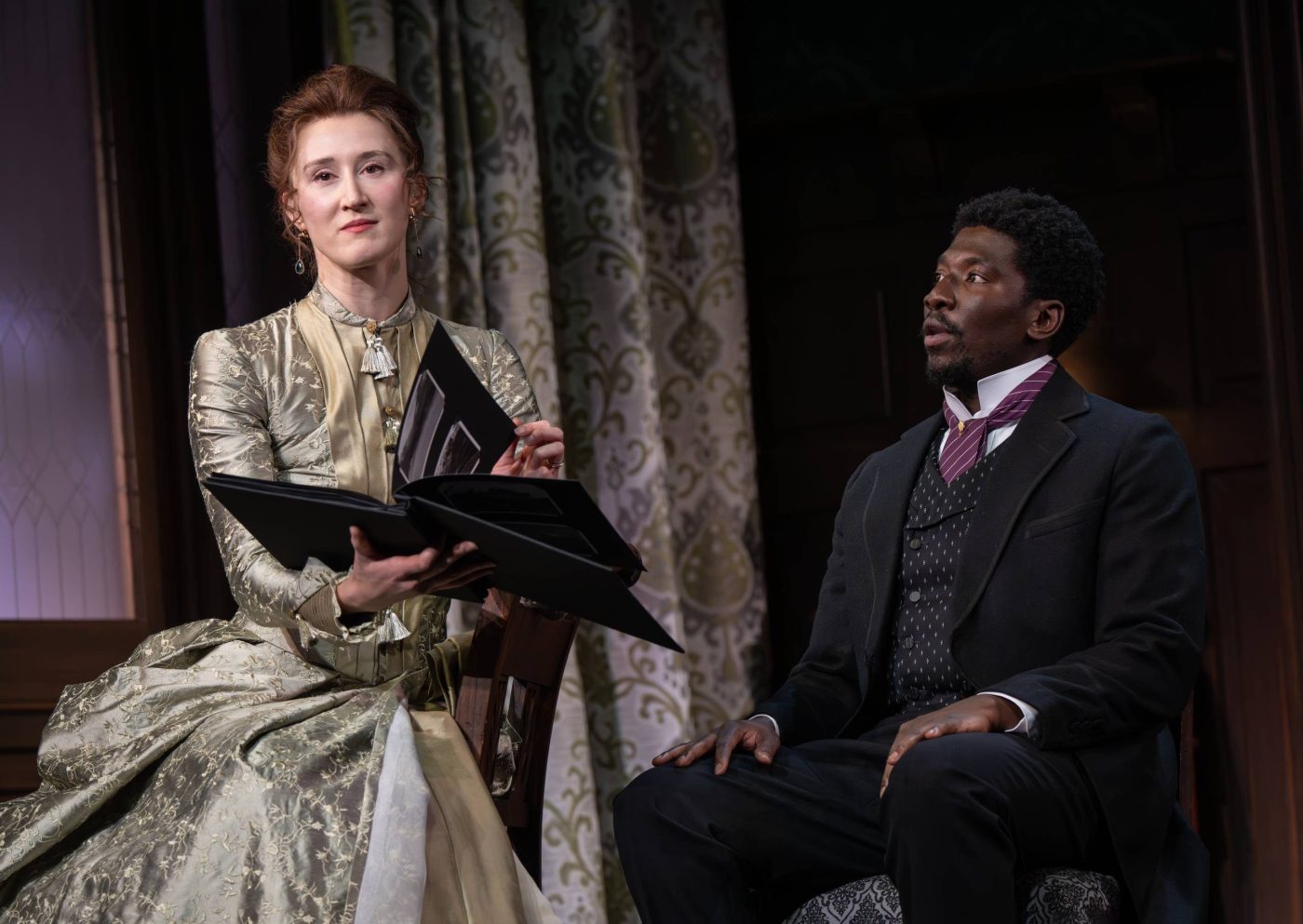
Amid all the Scrooges and Santas and Nutcrackers this month, a somber, stark, depressing and though-provoking production of Henrik Ibsen’s “Hedda Gabler” feels like a breath of fresh air.
This lavish, confident and elegant production, at the Yale Repertory Theatre through Dec. 20, happens to be the last show directed by James Bundy before he steps down from his simultaneous jobs as artistic director of Yale Rep and dean of the David Geffen School of Drama at Yale this coming spring.
This is the classic drama of a modern woman maneuvering a repressive, regressive, sexist society while dealing with a stodgy spouse and the unexpected return of an old lover. It’s also an ideal play for December viewing, since it evokes the sort of celebrating and socializing that can turn sour. “Hedda Gabler” is the kind of play that makes you want to rewrite your New Year’s resolutions so they’re more spiritually aware.
Heightening the formality of Norwegian social circles in the 1890s, Bundy and the actors and designers unite to create a production that sets up a controlled environment and makes you care deeply about the individual characters: The headstrong newlywed Hedda hoping to assert her will in her new home, her acquiescent yet cautious husband, her vibrant old flame who has returned to the city with revolutionary zeal and a bunch of busybodies who, as in most Ibsen plays, cause calamity with their gossip and their rushes to judgement. It all ends badly, whether you’re talking about Hedda’s personal struggle for happiness or you’re more concerned with the greater message of one person fighting about social strictures.
In “Hedda Gabler,” the plot is fueled by two things: the mannered decorum of a small community and the wildness that seems to strike those who are stifled by such social customs. The newly married Hedda Tesman (nee Gabler) seems to straddle that line. She is keen to upset social norms but abhors scandal. She is already regretting her marriage to the dull, bookish Jorgen Tesman, and is further disappointed when Jorgen’s likely promotion at work hits a snag.
Hedda is not the only person struggling to establish themselves on their own terms in the stuffy, repressive and wary old-world social scene of Christiana (now Oslo), Norway 135 years ago. There’s also Eilert Lovborg, an exceptionally gifted scholar/philosopher who has returned to the area having just published an acclaimed new book, with even greater fame prophesied for its follow-up. Lovborg totes around his newest book in manuscript form, a dramatic reminder how fragile and vulnerable such documents can be. Just as tenuous is his mental state, as Eilert reevaluates a number of relationships, from his past fling with Hedda to his current connection with his assistant Thea to his place in academia.

Austin Durant (left) and Max Gordon Moore, two Broadway actors whose careers began at the Yale School of Drama, return to play Judge Brack and Jorgen Tesman respectively in “Hedda Gabler” through Dec. 20. (Joan Marcus)
Bundy is a skilled director — it’s what he studied at the drama school himself in the mid-1990s — but perhaps his greater talent is in casting and packaging. It was Bundy who cast and directed Dianne Wiest (who once played “Hedda Gabler” at Yale Rep in 1981) in Samel Beckett’s “Happy Days,” Paul Giamatti in “Hamlet” and Charles S. Dutton in “Death of a Salesman,” all at the Yale Rep in the past two decades. He’s worked with big stars as well as reliable regional theater talents and throngs of up-and-coming Yale student actors. He is very good at making sure everyone in his casts are seen and appreciated.
There are countless examples of Bundy productions where a small gesture by a supporting character could crystallize a whole production. In “Hedda Gabler” he has chosen a play where such nuance is everything. It’s a plot where the characters’ actions are very clear but their motivations can be debated endlessly. Bundy understands this implicitly and builds a theatrical laboratory for actors who know how to express an extraordinary range of emotions.
For his swan song, Bundy has assembled a sterling cast mostly made up of Yale drama school graduates he knew as students. Max Gordon Moore, whose ability to imbue mundane or dull-seeming characters with vital sparks of humanity was exemplified by his performance as the scientist Valentine Coverly in Bundy’s 2014 production of Tom Stoppard’s “Arcadia,” is ideal as Hedda’s alternately doting and clueless husband Jorgen. Austin Durant, who has previously distinguished himself in Bundy productions at the Yale Rep in roles large and small, displays a quiet intensity as the self-satisfied Judge Brack, confidante to both Hedda and Jorgen.
James Udom, previously at the Yale Rep in Liz Diamond’s production of Suzan-Lori Parks’ odyssey “Father Comes Home from the Wars, Parts 1, 2 & 3” and who has done a lot of Shakespeare since graduating from the drama school, makes Eilert Lovborg smolderingly attractive without overlooking his intelligence. Stephanie Machado (who brought a very different emotional skill set to the frantic comedy “Laughs in Spanish” this year at Hartford Stage) brings realistic fear and anxiety to the often unsung role of Thea Elvstead, Eilert’s smitten assistant.
There are no small roles in Bundy productions, so Felicity Jones Latta (not a Yale grad but a veteran of three previous Bundy-directed shows at Yale Rep) gets shown to good advantage as Jorgen’s socially conscious aunt Juliane Tesman. Even the veteran character actor Mary Lou Rosato has a couple of big moments in an otherwise tiny role.
The title role of Hedda is played by Marianna Gailus, who doesn’t have a drama school connection but was an undergraduate history major at Yale College. She comes to Yale Rep fresh from being Andrew Scott’s standby for Simon Stephens “Vanya,” a one-person adaptation of Chekhov’s “Uncle Vanya” done off-Broadway earlier this year. Gailus has a striking presence, both willowy and wiry, both limber and taut. Her physicality is arresting, but it’s her thoughtful, often understated interpretations of key lines and scenes in the play that make this performance so illuminating.
This is a leisurely production that allows plenty of room for pauses, long steady reactions and pacing back and forth. The stage is both wide and deep, and actors cross the full length or width of it regularly. The scenic design by Jessie Baldinger also allows the performers to make big entrances and exits, a good thing because Ibsen is a genius at building up a major character through the gossipy dialogue of the supporting cast before the subject of their conversation ever sets foot onstage.
James Bundy directs ‘Hedda Gabler’ as his final show before leaving leadership roles at Yale
Another of Ibsen’s talents is foreshadowing all the key themes and twists of the plot as it is still unfurling.
This year brought a new film version of “Hedda Gabler,” Nia DaCosta’s “Hedda,” which takes liberties with Ibsen’s script, the time period of the play and some key characters. DaCosta’s changes can be bracing, adding modern energy and added social relevance to the piece. Other than some racial diversity in the casting, Bundy doesn’t choose to modernize “Hedda Gabler” at all, which is its own wise choice. Using Paul Walsh’s fluid, naturally conversational translation from the original Norwegian, this production beautifully demonstrates the play’s timelessness, solid structure and suspenseful pacing. This is an act of careful interpretation rather than updating or reimagining.
Again, this is the kind of thing Bundy has been especially good at in his more than two decades at Yale Rep. His “Hedda Gabler” lines up neatly with his productions of Oscar Wilde’s “A Woman of No Importance” in 2008, Beckett’s “Happy Days” in 2017 and two Edward Albee plays, “A Delicate Balance” in 2011 and “Who’s Afraid of Virginia Woolf” in 2022.
“Hedda Gabler” has a famously distressing ending, both for the audience and for the characters onstage. How this final moment is staged can sometimes undermine much of what has come before. Bundy and his designers certainly do not underplay the ending, but it is nowhere near as graphic or sensationalized as some other productions of the play seen in Connecticut, particularly the Doug Hughes production starring Martha Plimpton at the Long Wharf Theatre 25 years ago. What this rendition has going for it s a sublime steadiness, a slow build to a tragic ending. The revelation is how easily, through self-interest, obliviousness and neglect people can push each other over the edge. It’s a great lesson to impart at this time of year and at this time in history and a fine way for Bundy to end a sterling career as an administrator, educator and theater artist at Yale.
“Hedda Gabler” runs through Dec. 20 at the Yale Repertory Theatre, 1120 Chapel St., New Haven. Remaining performances are Tuesday through Friday at 8 p.m. and Saturday at 2 and 8 p.m. $15-$65. yalerep.org.