
Playhouse on Park has taken another shot at a heartwarming if disarming Christmas-themed musical war drama.
The theater first presented “All is Calm: The Christmas Truce of 1914” in 2020 as a streaming production filmed outdoors during the COVID pandemic. The actors rehearsed via Zoom and the singers rehearsed spaced far apart from each other in a church. The resulting video was presented in a formal, ceremonial fashion. This was powerful in its own way, befitting a piece that behaves more like a choral song cycle than a conventional musical theater piece.
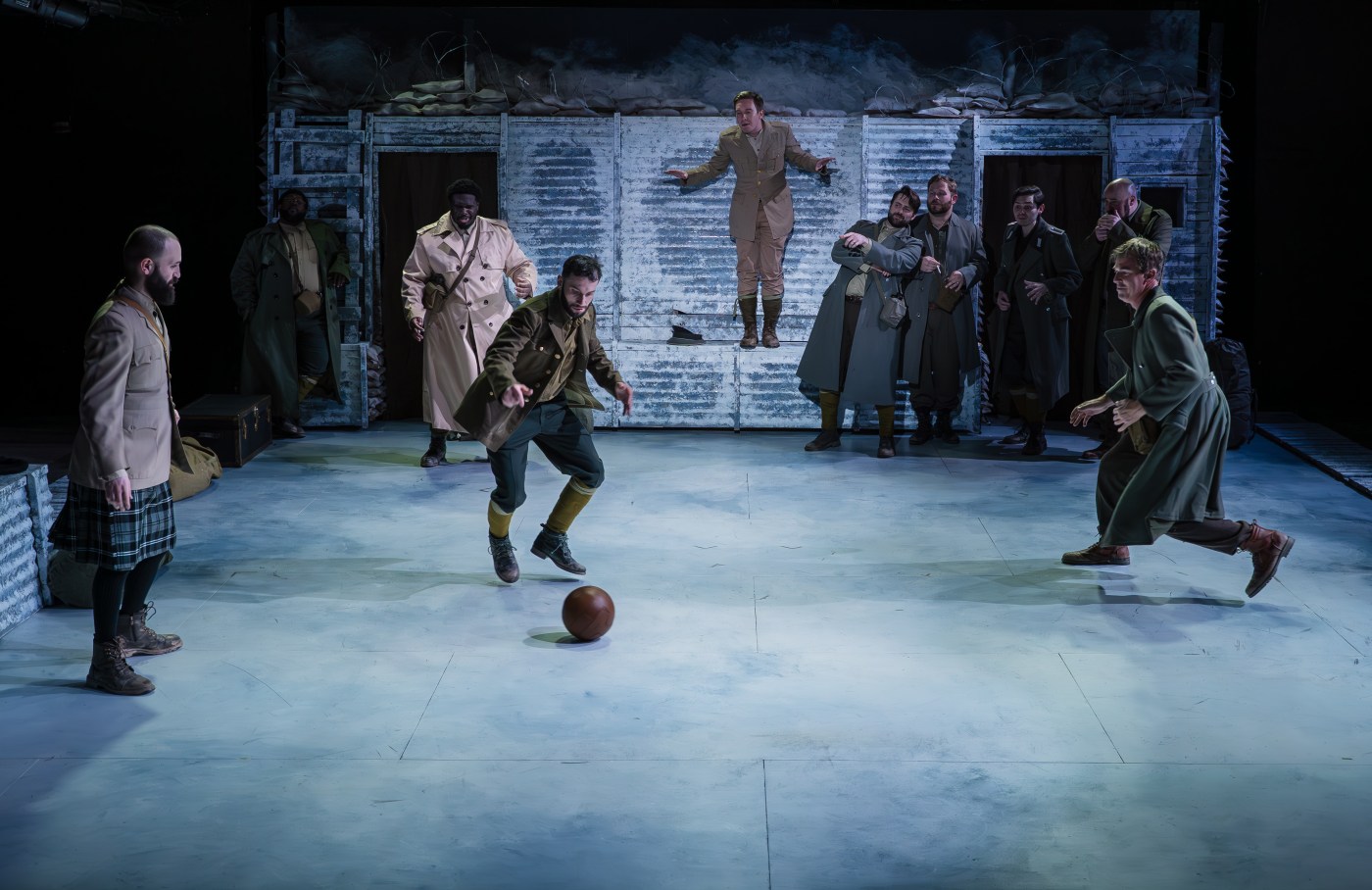
This time, the show is being staged live on the playhouse’s floor-level performance area, designed by scenic/lighting designer Johann Fitzpatrick to resemble an army outpost in a desolate No Man’s Land battlefield on the Western Front during World War I. The dozen-man cast feels right on top of each other on the small stage. The camaraderie of the soldiers is palpable and visceral.
A community feel and ethereal harmonies are essential for this show, which brings to life an extraordinary, if short-lived, Christmas miracle. On Christmas Eve in 1914, six months after the start of World War I, opposing British and German forces laid down their guns and greeted their foes with fellowship rather than ferocity. Stories were told, songs sung, gifts exchanged and soccer balls kicked around. The truce was brief, disapproved of by commanding officers, and was not repeated. “All is Calm” admirably tells the whole story of the truce, even when some the cold realities diminish the warmhearted tale of hope and peace the it most wants to be.
The show’s director, Sasha Brätt, and music director, Benjamin Rauch, both worked on both Playhouse productions (streaming and now live) of this difficult, emotional piece, which was scripted by Peter Rothstein with vocal arrangements by Erick Lichte and Timothy C. Takach. “All is Calm” was around for a few years before Playhouse on Park latched onto it, premiering at Minnesota’s Theater Latté Da (where it became an annual event) in 2007, and having its New York debut in 2018. There was a filmed PBS version that aired in 2020.
“All is Calm: The Christmas Truce of 1914” is performed by nine singers plus three performers who are primarily actors, though everyone both sings and acts. Neither the words nor music are completely theatrical. The text is shaped like an oral history, complete with the actors announcing the names and ranks responsible for the words they’ve just recited. The memories they’re sharing are verbatim quotes from those who took part in the truce, mainly from the British side, drawn from memoirs, correspondence and history books.

The cast of “All is Calm: The Christmas Truce of 1914” at Playhouse on Park, exhibiting the camaraderie that elevates this heartwarming Christmas tale. (Meredith Longo)
The text can have a formality to it. The songs are familiar folk songs (“Will Ye Go to Flanders?”), war songs (“It’s a Long Way to Tipperary”), Christmas carols (“Good King Wenceslas”), “Auld Lang Syne” sung with the demoralized lyrics “We’re here because we’re here because we’re here …” and an Army enlistment song sung to the tune of “Alexander’s Ragtime Band.” Even the plot is familiar, since there’s an inevitability to it that the show’s creators freely acknowledge. There’s fighting, there’s a truce (as foretold in the show’s title), and since we know it’s 1914, there’s three more years of fighting expected.
With tunes and sentiments and story all so well known or easily understood, much of the drama and artistry of “All is Calm: The Christmas Truce of 1914” comes from Brätt’s staging, Rauch’s work with the vocalists and some specific uplifting performances. The actors who provide the narration and bring dozens of people briefly to life in short bursts of prose are neatly cast with the lively Niko Touros (star of the playhouse’s 2018 production of “In the Heights”), Ryan Phelps (who’s good at old white man voices from captains and generals right up to Winston Churchill) and Kenneth Galm (who brings an element of chipper, cheery youthfulness). They elevate what could be mere between-song patter into a full theatrical experience.
Four performers — actor Touros and singers Jermaine Woodard Jr. and Alex Hunt (both baritones) and tenor Spencer Hamlin — were all part of Playhouse on Park’s previous streaming version of “All is Calm.” The other vocalists for this new version are Bruce Barger, NicDaniel Charles, Charles Eaton, Jeremy Luis Lopez, Omar Sandakly and Luke Scott. Most of the singers come from the worlds of opera and church choirs. Even when the songs are simple and folky, the vocals are transcendent.
“All is Calm: The Christmas Truce of 1914” is an elegantly paced, trimly designed and exquisitely sung evening that plays like a Christmas service of Lessons and Carols but where the lessons are drawn from real life rather than the Bible and where marching songs and drinking songs take on the somberness of hymns. It gets a lot done in just 70 minutes. The stage version has the distanced effect of a choral concert but also the energy and directness of a small theater piece and even retains some of the filmic qualities of its earlier streaming versions.
There’s a bleakness to the design (set and lighting by Johann Fitzpatrick, costumes by Micah Ohno, props by Pam Lang) that fits the sparse dark nature of No Man’s Land. The voices carry as crisply and clearly as if they were outdoors on a chilly evening (which, in the streaming version, they were).
This is a show full of gentle humor, grace, humanity and heart, a true alternative Christmas show for those who might need something less fantastical than “A Christmas Carol” or “The Nutcracker” and less goofy than “Christmas on the Rocks.” It’s a meditation on widespread violence and suffering that values tranquility and beauty.
“All is Calm: The Christmas Truce of 1914” runs through Dec. 21 at Playhouse on Park, 244 Park Road, West Hartford. Performances are Wednesdays and Thursdays at 7:30 p.m., Fridays and Saturdays at 8 p.m. and Sundays at 2 p.m. $36-$44, $34-$42 seniors/students. playhouseonpark.org.