
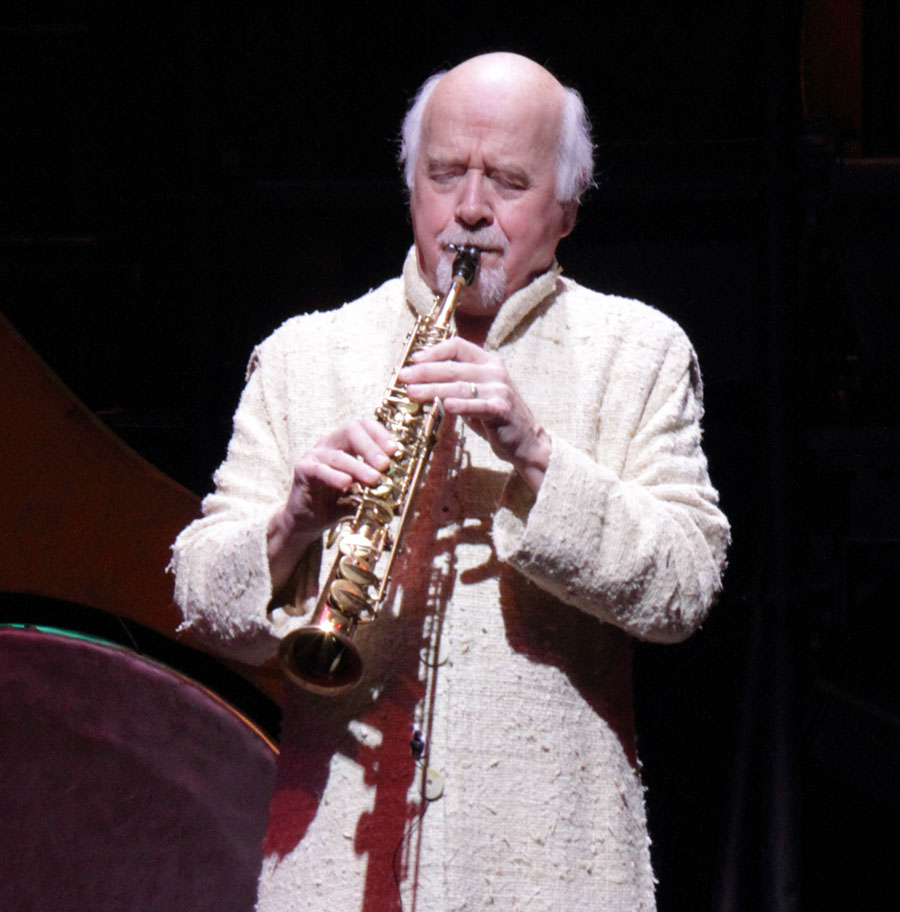
Paul Winter is acclaimed as a pioneer of new age music, World music and crossovers between jazz, classical and other sounds. The ensemble he founded nearly 60 years ago, Paul Winter Consort, is attuned to the sounds of nature and promotes environmental and ecological concerns.
The ensemble is famous for its annual winter solstice concerts and is holding one on Dec. 19 at 7 p.m. at Yale University’s Woolsey Hall in New Haven.
The New Haven show is part of a seven-city New England tour the consort is doing this month. Other stops include the Tarrytown Music Hall and Troy Savings Bank Music Hall in New York, the Cathedral of St Paul in Burlington, Vermont, the Cathedral of St Luke’s in Portland, Maine, and three venues in Massachusetts: St James Place in Great Barrington, Bombyx Center for Arts & Equity in Florence and The Great Hall in Needham.
Winter has been active as a musician and a recording artist since the early 1950s. Of his more than 60 albums, many are related to the consort’s famous solstice concerts. He sees the winter solstice — marking the shortest day and longest night of the year — as a time for spiritual renewal, healing, hopefulness, celebration, community and unity. For centuries the winter solstice, which takes place on Dec. 21, has been seen symbolically as a time of rebirth when darkness yields to the returning light.
The most recent Paul Winter Consort album, “Horn of Plenty,” was released a month ago on the Living Music label. Titles of the dozen tracks on the new release evoke frequent themes of Winter’s work: “Dolphin Morning,” “Grand Canyon Surprise,” “Blues Cathedral,” “Wolf Eyes,” “Harvest Faire” and “Primavera (Spring).”
Winter has called Connecticut home since the mid-1960s, first in Weston and then in Redding, where he has lived since 1967. He says he was drawn to the state when he visited another jazz icon, pianist Dave Brubeck, in Wilton. Winter asked Brubeck what it was like to live in Connecticut as a professional musician. Brubeck responded that he played about 100 concerts a year and he could drive to most of them. Winter made immediate plans to leave New York City and find a cottage in the woods of Connecticut.

Saxophonist Paul Winter and the Paul Winter Consort present their annual winter solstice concert on Dec. 19 at Yale’s Woolsey Hall as part of a New England tour. (Courtesy of Paul Winter Consort)
Another propitious discovery about Connecticut that influenced Winter’s art was learning, one day after he moved to Redding, that the famed composer Charles Ives had lived “just down the road. I used to jog past his mailbox.”
When the centennial of Ives’ birth was celebrated internationally in 1974, Winter despaired at the form some of the observances were taking. “I knew enough about Ives to feel that he would have hated them,” he said, “so I though ‘What if we could do a grass roots event, something he would have wanted to go to?’”
In collaboration with New Haven-based Ives specialist James Sinclair, founder of Orchestra New England, Winter presented an outdoor concert “on a hillside by his home which made for a perfect amphitheater.” The acclaimed concert led to two years of touring an Ives program as well as an increased awareness of Ives in Connecticut. Recordings of the concert were never released due to issues concerning arrangements of Ives’ works but Winter said that decades later, the issues were resolved and he is currently working to get that historic “Charles Ives Show” recording release.
The annual winter solstice shows — and a separate series of summer solstice concerts which grew from them — came from the consort’s long relationship with the Cathedral of St. John the Divine in New York City. “The cathedral is probably the most open-hearted, liberal-minded temple on the planet. The dean there loved that we had ecological themes in our work. It occurred to me that the winter solstice was such a milestone event that we should create something around that. I had no idea that we would continue doing it all these years but it felt so right,” Winter said.
The Paul Winter Consort has had the same lineup for the past five years, with some of the musicians being steady members for decades. Soulful vocalist Theresa Thomason has been with the group for 25 years, while cellist Eugene Friesen has been a member since 1978. But Winter said that longtime collaboration is not the issue and that his interest is in working with uniquely skilled musicians who continue to rise to new challenges.
“Instead of documenting the past, we are looking to the future,” he said. Winter describes his consort colleagues as “great jazz players” who collectively explore “a convergence of cultures that happen in a parallel way, as in North America and Brazil, that has created amazing music in multiple genres. For me to say they are ‘rare birds’ would be an understatement.”
Besides Thomason and Friesen, and of course Winter on soprano saxophone, the Paul Winter Consort consists of pianist Henrique Eisenmann from Brazil, bassist Peter Slavov from Bulgaria and percussionist Bertram Lehmann.
While the consort continues to have a relationship with the Cathedral of St. John the Divine, the winter solstice concert has shifted to other venues in the past five years or so. Last year was the first time one was held at Yale’s Woolsey Hall. Playing there means having “Woolsey’s titanic organ to contend with,” Winter said. He’s referring to the hall’s Newberry Memorial Organ, built in 1903 and expanded in 1928, which boasts 12,641 pipes, 142 stops and two 20-horsepower turbines. The organist in Winter’s ensemble is Tim Brumfield, who was a cathedral organist at St. John the Divine for 40 years and was easily approved to play Woolsey’s imposing instrument. Winter called the Newberry organ “the mightiest in America, second only to the one at the cathedral in New York.”
“Sounds, in this unique stone forum, come alive in a dynamic way,” Winter said of Woolsey Hall. “The long reverberation time enhances all our instruments: my soprano sax, the cello, piano, bass, Bertram’s galaxy of world percussion instruments, and of course the incomparable voice of our vocalist, Theresa Thomason. And hearing Woolsey’s titanic Aeolian-Skinner pipe organ, in Tim Brumfield’s improvised solos, is an immersive aesthetic and physical experience.”
Paul Winter Consort concerts have an improvisational quality. The ensemble shifts to suit the environments where it plays, which can range from outdoors to theater spaces to places of worship. The Woolsey concert on Dec. 19 will obviously be informed by the presence of the colossal Newberry Organ, with Brazilian musical styles also high in the mix, but there’s the added thrill of the revered hall itself. “Playing at Woolsey is a real adventure for us, an acoustical adventure. We sound more ‘live’ there than at the cathedral,” Winter said.
The concert will include a new piece, “Promise of the New World,” which was composed as a response to the famous Ives piece “The Unanswered Question,” which Winter described as “more geographic in its conception.”
“Promise of the New World” concerns Brazil, which was branded a “new world” by explorers and colonizers such as Amerigo Vespucci in the 16th century. The piece’s title is ironic, Winter said, since the true “promise of the New World has never been realized here.”
Some of the pieces which have become standard at the winter solstice concerts, and which Winter expects will be played at Woolsey, include: “Sound Over All Waters” (a setting by keyboardist Paul Halley of a poem by John Greenlead Whittier); “How Can I Keep from Singing,” a folk tune introduced to him by Pete Seeger, with a strong part for the consort’s pianist Henrique Eisenmann; “The Rain is Over and Gone”; “Belly of the Whale,” featuring a cello solo by Eugene Friesen and described by Winter as “an improvised adventure for cello, keyboard, and Humpback Whale”; and “Lavadeiras,” composed by Eisenmann and dedicated to washer-women of Brazil who sing as they do laundry in the river.
One inspiration Winter cited for his singular approach to music-making, activism and cultural diversity is a famous lecture given at Harvard University by the genius classical conductor, composer and educator Leonard Bernstein on Ives’ “The Unanswered Question.” At the lecture Bernstein framed Ives’ question as “Whither music in our century?”
“Now,” Winter said, “the question is ‘Whither humanity?’”
The Paul Winter Consort performs its 2025 winter solstice concert on Dec. 19 at 7 p.m. at Woolsey Hall, 500 College St., New Haven. $49.77-$108.39. solsticeconcert.com.