
Connecticut’s Inspector General was clear: the police department did not follow its own policies.
This information is contained in a report the Connecticut Office of Inspector General released following the death of New York man who died by suicide in January while in custody at the Stamford Police Department.
The results of the investigation determined that the manner of Jamal Linton’s death was suicide and not the result of police use of force or criminal action. However, the evidence also determined that the Stamford Police Department “did not adhere to its own policies designed to prevent these types of incidents from occurring,” according to the report from Inspector General Eliot D. Prescott.
On Jan. 26, Stamford officers were dispatched to Southfield Avenue around 7:18 a.m. on a report of a domestic incident. Arriving officers located a woman in front of the apartment complex who was allegedly yelling “He’s over there,” according to the report.
Officer Matthew Harrison said he saw a man driving a white sedan who was allegedly attempting to exit the parking lot. As Harrison used his patrol vehicle to block the path of the vehicle, the man allegedly got out of the vehicle and began to run toward Southfield Avenue. Harrison was able to tackle the man and place him under arrest. He was identified as Linton, 36, of Brooklyn, New York, the report said.
Officers alleged that the woman had a visible laceration on her left arm. She was transported to Stamford Hospital for treatment, according to the report.
At the hospital, officers interviewed the woman, who alleged that Linton, her boyfriend, had returned to her apartment from his restaurant job in Brooklyn, New York at 6 a.m. and they got into an argument. She claimed that she went into the bathroom and locked the door. She then told police Linton allegedly kicked down the door, punched her in the face and then threw her down, the report said.
According to the report, she told police she hit the toilet, breaking it apart, which resulted in the cut on her arm. She also alleged that while she was lying next to the toilet, Linton began to choke her.
When the woman said she was going to call 911, she claimed that Linton took her phone away, the report said. He reportedly gave it back to her so she could call her job; she said sent her mother a text stating, “Call cops.”
Following his arrest, the officers did a record check on Linton and learned that he had a full no contact protective order, and the woman was the protected party, according to the report.
Linton was transported to the Stamford Police Department where he was booked and charged with violation of a protective order, interfering with an officer, second-degree assault, second-degree criminal mischief, disorderly conduct and second-degree strangulation.
Linton’s bond was set at $150,000. According to the report, he was unable to post the bond and was held at the Stamford Police Department detention facility pending his court arraignment scheduled the following day.
During the booking process, according to the Stamford Police Department’s policies, before entry into the holding facility, all prisoners are to be searched, the report said.
“Any item that could be used to inflict harm to the prisoner or an officer such as medications, shoelaces, belts, ties, headbands, matches, sharps, etc. will be removed from the prisoner,” the policy states according to the report.
The report said Harrison searched Linton twice; once at the time of booking and before he was put into a cell at the Stamford Police Department jail. “Although Harrison ran his fingers along the inside of the rear and sides of the waistband of Linton’s pants, he did not do so in front,” according to the report. The buckle of Linton’s belt was view in a photo released by the inspector general.

The buckle of Jamal Linton’s belt can be seen in the photo during a search by the Stamford Police Department. (Courtesy of the Connecticut Office of Inspector General)
An an inventory of the property taken from Linton including $1 cash, two cell phones, seven keys, a key fob, a charging cord, a vape, two earrings, a pair of long johns, a black T-shirt, a black sweater, a silver watch, a Discover Card, a Visa, a Mastercard and a diamond chain, the report said.
In addition to requiring a search of each prisoner, the booking officer is required to evaluate a prisoner for suicide risk by the completion of a Prisoner Safety Screening Form. According to the report, Harrison completed a form for Linton. Based on entries on the form, Linton posed little to no risk of suicide.
Another policy directs booking officers to be alert for signs of suicidal tendencies that are separate from the answers given on the form. The report said there was no indication that Linton exhibited any of these signs.
Harrison also did a criminal record check for Linton that revealed an arrest in Pennsylvania on Aug. 18, 2024, for aggravated assault by vehicle while DUI, reckless driving and related charges. Linton was due to appear in court in Allentown, Pennsylvania on March 13, 2025.
That evening around 5:42 p.m., Linton was reportedly found unresponsive in his cell with a ligature around his neck, the report said. According to the report, the belt that Linton used as a ligature was not discovered during the two searches.
Investigation underway after man being held at Stamford Police Department died by suicide
Two officers — Officer Eleni Hatsis and Officer Nicholas Kuhn — were assigned to manage and monitor the prisoners that night, the report said. Police policy requires that prisoners be monitored via television and audio monitors and a physical check is expected to be done every 30 minutes. The physical checks are to be electronically logged by booking officers, according to the report.
Around 4:05 p.m. Kuhn said he was engaged in conversation with Hatsis and was periodically checking the cameras on all the prisoners that were currently still in lockup, according to a statement he gave to the inspector general. During this time, he said he observed Linton who appeared to be talking on the phone, the report said.
According to a statement from Hatsis, around 4:18 p.m., Landry enters the jail area as she and Kuhn walked over to the processing computer where she documented the time a female prisoner left the jail area with two other officers. She then updated Landry on all the other prisoners regarding medication, bonds, etc. and Landry then left the jail, according to the report.
“I returned to my desk in the jailers’ area where I continued to monitor the jail cameras (which are located directly in front of me) in which I observed everyone either moving around, talking or laying down. At this time, Linton was still laying down on the cell bench with his hoodie over his head and arms inside the hoodie,” she stated, according to the report.
At some point after that, Hatsis said she observed Linton getting up to use the bathroom then moving around in his cell.
“Multiple camera checks revealed him continuously moving around, using the bathroom again, looking at the cell block phone as though he was going to make a call, and then sitting back down on the bench,” Hatsis said, according to the report. “As some point I looked up at the cameras again and saw that Linton was sitting on the floor near the jail cell door.”
She said she didn’t think anything of it since a lot of the prisoners sit on the floor for better heat ventilation, the report said.
Around 5:18 p.m., Kuhn left the jailers area and said that he was going to check on the prisoners in the back that are yelling, Hatsis said. He returned shortly after around 5:20 p.m., according to the report.
Hatsis said she and Kuhn continued to talk until approximately 5:39 p.m. when she took a look at the cameras and told Kuhn she would do a check of the male area cells since it was approximately at the 30-minute mark from when he allegedly walked back there.
At approximately 5:40 p.m., Hatsis said she walked over to the processing computer to check on the log to see if any prisoner needed medications for the nighttime or any special arrangements for food then proceeded to walk back to the male cell area, according to the report.
“While in the male cell block area, I fobbed in at approximately 1740 hours and then spoke to most of the prisoners where I was able to confirm that they are well and didn’t need anything. It should be noted that the cell lights were turned off from the previous shift so looking into the cells to see exactly what each prisoner was doing was difficult. Most prisoners came to the window to ask what time it was, when dinner was coming or if I could get them water,” she said, according to the report.
Hatsis noted that Linton did not come to the window.
“I then checked the cameras in the jailers area and saw that Linton was still sitting on the floor and no movement was observed. Sitting on the floor was a regular doing by prisoners because heat came from underneath the door as mentioned before but even so, movement or breathing can be somewhat observed through the cell cameras and while watching the cameras I did not observe either,” she stated in the report.
“I then advised Officer Kuhn that I would wake him up to see if he was okay or needed anything. Upon returning to cell No. 8, I looked into the cell and saw that Linton was leaning up against the wall but something was attached to the cell block phone (a string or rope like fixture) leading to his neck area, underneath his hoodie. It should be noted that Linton had his hoodie up and, even then, it was difficult to see exactly what was going on. I saw that he was not moving, breathing or responding to my questions so I assumed that the string was around his neck, and he had hung himself. I then ran back to the jailers area at approximately 1742 hours where I advised Officer Kuhn that Linton might have hung himself in the cell,” she said, according to the report.
Kuhn then ran back to Linton’s cell around 5:42 p.m. Hatsis turned on the lights, advised Sgt. Landry about their findings and ran back to help Kuhn.
“While in the cell, Officer Kuhn and I entered and saw that there was a string-like fixture around the corner of the cell block phone wedged in there tightly. We attempted to lift Linton up and get it off him or cut it, but eventually Officer Kuhn was able to rip it out of the wedging,” she said, according to the report.
According to Kuhn’s statement, “I was unable to locate a pulse and immediately began to conduct CPR.”
The officers provided medical aid until the arrival of Emergency Medical Services and the Stamford Fire Department. He was transported to Stamford Hospital where additional life-saving measures were attempted before he was pronounced dead at 6:26 p.m., the report said.
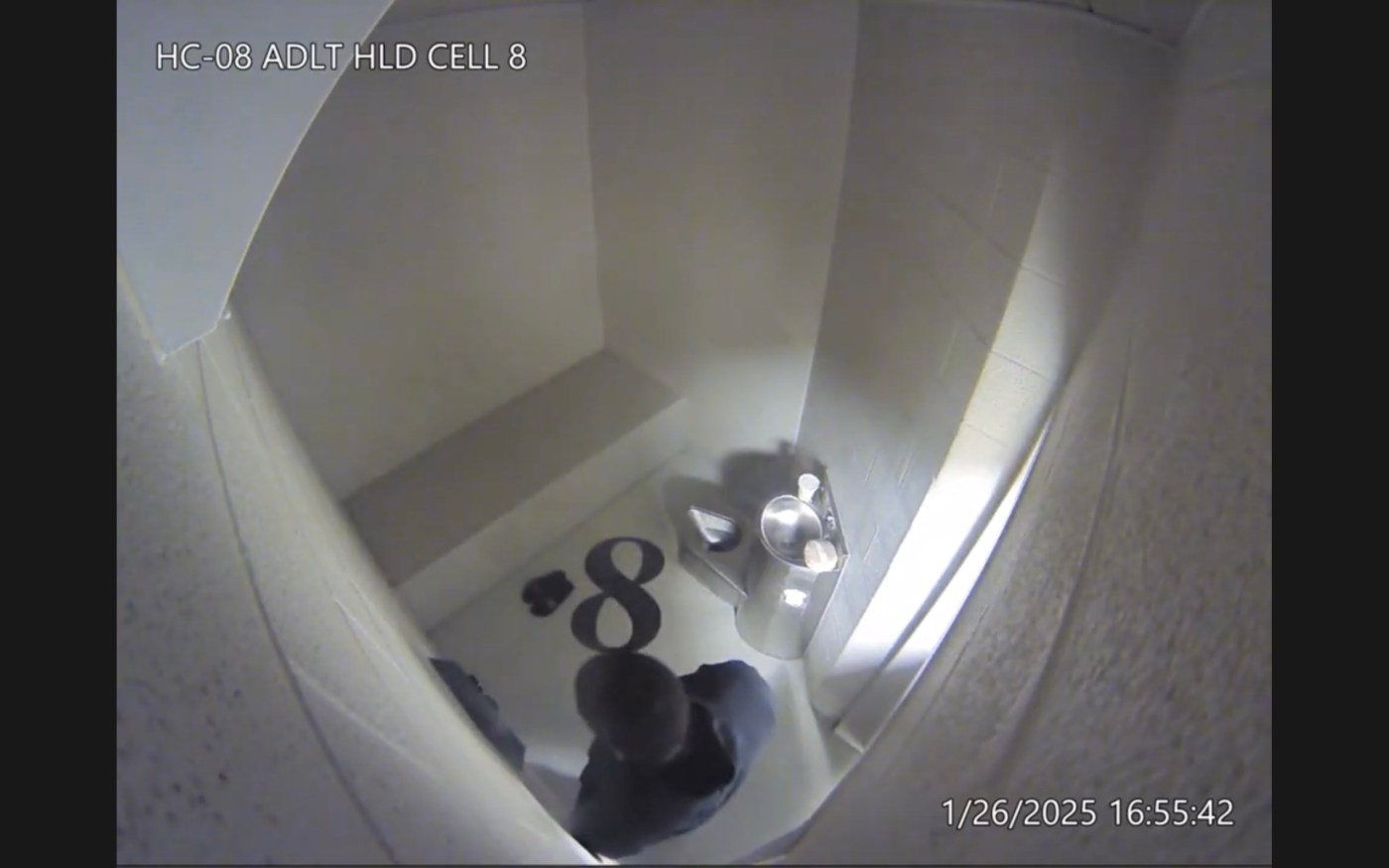
According to the report, the electronic prisoner monitoring log for Jan. 26, 2025 showed that, prior to Hatsis and Kuhn starting their shift at 3 p.m., a cellblock check was made at 1:15 p.m. by Officer Joseph Joppi. The next log entry is a cellblock check by Hatsis at 5:41 p.m. According to the log, there were no documented cellblock checks from 3 p.m. to 5:41 p.m. The report noted that Linton reportedly hanged himself between 4:56 p.m. and 5:07 p.m.
Investigators also obtained camera footage showing Linton’s activities while in he was in cell. According to the report, the camera recorded the following:
- 4:55 p.m.: Linton is standing near the phone box.
- 4:56 p.m.: Linton is holding something.
- 4:58 p.m.: Linton is putting an item onto the phone box.
- 4:59 p.m.: Linton is attaching an item to the phone box;
- 4:59 p.m.: Linton is holding the attached cord with a loop (a ligature).
- 5 p.m.: Linton is holding the ligature.
- 5:01 p.m.: Linton has his hood up and is holding the ligature.
- 5:04 p.m.: Linton appears to have the ligature around his neck.
- 5:04 p.m.: Linton moves to a kneeling position.
- 5:05 p.m.: Linton is on the floor.
- 5:06 p.m.: Linton is struggling on the floor. He has his fists clenched and his arms are moving.
- 5:09 p.m.: Linton stops moving and remains motionless.
The Office of the Chief Medical Examiner performed an autopsy on Linton on Jan. 27. His cause of death was listed as hanging and the manner of death as suicide (hanged self in jail), the report said.
According to the report, the evidence supports the medical examiner’s finding that Linton committed suicide by hanging. The findings, however, raised two related issues as noted by the inspector general. First, that Linton’s suicide was predictable, and second, that his suicide was preventable.
As noted, the Stamford Police Department policy mandates the use of a Prisoner Safety Screening Form to identify people who may pose a risk of suicide, the report said. But, according to the report, “The form is considered to be is effective in predicting suicide risk as long as the individual honestly answers the questions. In some cases, however, like the present case, an individual who harbors suicidal thoughts will give answers intended to hide that fact. That is why the Stamford PD Form and policy directs officers to look beyond the arrestee’s answers to see if, notwithstanding the answers, the individual’s state of mind or other circumstances suggest a suicide risk.”
Linton answered the questions in a manner that “did not suggest a risk of self-harm,” the report said. “Nevertheless, nine hours later, he hanged himself. It is difficult to imagine the depths of despair that motivated him to do that. Perhaps he feared a lengthy incarceration. His despair may have been driven by the felony charges he faced in Stamford or the serious crime for which he had been charged in Pennsylvania. It may have been something else. My investigation has not revealed the ‘why?’, and I cannot fault the officers of the Stamford Police Department for failing to perceive a suicide risk that was far from evident,” the inspector general stated in the report.
The inspector general also noted that the “preventability of this tragedy, at least in part, turns on the lack of internal compliance with the Stamford Police Department’s own policies designed to ensure prisoner safety – including preventing self-harm. In two regards, those policies were not followed. First, a thorough search of Linton at booking and again when he was placed in a cell should have found the belt that he ultimately used as a ligature. He never should have been placed into a cell with the ability to retrieve that item from his pants,” he stated in the report.
“Second,” the inspector general wrote, “the officers who were tasked on January 26 to monitor and ensure the safety of the prisoners, including Linton, did not competently do their jobs. They began their shift at 3 p.m. and Linton was discovered at 5:42 p.m. In that interval, according to Stamford policy, four physical checks of the cells at 30-minute intervals should have occurred.
“The electronic log reflects that they performed one cell check, but not until 5:42 p.m. when Linton likely was already dead. The physical presence of the officers in the cellblock and their interaction with the prisoners might have discouraged Linton from connecting the belt to the phone box for fear of being discovered,” the inspector general stated in the report. “I cannot know for sure; what I do know is that Linton never confronted that risk of discovery because no physical checks were made. Moreover, the officers’ monitoring of the cell video feed was deficient.”
Lastly, the inspector general noted in the report that the officers’ statement that they regularly checked the monitors “does not seem reliable because Linton’s actions in committing suicide, beginning when he can be seen holding something and ending when he stopped moving, lasted almost 10 minutes. Yet, this activity was not observed.”
In conclusion, the inspector general said the investigation determined that Linton’s death was not the result of either police use of force or criminal action, therefore the Office of Inspector General “will take no further action in this matter.”