
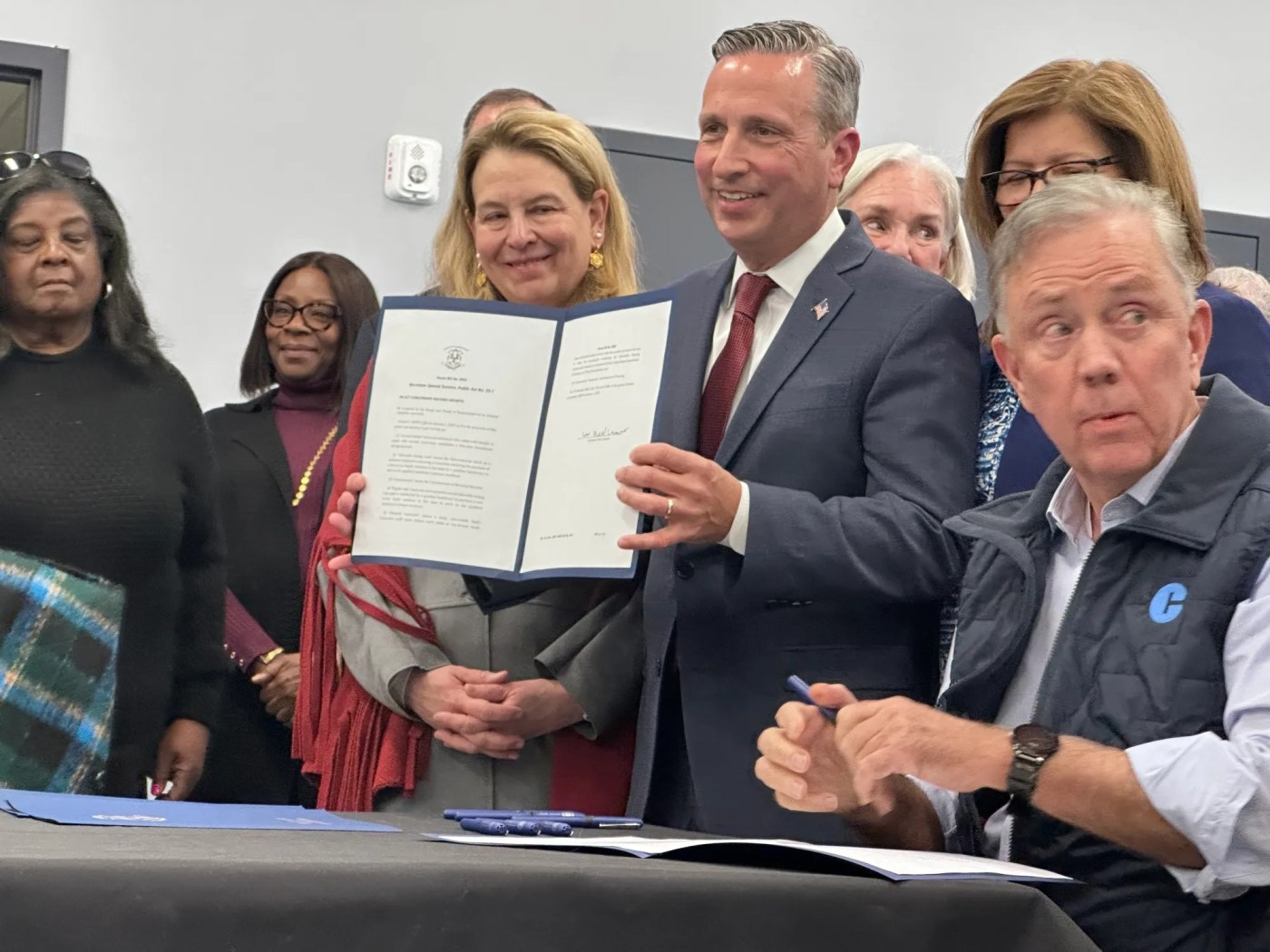
At a ceremonial signing of an omnibus housing bill opposed by every Republican in the General Assembly and the two GOP candidates for governor, Gov. Ned Lamont embraced the measure Monday as a step toward addressing a housing crisis central to the high cost of living in Connecticut.
“Well, you’re not serious about affordability unless you’re serious about housing, and housing starts with a diversity of housing where all of our folks can afford to step up, step down, but have a place they can call home,” said Lamont, a Democrat seeking a third term in 2026.
Lamont spoke at Oak Grove, a new 69-unit apartment complex in Norwalk open to renters earning between $45,000 and $179,120 annually. With a community center that provides free after-school care to K-5 children, the complex caters to working parents in one of the most expensive corners of a high-cost state.
The ceremony was an element of a campaign narrative casting the governor’s surprising veto in June of an earlier version of the bill as key to the subsequent revisions drafted in consultation with Republican and Democratic municipal officials, several of whom stood with Lamont to praise the outcome.
After the opposing the original version, the Connecticut Conference of Municipalities and Council of Small Towns endorsed House Bill 8002, the version passed in a special session last month. Key provisions require municipalities to set goals for housing growth, and the law provides incentives to meet them.
To lower costs and streamline permitting, the law eliminates minimum off-street parking requirements for new developments with up to 16 housing units and sets parameters allowing conversion of commercial properties to residential without special hearings before planning and zoning commissions.
State Sen. Ryan Fazio of Greenwich and former Mayor Erin Stewart of New Britain, who are competing for the GOP gubernatorial nomination, have joined Republican lawmakers in branding the law as undermining local zoning control of the state’s 169 cities and towns.
“Look, it’s a political football for the candidates, no question about it,” Lamont said. “For me, it was important to get the mayors and first selectmen on board on a bipartisan basis. We got that done. And I think at the end of the day, you make the case to the people: this is really important for their kids, important for our economic future.”
Michael J. Freda, a Republican in his ninth term as first selectman of North Haven, said municipal officials of both parties accepted the governor’s invitation to negotiate a compromise that constructively encourages housing development without undermining local control.
“I’m starting to hear, even in my area, that the bill is a bad bill. ‘We’re going to lose local control.’ I can tell each and every one of you here, we’re not going to lose local control. I can guarantee you that,” Freda said. “And if anybody has any questions, you can call me at North Haven Town Hall.”
Senate Majority Leader Bob Duff, D-Norwalk, a prominent force behind passage, as was House Majority Leader Jason Rojas, D-East Hartford, said Republicans wrongly assume that the bill is a liability for Democrats.
“I think the Republicans are on the wrong side of this issue, because you see all across the nation where Republican legislatures are leading on housing, and they have done things that are far more radical than anything we would ever consider even doing,” Duff said.
More than a dozen states have enacted housing laws since 2022.
Common provisions include mandates that limit local review by setting standards for what can be built as-right, a push to allow duplexes, triplexes and other modest multi-family housing in single-family zones, incentives for higher-density projects near transit lines, and rules easing the the redevelopment of underused commercial properties as housing.
“This is a political loser for anybody who voted against the bill,” Duff said “Housing is important for seniors. It’s important for our middle-class families, important for our recent college graduates.”
Some of the Democratic lawmakers attending the ceremony were from wealthy suburban districts, including Sen. Ceci Maher of Wilton and Reps. Lucy Dathan of New Canaan, Eleni Kavros DeGraw of Avon and Cristin McCarthy Vahey of Fairfield.
Republican lawmakers remain opposed.
“Democrats have said this bill will make our state more affordable, jump-start our economy, and today even billed it as a solution to homelessness,” said House Minority Leader Vincent J. Candelora, R-North Branford. “When you promise everything to everyone, the reality is nobody gets what they’re expecting. The idea that giving private equity developers free rein will solve these problems is wishful thinking.”
Rep. Tony Scott of Monroe, the ranking House Republican on the Housing Committee, said other housing measures are sure to follow.
“This is not the end of the discussion around housing reform. In a virtual conference last month, the committee chairs announced their intent to resurrect proposals on no-fault evictions and prohibiting landlords from reviewing a prospective tenant’s criminal history. Both measures could have a chilling effect on an already strained housing market,” he said.
Also in attendance were community housing advocates furious at Lamont’s veto, which they say was him bowing to opponents who organized opposition on social media.
“We’re not always the loudest people in the public hearing or on the Facebook page, but the pro-homes movement is strong and vibrant in Connecticut. Our voices matter,” said Peter Harrison, the Connecticut director of the tristate Regional Plan Association.
He thanked supporters who had lobbied the governor, as well as Lamont for delivering on a promise to produce a substantive law.
“This is your victory, as much as it is anyone behind you,” Harrison said to advocates, then glancing at Lamont. “I do want to thank the governor for keeping his word, for getting all of us back together and getting a compromise bill.”
The Regional Plan’s affiliate is Desegregate Connecticut, which made clear after the veto that Lamont was not welcome at a national “YIMBYtown” conference it hosted in September in New Haven.
Harrison smiled Monday and noted there was “a little bit of a detour where the governor, you know, couldn’t make it.” But he was happy to stand with him on Monday.
Mark Pazniokas is a reporter for the Connecticut Mirror. Copyright 2025 @ CT Mirror (ctmirror.org).