
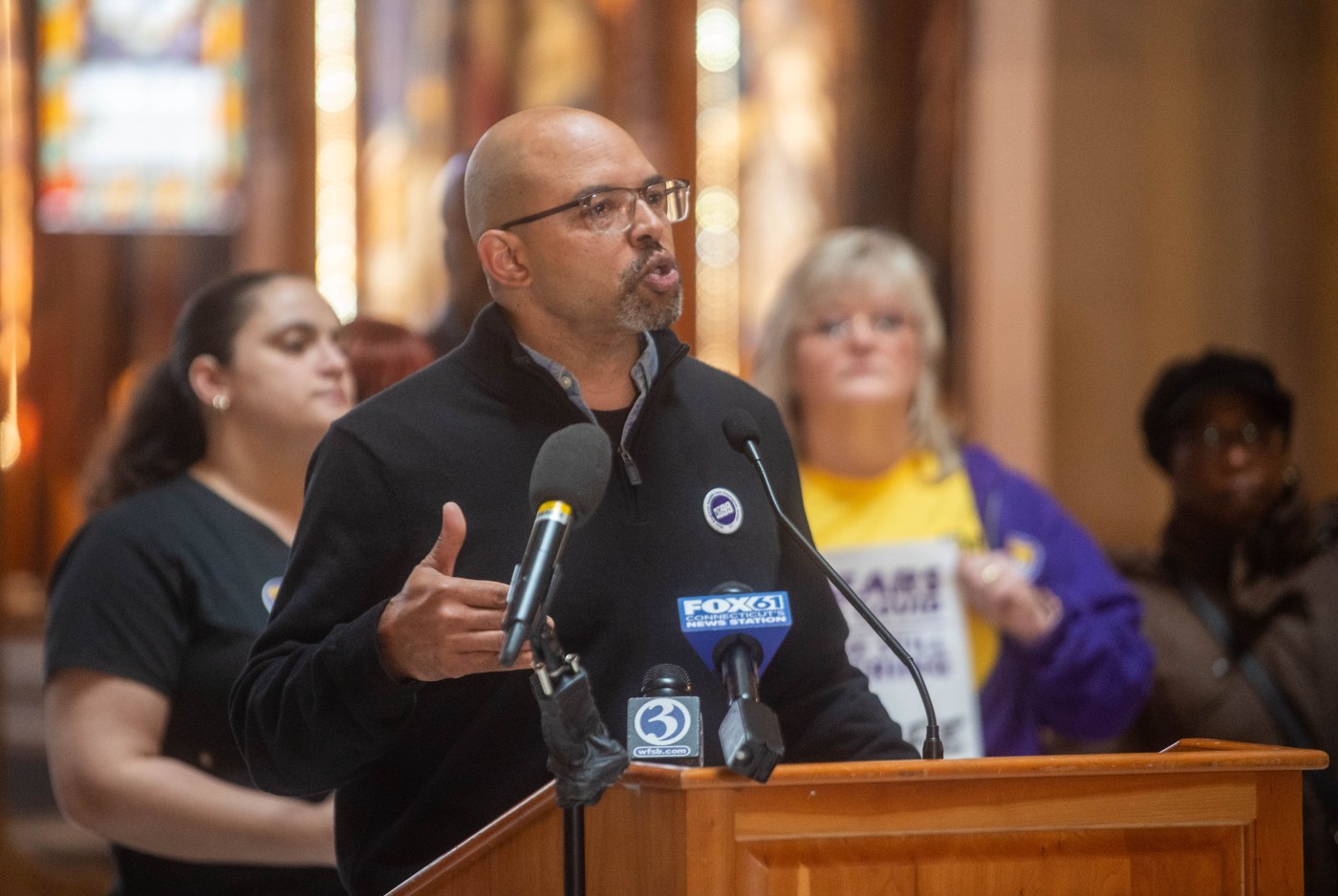
Facing a nationwide nursing shortage, advocates are calling for President Donald Trump’s administration to drop its plans for reducing federal student loans for advanced nursing degrees.
Graduate students previously were allowed to borrow about $50,000 per year, but that would be reduced to about $20,000 annually with a lifetime cap of $100,000, starting in July 2026, officials said.
The limitations were included in Trump’s tax-and-spending measure known as the Big Beautiful Bill that Democrats have derided as the Big Ugly Bill. Beyond the caps, the federal education department also removed nursing from the classification of “professional degree” that advocates say reduces access to student loans.
“Here is the definition of stupid,” U.S. Sen. Richard Blumenthal said at the state Capitol complex in Hartford. “At a time when you have a shortage of nurses, put unrealistic, cruel, dumb caps on student loans for nurses. That’s what’s not to do.”
In Connecticut, the health care system needs to hire about 3,000 nurses per year because of retirements, departures, and burnout in the profession, officials said. But only 2,682 enrolled last year in a process that has been repeated through the years, officials said.
“Fewer people are enrolling than there are slots,” Blumenthal said. “The net result is we are losing nurses, and we are not replacing them at a time when we already have a healthcare crisis of affordability.”
He added, “Nurses are the backbone of our health care system. They are the ones at the bedside who monitor patients’ performance. They are the ones who help patients in the middle of the night when they encounter some kind of crisis. They are the ones who talk to relatives, loved ones, who come to the hospital to visit. And they are the ones who advocate for patients.”
But the Trump administration has defended the loan caps, saying they are necessary.
The omnibus bill “placed commonsense limits on federal student loans for graduate degrees,” the federal education department says. “These loan limits will help drive down the cost of graduate programs and reduce the debt students have to take out. Graduate students received more than half of all new federal student loans originated in recent years, and graduate student loans now make up half of the outstanding $1.7 trillion federal student loan portfolio.”
A special committee has called for a borrowing limit of $200,000 for federal student loans for “professional degrees” like medicine, law, and dentistry, among others. Other graduate programs, like nursing, would be categorized on the limit of $100,000, while undergraduate nursing students are largely unaffected by the bill’s limits.
Under the heading of “myth vs. fact,” the federal education department addressed the issues on its website.
“Myth: The Trump Administration does not view nurses as professionals because they are not classified as a ‘professional degree,’ ” the department said. “Fact: The definition of a “professional degree” is an internal definition used by the department to distinguish among programs that qualify for higher loan limits, not a value judgement about the importance of programs. It has no bearing on whether a program is professional in nature or not.”

Like Blumenthal, the Connecticut Hospital Association has raised concerns about the federal bill.
“Our nation is facing a critical healthcare workforce shortage,” the association said in a statement. “In this moment, we must all focus on strengthening recruitment, expanding access to education, and supporting attainable pathways into healthcare careers – not creating barriers. Lowering loan caps for high-demand clinical fields undermines efforts to grow the workforce and shows a troubling lack of vision for the future of care.”
The association added, “Instead of lifting up essential professions, it sends a discouraging message to many practicing and aspiring providers, including nurse practitioners, physician assistants, social workers, critical roles in the rehabilitation services (including physical therapy, occupational therapy, and speech therapy), pediatric providers, and others at the heart of care delivery. These policy changes will only make it harder to build and sustain the workforce that patients will rely on in the future.”
Overtime
The nursing shortage has led to high amounts of overtime in the Connecticut state budget, officials said.
Statistics from the state comptroller’s office show that the state spent $378 million for overtime during the 2024 calendar year across nearly 50 departments in state government. The highest amounts were in the state prison system with $113 million in overtime, followed by the Department of Mental Health and Addiction Services at $62 million and the state police at $60 million, according to the records.
Among the top 25 individuals with the most overtime, 17 work for the state police, while six work in mental health facilities. Three of the top five employees, at more than $230,000 each for overtime alone, work at the Whiting Forensic Institute, an inpatient psychiatric facility for those in the criminal justice system who require 24-hour care and have been committed by the Psychiatric Security Review Board or need to have their competency restored before trial.
The high amount of overtime at the mental health department is related mainly to nurses working at Whiting and Connecticut Valley Hospital, which are both in Middletown. Amid the nationwide nursing shortage, the hospitals are paying overtime to nurses in order to fill shifts, officials said. In addition, the staffing ratios need to be higher for the patients who have more complex needs than those in general hospitals, officials said. Connecticut Valley is the largest operation in the mental health department with 974 full-time equivalent employees, while Whiting has 493 employees.
The overtime is sometimes related to one-on-one care for psychiatric patients who might be suicidal or in danger of harming other patients or staff members. In addition, costs increase sharply when double-time rates are paid to staff members who are required to work if a fellow worker calls in sick, for example.
Earlier this year, Gov. Ned Lamont said his administration has been trying to hire more nurses and other workers in certain areas where overtime is being racked up in the millions.
“We’re trying like heck to get more troopers, more corrections officers, more nurses — those places where you do see an awful lot of overtime,” Lamont said when asked by The Courant. “We’re prioritizing that in terms of hiring. In other places, we’re not hiring as fast just to keep an eye on the budget.”

Rob Barile, president of SEIU 1199, represents nurses at a wide variety of locations.
“If you value care, you have to value nurses,” said Barile, whose mother became a nurse. “The professionalism of nurses cannot be canceled by a federal memo. … If Washington does not protect the nursing profession, our states must. … Nurses are professionals. Caregivers are professionals.”
Citing nursing homes and federally qualified health centers, he added, “The shortage is in every sector. We’ve seen it get much worse since the pandemic.”
Keisha Gartman told the story of her long journey from being a certified nursing assistant and then a licensed practical nurse before becoming a registered nurse in 2022. She said she went back to college and accumulated $127,000 in student loans before having a large portion sliced off under a federal forgiveness program for certain professions.
Without loans, she said, “I would never have been able to make it through.”
Christopher Keating can be reached at [email protected]