
After two decades of public financing in Connecticut elections, the 2026 political cycle is expected to be the most expensive yet.
The state has handed out nearly $175 million to more than 2,600 candidates since the voluntary program started, but the total for the governor’s race alone will jump to more than $18 million for a single candidate who qualifies for public financing, wins a primary, and reaches the general election in 2026.
The 2026 total represents more than double the amount from the days when Democrat Dannel P. Malloy received $2.5 million for the primary and $6 million for the general election in the governor’s race that he won in 2010.
The state legislature changed the law and increased the totals in an effort to ensure competitive races as major self-funders, including Democrat Ned Lamont, have entered the race in recent years.
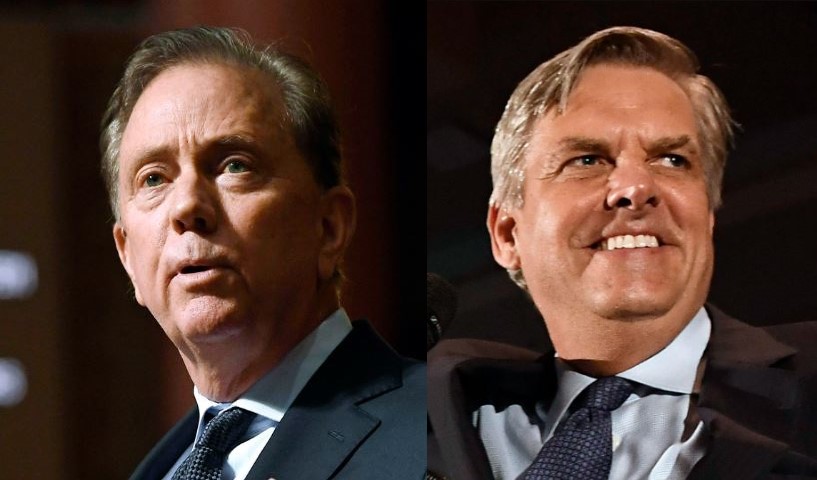
In the 2022 contest, neither Lamont nor Republican candidate Bob Stefanowski accepted public financing. Instead, Lamont spent $25.7 million of his own money, while Stefanowski spent $14.5 million of his personal money in the most expensive governor’s race in Connecticut history. Unlike in 2022, three of the four major candidates in the current race, Democratic state Rep. Josh Elliott of Hamden, Republican state Sen. Ryan Fazio of Greenwich and former New Britain mayor Erin Stewart, are seeking public financing. While they all have been raising money, none of them has formally applied yet for the state grant, officials said.
Knowing that the stakes and expenses would be higher than in the past, the state legislature voted to increase the totals so that the publicly financed candidates would not be completely outspent by wealthy self-funders.
But in an effort to avoid a lopsided contest in 2026, those qualifying in the governor’s race would receive at least $3.22 million for the primary, including about $800,000 for expenses leading up to the state party conventions in May. In addition, a publicly financed candidate who wins the primary would then receive at least $15.49 million for the general election, according to the State Elections Enforcement Commission, which awards the grants.
The final numbers will be announced in January and adjusted for inflation — meaning that the numbers will go even higher. Between the primary and the general election, a candidate in the governor’s race could receive a combined total of more than $18.7 million, the highest in state history.
State House Republican leader Vincent Candelora of North Branford said the emergence of wealthy candidates in recent years prompted a reassessment of the funding levels.
“That was part of the equation,” Candelora told The Courant in an interview. “We needed to make sure that public financing isn’t discouraged. … It needs to reflect the amount of self-funders that we’ve seen at the gubernatorial level. More times than not, we’re having millionaires entering the race. Is that because it’s too difficult to raise the money for public financing?”
Connecticut elections have shown that wealthy candidates do not always win. That includes two races each by Republicans Tom Foley and Linda McMahon, along with two races by Stefanowski. Lamont also lost his first two races, despite spending millions on each contest. He lost the general election in 2006 to U.S. Sen. Joseph I. Lieberman after winning the Democratic primary months earlier.
In the 2010 race for governor, Lamont spent $9 million before losing the Democratic primary to Malloy, who had $2.5 million in public financing.
Since then, Lamont defeated Stefanowski twice and is trying to win his third, four-year term for governor — a feat accomplished only once in Connecticut in the past 200 years by Republican John G. Rowland.
A large majority of officials currently in office have been elected by using the program. In the state House of Representatives, 95% of the current representatives participated in the program, along with 89% of the sitting senators, according to numbers compiled by Joshua Foley, the senior attorney and chief spokesman for the State Elections Enforcement Commission. In addition, two-thirds of those holding statewide offices also were elected while using public money.

The old system
The public financing system, known as the Citizens Election Program, was created after a series of political scandals that drove Rowland and then-state treasurer Paul J. Silvester from office before they were sentenced to federal prison.
Candidates are required to raise a certain amount of money, depending on the office they are seeking. If they reach the required total, then they would receive public funds while agreeing to abide by the specific spending limits.
Under the complications of state law, the program is funded by public money, but not by taxpayers’ money. The money is largely collected through “escheats,” such as unclaimed bottle deposits that go back to the state if consumers fail to return their bottles and cans for 10 cents each. As such, the program is not funded directly from the state’s general fund that includes the state income tax and other taxes.
While the voluntary program was signed into law by then-Gov. M. Jodi Rell in 2005, the first year that state legislators were able to participate was 2008. In nine legislative elections since then, state legislators have received $110 million, while statewide candidates have received another $64.6 million.
In a system designed to prevent corruption in politics, the program has been hailed as a national model.
Deputy House Speaker pro tempore Robert Godfrey of Danbury, who was first elected in November 1988, went through numerous elections under the old system as he ranks among the longest-serving legislators in Hartford.
“I remember what it was like, and the whole system was funded by lobbyists, which was not a good thing,” Godfrey told The Courant in an interview. “It still cost quite a bit of money. Everybody — regardless of your party, regardless of left, right and middle — would have fundraisers in Hartford, and lobbyists paid a lot. They paid enough to run a campaign.”
Concerning the repercussions, Godfrey added, “After the election, well, you had to listen to the lobbyists. Now you didn’t have to do what they said, and they never really asked. They never connected the donation to a particular issue, but they certainly had your ear. … That has changed. Yes, I still deal with lobbyists — less for their advocacy and more for the information they have. They are an information resource. There’s certainly nothing [in the media] that covers the details of industries or nonprofits, so we rely on them for information.”
At this point, politicians have come to rely on the public money so much that there is no turning back.
“It’s made a huge difference,” Godfrey said. “It’s cleaner, it’s fairer. I think it has encouraged people to run, even if they don’t have a snowball’s chance. When I talk to colleagues from other states, they are perpetually fundraising. Certainly, CEP levels the playing field.”
On the other side of the aisle, Candelora agreed that public financing has allowed candidates to run who might not otherwise seek office. While raising money at the gubernatorial level is more difficult than it appears, the lower cash amounts make it largely manageable for the state legislature.
“We certainly do not want to see barriers created for people to run for office,” Candelora said. “On the state rep and senate levels, I think it has been fair.”

Deputy House Speaker Pro Tempore Bob Godfrey of Danbury is a strong supporter of public financing of campaigns. Here, he is shown in 2018 on the floor of the state House of Representatives with William Tong, who has since been elected as state attorney general.
How the money is spent
In addition to agreeing on spending limits, the candidates are allowed to spend money only on campaign-related items.
“The biggest single expense in my type of campaign is mail,” Godfrey said. “The prices have shot up over the years. Some of us remember when a first-class stamp was 3 cents.”
A major expense for legislative candidates is the creation, design, printing, and mailing of the actual literature that is sent directly to the mailboxes of voters. In a fast-changing media landscape with younger voters frequently relying on outlets like TikTok, candidates need to maneuver and sometimes check with younger campaign staffers on how to get their message directly in front of the voters.
As an urban legislator, Godfrey represents part of one city — unlike lawmakers who represent as many as nine towns in rural Litchfield County.
“There’s no mass media here in western Connecticut,” Godfrey said, noting that his hometown paper is the Danbury News Times. “I’m the only person on my street who gets a daily newspaper delivered, and there are 25 or 30 households. That’s not available. There’s no local radio station with news or any kind of civic involvement at all here in the Danbury area. There’s a couple of Spanish and Portugese weeklies, but when you buy an ad in those kinds of media, you’re wasting a lot of money on people who don’t vote and can’t vote. So the only things that we can actually do that is effective is direct mail, phoning, and door-knocking.”
Facing a Democratic primary in 2024, Godfrey said he received $36,000 for the primary and another $36,000 for the general election — vastly below the levels in the governor’s race. To qualify for that funding, he said he raised about $6,000 from multiple contributors, including voters who contributed as little as $5.

(Aaron Flaum/Hartford Courant)
History
After Connecticut was rocked by scandals that led to the nickname of “Corrupticut,” Rell pushed for the changes as part of the state’s most sweeping reform package since the post-Watergate era.
In difficult financial times through the years, both Democrats and Republicans have proposed cutting the program during efforts to balance the state budget. But the state has been running up operating surpluses for the past seven years, and there have been no serious efforts to cut the campaign money. Instead, it has been increased for next year.
In 2015, Rell — no longer in office — went public over her concerns about potential cuts.
“I am profoundly disappointed that legislative Democrats would turn aside, through budget cuts, the public campaign financing program many of us worked so hard to put in place to prevent political corruption scandals,” Rell said at the time. “The Democrats have effectively eviscerated the spirit of the law since 2011 and now they are looking to overturn the actual letter of the law altogether.”
Rell continued, “We passed these strong campaign reform measures following a dark period in our state’s history in 2003 and 2004. Prohibiting state contractors and limiting special interests from paying-to-play through political campaign contributions was the right thing to do then, and it’s the right thing now.”
Later in the same day that Rell made her remarks, both House and Senate Democrats withdrew their proposals and effectively ended the discussion on budget cuts.

(Christopher Keating/Hartford Courant)
As a longtime veteran lawmaker who was first elected in November 2006, Candelora remembers the old system and says the current system has opened the field to more candidates.
“There were a lot less competitive races [before 2008],” Candelora said. “You had to rely on money that you were able to raise from your connections. I do think CEP has allowed people to run for office that might not be financially connected.”
Christopher Keating can be reached at [email protected]