
One of the biggest issues facing Wall Street and the nation recently is how long the rampant enthusiasm over artificial intelligence will last.
Analysts debate back and forth whether the huge run-up in AI stocks is a bubble that will burst or if the increases will only continue if AI meets expectations that it will fundamentally change the American economy.
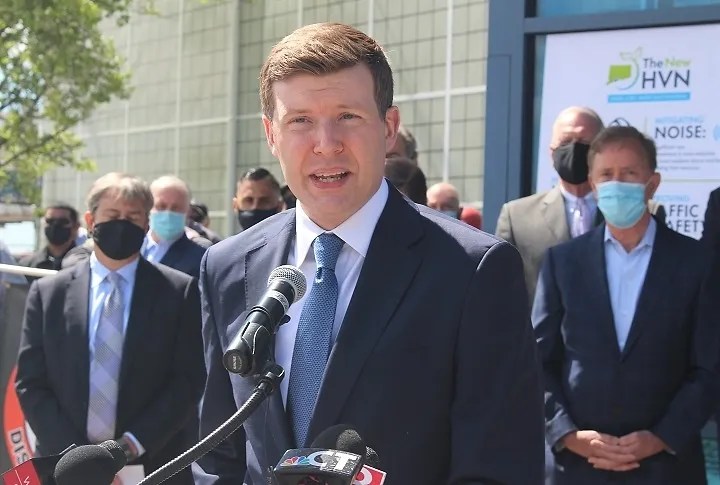
In his latest economic update, state Comptroller Sean Scanlon focused this week on artificial intelligence that has a direct impact on major Connecticut industries that include insurance, finance, higher education, advanced manufacturing, and health care. As such, economists at the U.S. Treasury department rank Connecticut as ninth in the nation among states whose employment is directly impacted by artificial intelligence.
“My personal view on the AI bubble is it is not a question of whether there will be one or there won’t be one,” Scanlon told reporters on a Zoom call. “I think it’s a question of what the fallout of that bubble is going to be when it does pop. And I think what a lot of the Wall Street speculation is about right now is just trying to figure out how large of an impact that that potential bubble bursting would be in terms of how much would be felt by regular people.”
Artificial intelligence has been generating huge gains in the stock market and causing increases in the S&P 500 index that is closely watched by investors. But the biggest gains have come from the so-called Magnificent Seven, which are the top companies in the nation that include Amazon, Apple, Microsoft, Tesla, Nvidia, and the parent companies of Google and Facebook.
Since the seven companies have dominated the index as some other companies have posted mediocre profits, some critics now refer to the S&P 493 instead of the S&P 500.
“Obviously, every company is rushing to invest billions of dollars in this technology, and so everybody is exposed to this in one way or the other,” Scanlon said. “I think it’s just a question of which economic bubble does this look like. There are many precedents in history. We don’t know which one this will be closer to, and I hope, obviously, it will not be one of the larger ones. But it is something that we certainly are constantly taking a look at.”
In a mixed economy with high levels of income inequality in Connecticut, some families are struggling to buy food at the same time that millionaires and billionaires in Greenwich and other Fairfield County towns are closely watching the stock market on Wall Street.
The market has been booming in recent years, setting all-time records under both President Joe Biden and then under President Donald Trump. But some stock analysts are highly concerned about the potential bubble.
Nvidia, a startup company that has become a key player in the AI world, became the first company with a market value of $5 trillion — worth more than many companies combined. The blistering speed of Nvidia’s rising stock value was shown as it passed $4 trillion in July 2025 and then $5 trillion soon after on Oct. 29. While the daily volatility causes ups and downs every day, the jumps in Nvidia’s stock have been astronomical since the company went public in 1999.

As part of his monthly report, Scanlon said that the state is now projecting a surplus of $164 million in the general fund for the fiscal year that ends on June 30. Officials are also projecting a surplus of nearly $44 million in the once-troubled Special Transportation Fund that has been running up surpluses in recent years.
In a mixed bag of results, corporate tax collections were down $186.9 million due partly to changes in federal tax policies on businesses and underperformance in corporate profits. At the same time, Wall Street kept booming as the “estimates and finals” category increased from wealthy investors who collect large capital gains that are paid through the state income tax on a quarterly basis. In addition, the pass-through entity tax that was created following federal changes in 2017 has continued to perform well.
Impact on electricity
In its economic update report, Scanlon’s office stated that AI depends on complicated data centers that require huge amounts of electricity and water.
“As technology companies rush to spend hundreds of billions of dollars on AI infrastructure in the U.S. over the next few years, electricity is becoming the limiting factor,” the report stated. “People in other parts of the country where large data centers are concentrated are starting to see the impact in their electric bills. Are new data centers increasing the already-high electric rates in Connecticut, too? So far, the answer appears to be no, at least not directly, since no AI-scale data centers have been connected to the New England electric grid.”
The report also cited the impact on radiologists, who are medical doctors who read X-rays and MRIs for patients.
$90M AI center in CT could project new hub of technology, bring jobs and economic development
“In 2016, Geoffrey Hinton, who has been called the “Godfather of AI,” suggested that medical schools should stop training radiologists because AI would outperform them within five years,” the report stated. “Essentially, radiology is highly exposed to AI. And it’s true that AI has been a game changer in radiology. As of 2024, radiology tools account for 78% of all FDA-approved, AI-enabled medical devices and have been widely deployed because of their pattern recognition strengths. Yet strong demand for radiologists has continued.”
The report added, “Several factors help explain this. AI tools generally perform worse in real hospital settings than in benchmark tests. Radiologists also do much more than read images during a full day’s work. Additionally, regulators are reluctant to allow, and insurers are reluctant to cover, fully automated readings without any human oversight.”
On a continuing basis at the comptroller’s office, economist Michelle C. Parlos closely watches the impact on jobs that will be both helped and hurt by AI.
At law firms, artificial intelligence could potentially do much of the work that paralegals have traditionally done and could potentially help solo law practitioners, officials said.
“Jobs are going to be evolving,” Parlos told reporters this week. “We don’t know how all of this will play out.”
Christopher Keating can be reached at [email protected]