
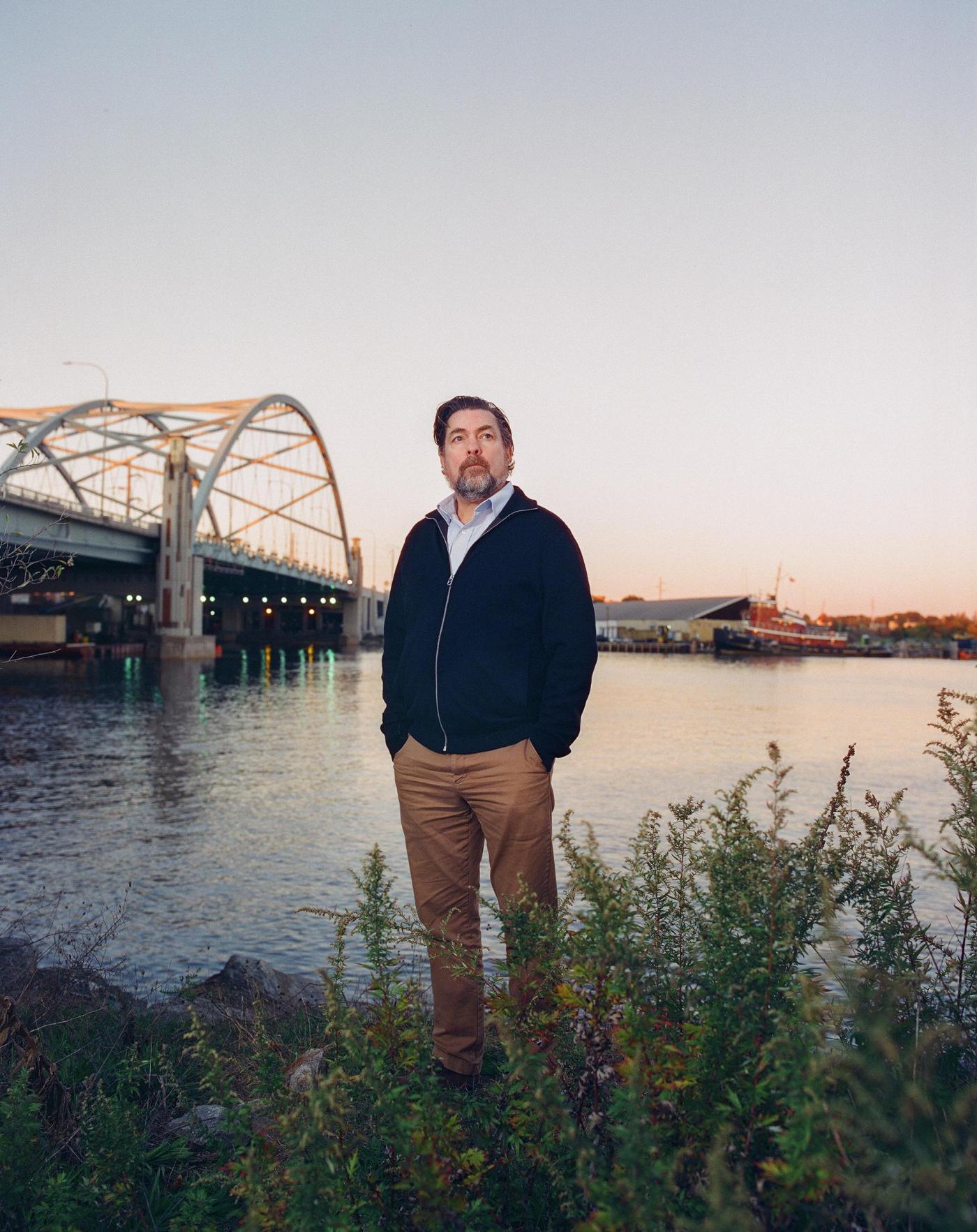
Austin Becker developed an early warning system to protect critical infrastructure from storms. His project’s funding was eliminated in April.
I’m a marine policy researcher who studies how we can make coastal areas safer from big storms and sea level rise.
In 2014, I started developing a new system to help emergency managers quickly get information about the potential damage from hurricanes and nor’easter storms. I collaborated with Isaac Ginis, a professor at the University of Rhode Island’s Graduate School of Oceanography, to make a system, which we called CHAMP: Coastal Hazards, Analysis, Modeling and Prediction.
What really matters when a storm hits is not the flooding or wind itself, but rather the resulting damage. Emergency managers need to know what kinds of things lie in harm’s way before a storm’s landfall — things like roads, backup generators, electrical transformers and HVAC systems. Our system provides uniquely specific information about the storm’s potential damage to these facilities by predicting not only the height of floodwaters or the amount of wind expected, but also the specific things that might be damaged.
This work depends on a lot of trust between us researchers, the folks that manage the infrastructure facilities and the emergency managers. We do a lot of communication that helps everyone better understand what the risks from a storm really are. My team conducts interviews with the people who manage these facilities along the coast and asks them: What keeps you up at night when a storm is heading up the coast?
By combining the information about their concerns with our flood and wind predictions, we can create maps and reports that show where the big risks are in real time. For example, let’s say flooding is predicted to damage an electrical transformer. Our maps highlight the transformer as a point of concern, and then an emergency manager can quickly flag the problem and pass that information along to others who need to know.
All of that work stopped overnight. We had four projects funded through Centers of Excellence, a program at the Department of Homeland Security. But on April 8, the department terminated the entire program. From supply chain resilience to criminal investigations, all supported projects were stopped, including ours.
Fortunately, we have some state funding from Rhode Island for our work in state, and Connecticut recently helped us finish another project. But we had to stop our work on several others and cancel trainings to show communities how CHAMP works. Even though we had done the bulk of the work, and despite everyone’s time and effort, we could not deliver what we had promised.
These early warning and planning systems really help people manage the kind of storms we regularly see in the news. There’s a barrage of these kinds of catastrophic events, and getting the best available science and information to the folks who make critical decisions, especially in a way that they can easily use, is incredibly important for reducing human suffering and economic losses.
—
Austin Becker is a professor and the chair of Marine Affairs at the University of Rhode Island.
This article originally appeared in The New York Times.