
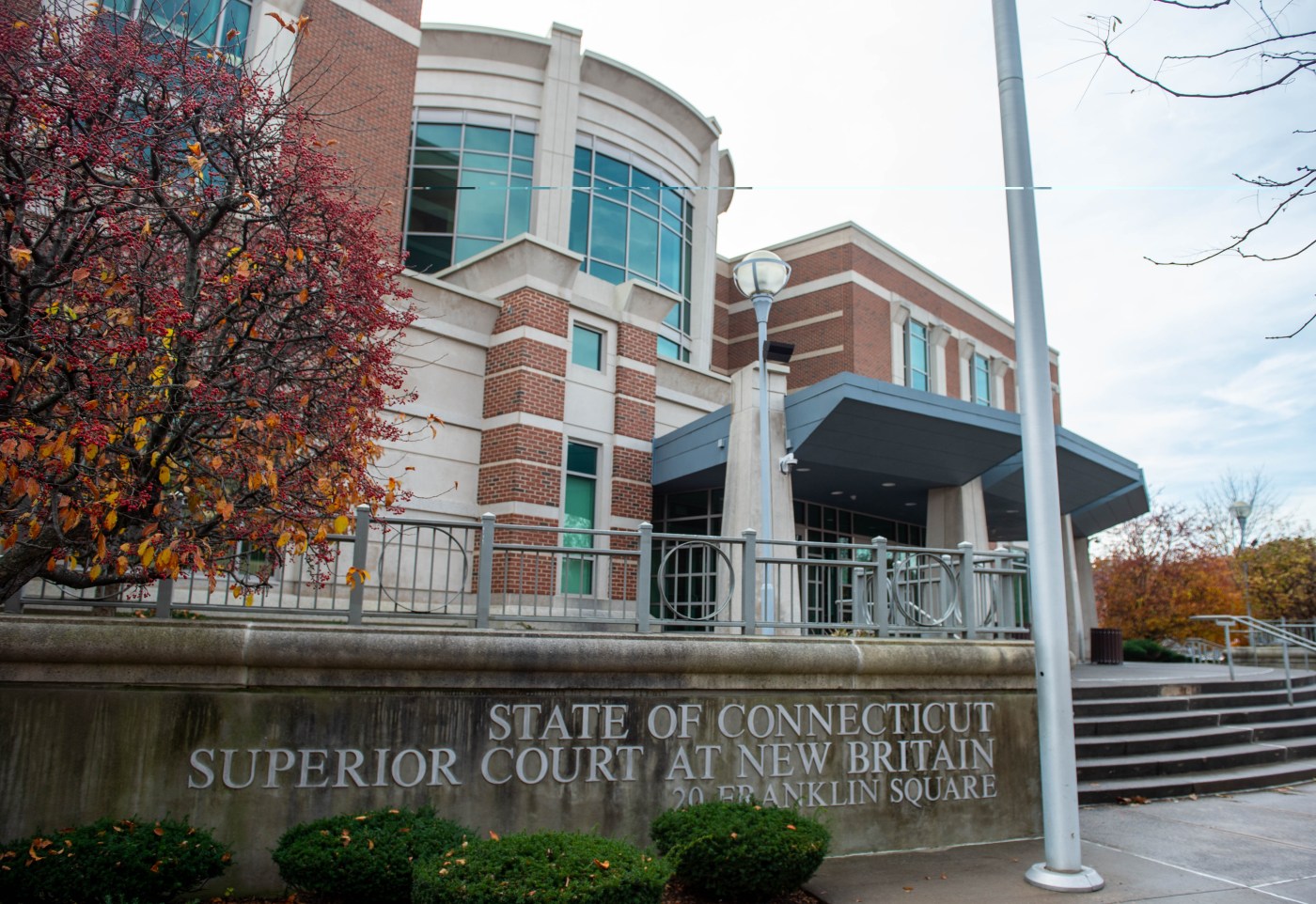
A Superior Court decision that found the state’s chief utility regulator operated outside the law and imposed years of flawed rate decisions appears likely to cool a long and bitter fight over setting electric rates.
But it remains to be seen how, or even if, the state’s biggest utilities can unravel a succession of decisions by former chief regulator Marissa Gillett that the companies say has cost them hundreds of millions of dollars, caused stock values to fall and precipitated a succession of credit downgrades and corresponding increases in borrowing costs.
Rates could increase if flawed rate decisions are corrected in ways that permit utilities to recover the enormous sums they say they have invested in networks but have been prevented — while Gillett ran the Public Utility Regulatory Authority — from recovering from customers.

Sen. John Fonfara, D-Hartford, listens to PURA Commissioner Marissa Gillett on Thursday, Feb. 20, 2025. As part of a deal to clear a path for Gillett’s nomination, Gov. Ned Lamont announced plans on Thursday to appoint Fonfara to a vacant seat on PURA, once it is turned into a quasi-public agency. Credit: Shahrzad Rasekh / CT Mirror
In a short and sharp ruling last month that could close what became a nasty and in some case personal dispute, Judge Matthew Budzik upheld every allegation two Avangrid gas subsidiaries made in lawsuits that sought to overturn year-old rate decisions that not only denied the companies rate increases, but slashed then existing rates.
Under Gillett, PURA broke laws, deviated from established procedure, interfered with utility appeal rights, illegally froze other commissioners out of the rate setting process and then violated public record laws to conceal the fact that she was making what amounted to illegal, and unilateral decisions on the rate cases, the decision said.
Budzik also referred two PURA lawyers — the authority’s general counsel and an assistant attorney general — to a bar grievance committee for investigation and possible discipline for concealing Gillett’s deletion of electronic records sought by the court.

The case reached Budzik when, after months of complaining quietly, the state’s two biggest utilities — Eversource and Avangrid — decided to undertake an unpopular political and legal challenge of PURA’s rate process. The fight reached the top of the legislature’s agenda earlier this year, where most of the Democratic majority sided almost reflexively with the regulators.
Gillett was portrayed by supporters, including Gov. Ned Lamont, as a guardian of consumer interests. Critics complained that she veered away from PURA’s statutory role as a neutral, quasi-judicial arbiter appointed to balance consumer and utility interests.
The utilities prevailed in court. As PURA’s legal defense unraveled in recent months, Attorney General William Tong’s office reversed course and conceded the allegations in the first of two utility suits against PURA. Within weeks, Gillett resigned and Lamont replaced her with Thomas Wiehl, formerly senior lawyer at the state Office of Consumer Counsel, and named a new panel of PURA commissioners.
House Speaker Matt Ritter, a Hartford Democrat who remained neutral during the debate, said he was stunned by the thoroughness of the utilities’ vindication. Until last week, Budzik had consistently ruled against utilities in rate appeals.
“Utilities are not the most popular people in any capital, I don’t care what state you are in,” Ritter said. “I have to admit I’m surprised at how accurate some of the descriptions and some of the things that happened were from people who said there is a real problem over there. Because there were so many people telling me it was not true.

House Speaker Matt Ritter of Hartford (Courant file photo)
“There was a bad culture at PURA and when you have a bad culture bad things happen. I am probably more surprised at this outcome than almost anything I have been involved with in my time as speaker,” Ritter said. “Because there was such emotion behind this. Normally when that happens, a resolution ends up in the middle ground.”
Elsewhere, the election year political reaction has been oddly muted. Tong and Lamont, once among the loudest Gillett backers and utility critics, had little to say about the ruling last week.
“These issues are the subject of ongoing litigation and because PURA operates as an independent quasi-judicial body, it would not be appropriate for the governor to comment on the substance of any rulings or potential settlement discussions,” a Lamont spokesman said.
A Tong spokeswoman said, “He stands by his previous statements.”
PURA’s concessions and Budzik’s ruling in what was the first of the two utility suits against PURA is likely to lead to the settlement of both because the concessions made by PURA in the first are admissible in the second. The first suit, before Budzik, was a rate appeal by the gas companies. In the second, before Judge Elizabeth Stewart, Avangrid and Eversource seek rulings that PURA followed improper procedures when setting rates and an order compelling it to stop.
Although the utilities assert they have lost tens of millions or dollars because of wrongly reached rate decisions since Lamont appointed Gillett in 2019, they are unable to seek damages because the state is legally immune to such claims.
Lawyers following the cases said that probably leaves the utilities two paths toward at least partial recovery of losses: re-starting rate cases still active in the PURA pipeline and applying for new rate hearings in closed cases where rates have been finalized and in some cases affirmed in appeals.
Both paths are expensive and time consuming. A rate case can take a year to complete and cost millions of dollars that end up in customer bills. The process would be complicated by Budzik’s finding that the rate procedure directed by Gillett was so flawed that records compiled under her administration are unreliable and must be redone.
“In light of the procedural errors outlined above, and the public interest involved in setting utility rates,” Budzik wrote in his decision, “the court concludes that, rather than making a decision based on a record compiled in an unfair hearing process, the far better course is to remand this matter as set forth herein such that any decision on the merits of a final rate decisions can be based on a record that was complied fairly.”
The utilities claim, among other things, that Gillett effectively seized control of rates by freezing follow commissions out of a process that is supposed to involve multiple commissioners in a balancing of consumer and utility interests. Utility lawyers argued the resulting decisions were at times arbitrary, inconsistent and contrary to precedent.
Major CT law firm hired by state to investigate PURA staff. It comes amid long-running controversy
That inconsistency, the utilities said, made it impossible to plan spending in an industry based on raising money through stock and debt, investing it in networks and recovering it through rates.
“It was totally unpredictable,” a utility official said. “How do you decide if you are going to expend tens or hundreds of millions of dollars on something without any real sense that you are going to be able to recover it?”
Michael Caron, a former PURA commissioner who complained of being pushed out of the rate process, described what he called the “capricious nature” of rate setting under Gillett’s chairmanship when questioned last month in a deposition by utility lawyers.
“My observation over the years has shown that the decisions that came out would set a new
precedent and then very similar circumstances on a succeeding docket of a similar nature would reverse that precedent,” Caron said. “I found that the decisions that have come out during her tenure tended to push costs out into the future. So she wasn’t really saving the ratepayers anything.”
Jeffrey Gaudiosi, PURA’s executive secretary, said in another deposition that Gillett restructured the authority in a variety of ways, one of which cut off communication between various departments. As a result, he said staff subject matter experts were prevented from talking with the supposedly co-equal commissioners who were removed from participation in the rate process. Gaudiosi said two former commissioners who served under Gillett’s chairmanship, Caron and John Betkoski, might not see a final decision written by Gillett until until just before its release.
“The agency became very siloed in that you were only given the information you needed for your daily job,” Gaudiosi said. “The communication of the agency really constricted and there wasn’t that open flow of communication and ideas anymore.”
Gaudiosi said Betkoski and Caron complained to Lamont’s office.
“I was told that all three commissioners were brought in and essentially told to play nice together, to work this out and work for the best of the agency.,” Gaudiosi said during his deposition.
“Okay. Did the policy change after that as far as you know?” he was asked.
“No, it didn’t,” he answered.
Staff who disagreed with Gillett were given punitive assignments, Gaudiosi said.
“You would be given tasks that are near impossible just in complexity and scope and given a very small time to do it and turn it in and that’s — that’s what the worry was,” he said.
The positive reaction by the utilities to Budzik’s decision suggests a break if not an end to what has been a very public war between PURA and the companies it regulates. Adding to the calming of tensions has been Wiehl’s reversal of an array of PURA policies including those criticized by Budzik and others that caused employee morale to suffer.
“I believe on the very first day that Chair Wiehl took over, he unlocked all of the doors, which
sounds like a small thing, but it was huge in terms of the agency,” Gaudiosi said. “He’s been encouraging everyone to just walk about the agency and talk to other people. And that
level of communication is something we haven’t had in quite a few years.”
But there is likely to be some sort of investigation of what happened and who beside Gillett is responsible. Among those calling for an inquiry is House Republican Leader Vincent Candelora, of North Branford, Gillett critic who said measures must be taken to ensure that public policy as important as setting electric rates cannot be compromised.

“The governor’s office summarily dismissing legitimate claims was always very frustrating to me,” Candelora said. “And I think the accountability needs to run much deeper. Removing the head of the organization doesn’t fix the foundational problems. And it doesn’t uncover those people who should be culpable for illegal activity and violating the public trust.
“There is a collection of individuals who continue to cover up wrongdoing. And so as long as that culture is still there, I think there is a problem.”