
In 2018, Bob Florence tapped out a message on Instagram.
Would James Wayman, then head chef of Mystic’s Oyster Club, try the soy sauce that Florence had been brewing in barrels in his basement?
Florence didn’t know that Wayman was already conducting his own nascent experiments with koji on the second floor of Oyster Club. Koji, a mold that transforms soybeans into soy sauce and rice into miso, has been a tool in Asian cooking for millennia, but Wayman was just beginning to explore how it might be deployed in his kitchen, from fermenting charcuterie to baking bread.
“Koji has been the single biggest game changer in the food I’ve made over the years,” said Wayman, sitting at a picnic table on a sunny October day outside of his cafe, Nana’s, in Mystic. When koji is used to inoculate beans and grains, it releases sugar from starch and amino acids from protein. Those flavors — of sweetness and umami — linger on the palate. Together they play a chord of flavor, Wayman says, rather than a single note.
“Some of the most amazing foods in the world don’t do that. An incredible peach is so amazingly delicious, but you eat it, you have the flavor sensation, and it’s gone, right? Koji has the ability to draw that out and make it bounce around all of your taste buds.”
Koji was also the critical ingredient transforming soybeans into the soy sauce in Florence’s basement in Mystic — a slow-motion Maillard reaction, the same chemical process that occurs when proteins and sugars are heated and rendered delicious. Think: the sear on a steak, or the caramel notes in the crust of a baguette.
When Florence took on soy sauce making, he was moving on from a long career that combined manufacturing with chemistry. Early in his career, he lived in Detroit and sold industrial plastics to the automotive industry, back when manufacturers were replacing clunky metal parts with plastic to lighten vehicles and improve mileage. Later, Florence worked in electronics manufacturing. Both industries brought him frequently to Japan and China, where he became a disciple of local cuisine.
Florence eventually used his training as a chemist to pivot from plastics to renewable energy, working with a startup that turned algae into oil. The science worked, but the business wasn’t profitable. By then, Florence was living in Mystic with his wife, children’s book author Debbi Michiko Florence. After selling off the equipment to the algae fermentation company, Florence started casting about for a new idea. He embarked on what seemed, at first, to be a hobby: brewing soy sauce at home.
“If you go to a grocery store in Japan, there might be a selection of like 20 different soy sauces, whereas in America you might have one or two or three,” Florence said. Often made by small family companies, local Japanese soy sauces, or shoyu, were “beautiful” to Florence. They were thick, opaque, umami-rich, and they enhanced food more deeply than the mass produced translucent varieties on U.S. shelves.
“My question was, how are they made? And can they be made here? And can I make them?”
Patiently, Florence waited. His koji-inoculated soybeans and wheat turned into soy sauce. He worked up the courage to ask Wayman to try it. Immediately, Wayman asked to put it on the menu at Oyster Club — written into the ingredient list as “Bob Florence Soy Sauce.”
“I was sort of tapping the brakes on being commercial. I was just looking for feedback,” Florence said. “But the next thing I know, he put it on the menu.”
Wayman could immediately tell that someone who cared about food was making the soy sauce.
“It was almost like an extension of him, in a way. His food felt like Bob,” Wayman recalled. The soy sauce and the human being who created it both possessed “a quietness, a softness almost, but an intensity and intellect.”

But even after that milestone, Florence continued to tinker. He sought advice from experts, sending a letter to 15 CEOs of Japanese soy sauce companies.
“My letter to them was really simple. It was, ‘Hi, I’m Bob. I make soy sauce in America, and I’m coming to Japan. Would you mind spending a few minutes talking to me about soy sauce?’”
Three CEO’s responded. “They were kind and gentle,” Florence said. They let him know his soy sauce was “OK.” Good enough to keep going. Of those CEO’s, Kyosuke Iida, president of Chiba Shoyu, became his mentor.
Florence, his wife Debbi, and Wayman invested in scaling up the business together, a brand they would call Moromi, which refers to the mash of ingredients put in a barrel to brew what will eventually be pressed and become soy sauce. They searched for a space to expand production and, just before the COVID pandemic hit, found a former batting cage in North Stonington, complete with AstroTurf, and transformed it into a soy sauce brewery. Today, Florence says that Moromi is one of just a handful of U.S.-made soy sauce brands.
Debbi, a third-generation Japanese American, has also written children’s books that play on the theme of cooking, like a picture-book biography of Michelin-starred Chef Niki Nakayama.
Over the years, Wayman has brought his perspective as a chef to the venture, convincing Florence to experiment. Many of these renditions highlight a single additional ingredient, like maitake mushrooms, sugar kelp, or rye, to create new flavor profiles.
Florence would be happy, he says, just making a single version of Moromi, but the experiments have played a part in attracting chefs from across the country to bring Moromi to the tables of their restaurants, to more than 200 shops, and even to Connecticut for visits to the Moromi brewery in North Stonington where they sign their names to the “chef’s wall of culinary creativity.”
Wayman is no longer affiliated with Oyster Club, but at his Nana’s locations in Westerly, R.I., and Mystic, Moromi and koji can be found all over the menu. There are miso glazed sourdough donuts, made to order. Pizza sauce with koji (“it makes a tomato taste more tomatoey,” Wayman says). Koji porridge sourdough bread. Even daily specials like a poke bowl highlight Moromi, with a splash of sugar kelp shoyu.
“It’s easy, if you know how to cook already, to integrate into your food,” Wayman said.
Even ice cream shop Mystic Drawbridge has gotten in on the fun, crafting their Sweet ‘n Salty Shoyu scoop with a touch of vanilla — cooking Moromi with sugar results in a deep, salty caramel that is at once simple and decadent.

The historic drawbridge on the Mystic RIver. File photo
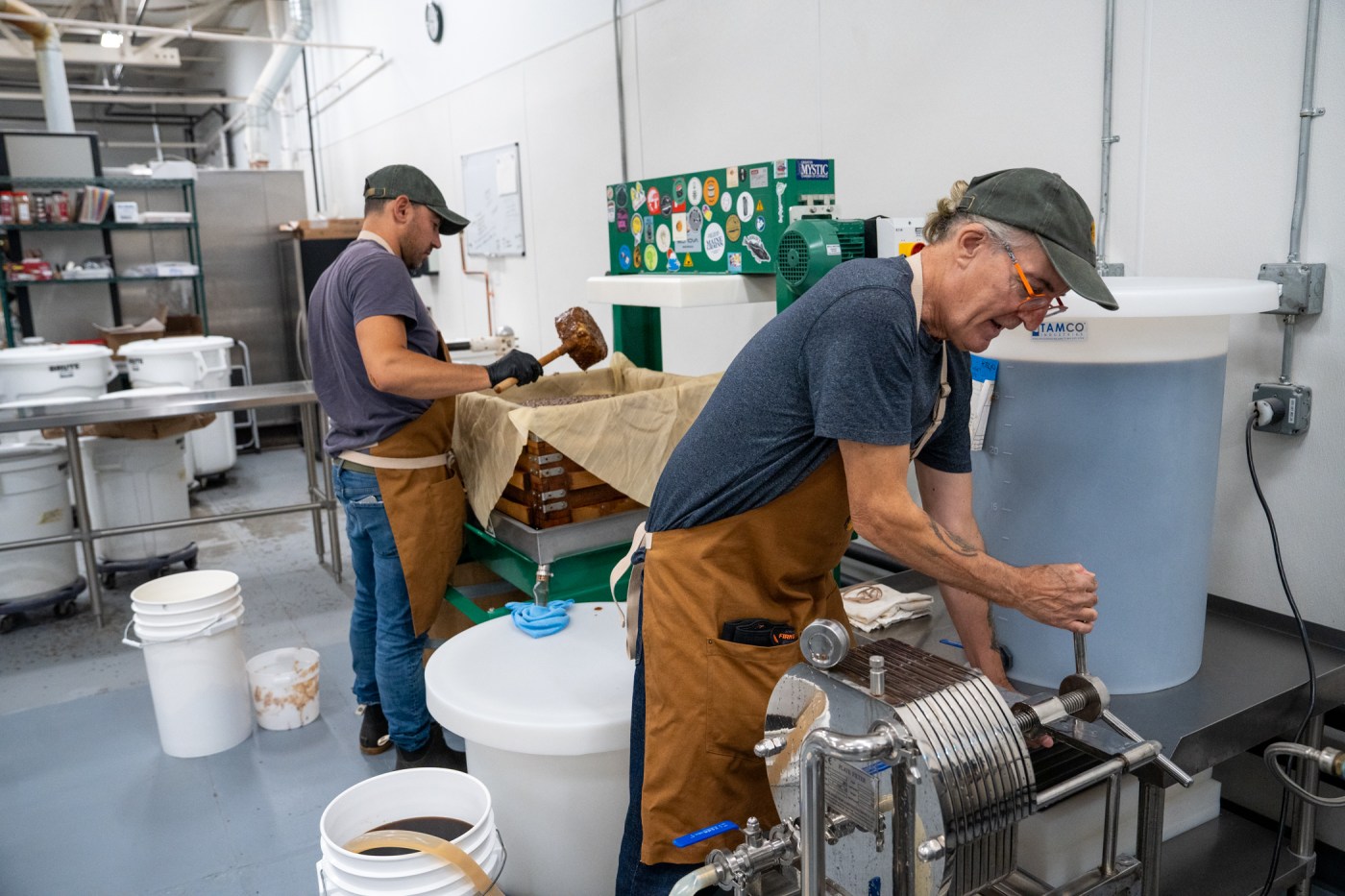
These days, Florence runs the day-to-day of the business. He gets up early, has a cup of coffee around 4:30 a.m., goes over orders and makes shipments. Perhaps he presses a batch of soy sauce, or inoculates a batch of soybeans which sit in a sauna-like room, paneled with cedar planks.
Florence has just one assistant on staff, and though Moromi is carried in stores across the U.S., the operation is small enough that they can handle the volume. Moromi isn’t carried by big box stores, which Florence says is a conscious choice in a business that’s defined by patience.
“It’s like anti-fast. Everything is slow. The fermentation. The pressing,” he said. “There’s nothing rushed.”
Laura Tillman is a reporter for The Connecticut Mirror (https://ctmirror.org/ ). Copyright 2025 © The Connecticut Mirror.