
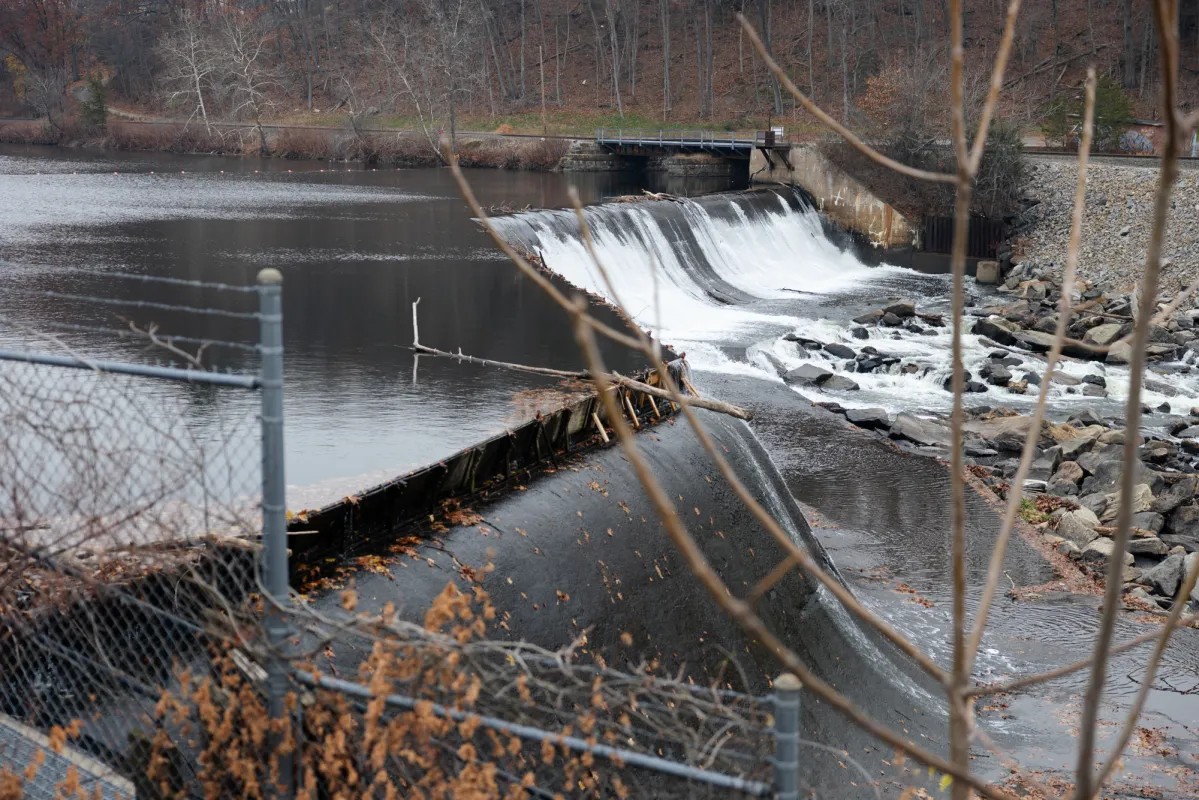
It’s a quality of life issue for people and animals.
For well over a century, fish making spawning runs up the Naugatuck River have had their journey cut short just 16 miles inland at the Kinneytown Dam in Ansonia.
Above the dam, the river flows relatively unencumbered from Thomaston 30 miles to the north, where it draws from dozens of tributaries that serve as vital habitats for spawning shad, lampreys, eels and Atlantic salmon.
Efforts to ease their path from Long Island Sound — including the installation of a fish ladder alongside the dam in the 1990s — have largely failed, officials say, and Kinneytown Dam remains a major migratory roadblock on the Naugatuck’s watershed.
“Without the removal of this dam, it can never be a river,” said Kevin Zak, a local advocate who has led efforts for years to restore the Naugatuck River, which he says behaves more like a “landlocked lake.”
“It looks like a river, and you would think that it acts like a river, but it doesn’t,” Zak said. “You can’t put a price tag on a free-flowing river, the economic and quality of life benefits are just astounding. You don’t have to build it, it’s already there.”
Earlier this month, the Connecticut Brownfield Land Bank announced that it had closed a deal to purchase the dam and surrounding property from a private company in Washington state for $1, a critical step forward in what officials expect will be a $60 million effort to remove the dam and restore the river to its natural course.
The project is the largest active dam removal effort currently underway in Connecticut, which has one of the largest concentrations of dams in the United States.
Many of the dams being removed date back to Connecticut’s industrial past, when rivers powered mills across the state.
“We have more than 4,000 dams in the state, and they’re being removed on a regular basis because they’re no longer functional,” said Alicea Charamut, executive director of the Rivers Alliance of Connecticut. “They’re deteriorating, and it’s important that they are removed before they cause too much damage.”
James Fowler, a spokesman for the state’s Department of Energy and Environmental Protection, said that removing the Kinneytown Dam will “provide significant ecological, recreational, and community benefits, including for nearby environmental justice communities.” The agency has contributed $1.6 million toward the removal effort.
The dam, which was built in 1840s, continued to operate as a hydroelectric facility until 2020 when its generators were turned off by its former owners, Enel North America.
Enel sold the dam later that year to a firm called HydroLand Inc., which stated its intent to repair and modernize the dam in order to continue producing electricity. But that plan never came to fruition, leaving the dam to languish while local officials began exploring ways to purchase the dam to tear it down. (In the meantime, Hydroland transferred ownership of the dam to a related entity based out of Washington state, Trimaran Energy.)
“That went from a long period of time of these guys still trying to squeeze some dollars out of us in this acquisition to acquiring it for dollar,” said Rick Dunne, the president of the Connecticut Brownfield Land Bank.
Timothy Carlsen, who is listed in official documents as a point-of-contact for both HydroLand and Trimaran, did not respond to multiple requests for comment for this story.

The Connecticut Brownfield Land Bank is based in Waterbury and has worked on over a dozen environmental assessment and remediation projects throughout the state. Dunne, its leader, is also executive director of the Naugatuck Valley Council of Governments.
Concerns with the dam aren’t limited to the obstruction of migratory fish. Advocates and local officials have also worried that the dam’s deteriorating condition could result in a failure that would send millions of gallons of water rushing downstream.
When the region was hit with devastating floods in 2023, the torrent of water flowing over the dam washed away much of an earthen berm carrying Metro-North’s Waterbury branch line, resulting in millions of dollars of damage.
The berm also separates the river from a canal that flows into an artificial pond containing contaminated sediments leftover from the days when Ansonia was a center of brass manufacturing. Flooding could spread that contamination.
“It was only a matter of a few more inches of rain, or another hour or two of heavy rain, it could have completely breached,” Dunne said. “So we’re really worried about catastrophic release at this point because we found out things about the integrity of this dam since we’ve been in there that are really scary.”
Zak, the advocate who now serves as president of Naugatuck River Revival, said the dam has also suffered from a series of longstanding flaws related to the design of the fish ladder that was built in 1999 at the behest of the the Federal Energy Regulatory Commission, in order to allow the dam to continue operating as a hydroelectric facility.
Videos filmed by Zak and posted online show fish struggling to make their way up river past the dam, while whole sections of the ladder are filled with debris.
“It was a terrible design,” Zak said. “Fish ladders, if they’re short and straight, are moderately okay. This is neither. This is extremely long… and it has a zigzag entrance, so the fish have to find it and navigate to it. Then they have to go up, down, back. It’s stupid.”
A 2010 fire in one of the dam’s two generation units caused further damage to the passageway, according to a complaint submitted to FERC in 2021 by the NVCOG and Naugatuck River Revival. By 2020, a report by the U.S. Fish and Wildlife Service found that the numbers of some fish species using the ladder — including alewife, shad and brown trout — had fallen by over 90%.
Enel North America, the company that owned the dam at the time the fish ladder was installed, did not respond to a request for comment last week.
Dunne said that more than $50 million has already been committed to the project from state and federal sources. More than half of that, $25 million, is state bonding approved by lawmakers earlier this year that’s awaiting final approval from the State Bond Commission.
The project has also been awarded a $15 million grant from the National Oceanic and Atmospheric Association as well as $4 million in federal Clean Water Act funding. The U.S. Environmental Protection Agency is also spending $1.5 million to test the sediment behind the dam for contaminants.
As part of the effort to remove the dam, Dunne said the land bank also plans to ask officials in Ansonia and Seymour to waive any taxes that went unpaid by the dam’s previous owners.
So far, Dunne said none of the money for the dam removal has been affeccted by President Donald Trump’s budget cutbacks. (Earlier this year, NVCOG had a $5.7 million federal grant to complete portions of the Naugatuck River Greenway Trail rescinded by the Trump administration.)
The land bank must also receive formal approval from FERC, which regulates hydroelectric projects, to remove the dam. A spokesperson for the federal agency said Monday that it has yet to receive a removal application related to the Kinneytown Dam.
Absent any delays in the delivery of federal funding or regulatory approvals, Dunne said he expects crews to begin work next year on relocating a series of sewer mains that will be affected by the project.
From there, Dunne said removal of the dam structure could take place as soon as 2027, with final work on the project wrapping up the following year.
“Demolishing the dam is a relatively simple, straightforward and short process,” Dunne said. “It’s dealing with the sediments, dealing with the flows and dealing with the reconstruction, the rehabilitation and restoration of all the river features… that’s where the work is.”
If successful, the demolition of the Kinneytown Dam would follow similar dam removal projects along Connecticut’s Scantic and Farmington Rivers, as well as a string of other projects along the Naugatuck River.
A decade ago, DEEP completed work on a $6.3 million fish bypass on the Tingue Dam less than 2 miles upstream from Kinneytown.
The bypass, which is surrounded by a park, is wider than a traditional fish ladder and features a more gradual incline to mimic the natural flow of the river. But despite praise for its design, advocates like Zak say it is of little use to fish if they never make it past Kinneytown.
John Moritz is a reporter for the Connecticut Mirror. Copyright 2025 @ CT Mirror (ctmirror.org).