
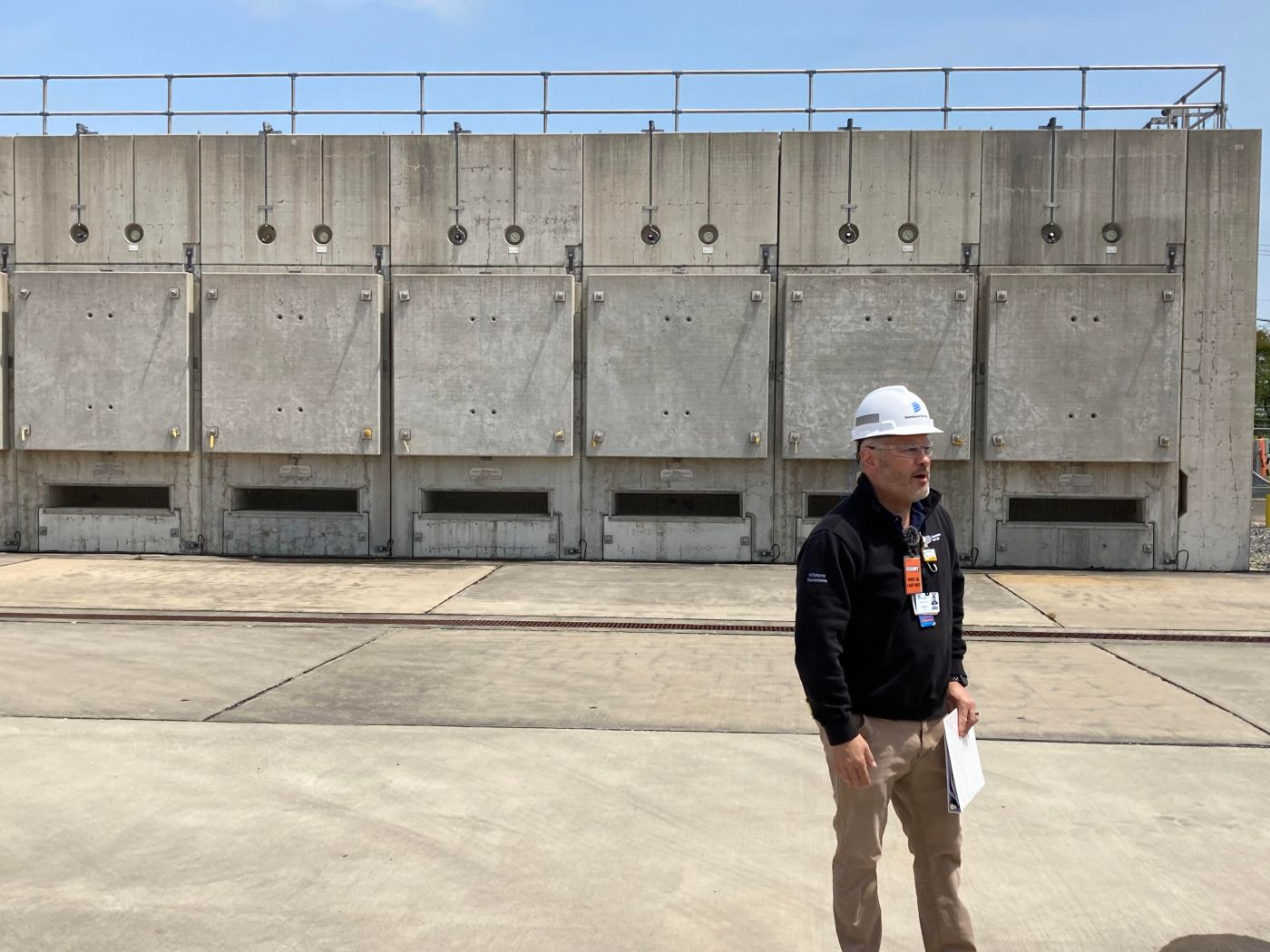
Nuclear power seems to be having a moment.
As the Trump administration methodically throws up roadblocks to slow, if not stop, carbon-free renewable solar and wind power, carbon-free nuclear appears to be the go-to idea for large amounts of power that are presumed to be needed in the future for data centers, AI and more.
Nevermind that before two new nuclear plants opened in Georgia in 2023 and 2024 — seven years late and double their original budget — there had been no new nuclear power plants in the U.S. in more than 30 years.
CT marks 50th anniversary of a Millstone power station unit. See what was reported in 1975.
Now the chatter is around so-called small modular and micro-reactors — touted as easier, cheaper, and faster, leading to a public perception they are ready to be pulled off the shelf and plugged in.
But here’s the problem with that. They don’t exist yet.
Former Nuclear Regulatory Commission Chair Allison Macfarlane, now director of the School of Public Policy and Global Affairs at the University of British Columbia, is among those who are frustrated with the public and governmental belief about small modular reactors, also known as SMRs.
“They do think that,” she said of the public perception that small nuclear reactors are an immediate option to help meet energy needs. “A lot of the media writes about these things as if they do exist. ‘We know that they’re cheap, we know that they’re safe.’ But we don’t know anything, because they don’t exist.”
But they are in development. As of last summer, the Nuclear Energy Agency dashboard listed 127 different small modular reactor designs in existence globally, with about 60% of them in active stages of research and development.
There are three reactors operating around the world that are reported to be small reactors: A floating one in Russia powering a remote Arctic region and two in China, but details about those projects have not been shared.
The SMRs are often bundled under the category of advanced nuclear energy. That advanced designation generally refers to the supposedly newer ways they are cooled, and changes to pressurization and uranium formulation common to the water-cooled light-water reactors that comprise most of the world-wide nuclear reactor fleet today.
“Advanced is rather a misnomer of a term,” Macfarlane said, echoing the views of others. “It should really be non-light-water, because ‘advanced’ suggests there’s something new here, and there isn’t anything new. Most of these technologies have been tried for 50 to 70 years.”
She said eight countries have tried to build more than 25 different versions of one of the technologies — sodium-cooled fast reactors. “No one has been able to get them to produce electricity economically, viably and reliably.”
What do we know and what don’t we know about updated nuclear power options? And how realistic are any of them — including in Connecticut?
The short answer — even the owner of the one nuclear station in Connecticut sees the challenges of building new nuclear in the state. And if those could be overcome, it would be a long way off.
The basics of nuclear power haven’t changed much in decades. It’s carbon-free. The classic units — like the 94 stations operating in the U.S. — can generate a lot of power. The two units at the Millstone Nuclear Power Station total about 2,100 megawatts. Plants can provide that power 24/7 with planned interruptions for re-fueling and maintenance. Despite a plant’s large footprint compared to similarly sized fossil fuel power, it takes up far less space than renewables such as wind and solar fields.
A mega data center could drive AI, deliver billions to CT. Will politics and power worries doom it?
It’s more efficient than other forms of power, including renewables, which means nuclear doesn’t lose as high a percentage of its power as other power sources do. Some nuclear systems require a lot of water for cooling — but so do conventional power plants — leaving both vulnerable to droughts, floods and warming water, some of which are due to climate change.
But nuclear power is not renewable and its radioactive waste is not really recyclable, as some claim. Plants take a long time to build and they cost a lot of money.
Enter the notion of small nuclear power plants broadly, and SMRs specifically.
Smaller nuclear units
“I find the name SMR a little bit misleading because it should be called smaller modular reactor, because they’re still 300 megawatts,” said Jacopo Buongiorno, professor of nuclear science and engineering at MIT. “This is a substantial facility, requires a lot of civil work, site excavation. So it’s not a factory-produced reactor by any stretch of the imagination.”
Buongiorno said the first one likely to be built in North America is from BWRX — a longstanding nuclear company — at the Darlington nuclear site in Canada. It’s slated for 300 megawatts.
An early-stage project in Wyoming by TerraPower, a private company founded by Bill Gates, will be 345 megawatts. In October the U.S. Nuclear Regulatory Commission, NRC, approved its environmental impact statement, the first such designation for new technology nuclear.
The federal government-owned Tennessee Valley Authority, TVA, is also building what it calls an advanced nuclear SMR that uses molten-salt cooling. The unit by Kairos, a startup, is not expected to go online before 2030.
Prior to these efforts, the Biden administration had approved one new project by another startup — NuScale — for a unit in Idaho. But that plan dissolved when costs increased. A larger NuScale design was approved in May by the Trump administration.
Also in May, President Donald Trump signed four executive orders to speed up several aspects of nuclear development. They include adding 300 gigawatts — that’s 300,000 megawatts — of nuclear power by 2050. And they order the NRC to speed up licensing, which some see as dangerous rubber stamping. Earlier this month, Trump nominated a former executive at Westinghouse, a longtime player in the nuclear space, to the NRC.
But Buongiorno and others said, as an alternative to the SMR, there is a proven modernized reactor already available in the U.S. — the AP1000 — Westinghouse’s full-size reactor.
“It’s a great design. It’s an American design. And my personal opinion is that our best bet if we want to grow nuclear is to build more of those AP1000s,” he said. “The downside of the AP1000 and any other large reactor is it takes time to build these units, and it costs a lot of money.”
That is also the reactor used in the two new units added to Georgia’s existing Vogtle plant. But Buongiorno said it would be a mistake to judge the economics of a new big reactor like the AP1000 by the Vogtle experience. It was the first of its kind so likely to be more expensive and slower, though he admitted overall the U.S. nuclear industry does not have the greatest construction track record.
Westinghouse also hadn’t built a nuclear plant in a generation, which brings up another category of problems. The kind of skilled workforce and expertise needed to build and maintain a nuclear facility has all but vanished in the U.S., as has the supply chain that once supported nuclear construction. While the fuel supply is the same for old and new nuclear plants, there’s not enough of it and some of what is needed comes from Russia.
Then there is the question of whether SMRs and micro-reactors will be cheaper and easier to build. The answer depends on the definition of cheaper and easier, especially considering the cost per unit of power.
Ask Buongiorno if it’s cheaper: “The answer is absolutely no. We expect, actually, small, modular reactors to produce energy that will be more expensive than large reactors. This is a mathematical certainty.”
Ask Macfarlane: “It’s quite realistic — at least the light water reactor designs are realistic. The advanced designs less so.” In fact, Macfarlane has just co-written a paper on the cost question. “We conclude that economies of scale still will hold. It’s just simply cheaper to build a single, large light water reactor than 10 small ones,” she said.
Ask Jeff Semancik, the Radiation Division director at the Connecticut Department of Energy and Environmental Protection (DEEP): “There’s a trade-off that you’re looking at between what are the upfront capital costs versus the long term cost of electricity.”
On the other hand, Buongiorno points out that investors will perceive the upfront risk as smaller.
“If the check that you need to write at the beginning of the project to build the plant is $3 billion instead of $10 billion, the risk associated with the project is significantly smaller. And that’s really the value proposition for the smaller reactors, the overall project risk, financial as well as execution. There is less to build.”
It’s generally thought the footprint for an SMR won’t be that much smaller, especially if the plan is to install several at once. Siting might be a little easier because of new safety systems that require a smaller perimeter, though factors like access to transmission lines or availability of transmission capacity could impact siting and cost.
The lower the power, the less potential radioactivity if a problem arises. There’s also less radioactive waste, though there’s still no U.S. repository to store it.
As the scale continues to shrink, Buongiorno believes his point about the cost per kilowatt hour continues to hold true. Power from microreactors would be even more expensive per unit, but they are a different animal. They are envisioned to be 10-15 megawatts, but could be as small as one megawatt. The concept is also more as a standalone system that’s not necessarily tied to the grid, so the need for transmission and distribution and its costs may be avoided even though the power itself costs more.
Their use, experts say, would be more for out-of-the-way or hard-to-access locations where connecting to a grid would be extremely expensive or even impossible and where the alternative might be diesel generators. Think remote mining camps or extreme rural Alaska without connecting highways. Or for use by the military, which the Trump executive orders specifically target. The military has a history of small reactor use in things like submarines and aircraft carriers going back decades, though the technologies are not the same as land units.
“The business model is very different. These are not grid-connected electric generators. These are co-located with their end users” Buongiorno said. “So the devil is in the detail of these things, which means it’s all going to be site- and customer-dependent.”
Microreactors are expected to be easily transportable with other needed components, but they are even less developed than SMRs. An initial testing pilot project in the U.S. is expected next summer, which may be aggressive timing, even though some of the well-known and experienced nuclear companies are looking at them. So true deployment, even if everything goes well, is still years away.
In the last few legislative sessions, lawmakers cleared a slight path. They lifted the state’s nuclear moratorium for the Dominion site in Waterford, which houses Millstone, thereby allowing for nuclear expansion at that location. They also established a process for municipalities to begin consideration of hosting new nuclear facilities and authorized $5 million in bond funds for DEEP to give grants for technical assistance for early site permitting.

To that end, in October DEEP announced informational sessions beginning in December to help municipalities better understand what nuclear power and its new iterations entail.
DEEP is aware of the realities of potential new nuclear power, as evidenced in this 2024 report that noted advanced nuclear technology, SMRs and more are in early stages and that “cost competitiveness has not yet been demonstrated and is unlikely to be realized unless or until such technologies move beyond ‘first of a kind’ projects and are deployed at scale.”
In other words, there’s a long way to go.
“It’s a significant amount of time that’s required to get these large projects off the ground,” said DEEP Commissioner Katie Dykes, noting that a project like Revolution Wind, under construction now, first solicited proposals in 2017. “Many of the resources that we’re talking about now and planning and engaging on, we’re contemplating deployment and commercial operation timelines that are in the late 2030s. That’s not unique to nuclear.”
But Connecticut does have some unique circumstances with nuclear — some helpful, some less so.
Dykes thinks the national lack of a nuclear workforce is less of an issue here with existing training at Three Rivers Community College in partnership with Dominion, as well as the skill sets associated with the state’s large defense industry — especially submarines and their nuclear components. And she said DEEP already is responsible for nuclear safety.

The Millstone Power Station in Waterford, once the focus of a political debate that included threats to shut it as cheap natural gas posed a competitive threat, is looking more affordable as gas prices soar.
On the other hand, she and others point out that a deregulated utility market like Connecticut’s could face challenges with nuclear’s expense.
“How do we create the right balance in terms of the investment approach here to making our market an attractive place to invest while not burdening ratepayers with all of the risks of cost increases?” she asked.
In the meantime, in late October, Connecticut signed on as the 12th observer state to an effort known as Advanced Nuclear First Movers, which also has 11 full state members. Its inception was several years ago through the National Association of State Energy Officials, NASEO, as an education mechanism around advanced and other new nuclear.
Now more formalized, the group is working through the variables and unknowns as states consider the various technologies in the face of state climate policies, electricity needs and costs.
Nuclear, while promising, is not a panacea, said David Terry, NASEO’s president. “It’s kind of flashy in the news right now for good reason, because people are interested. But it’s not a panacea,” he said.
And with trying to figure out what kind of power to use 30 years from now and a lead time that could be a decade, the message, he said, is to weigh the pros and cons carefully. “And, oh, by the way, if you choose the wrong thing and you choose too many of the wrong thing, you’re going to pay dearly.”
CT history
Connecticut’s nuclear history dates to the 1968 opening of the Connecticut Yankee in Haddam, which stopped producing electricity in 1996. Millstone Unit 1 began operation in 1971 and it stopped producing electricity in 1995. Units 2 and 3 — which are still running — opened in 1975 and 1986 respectively, with Unit 2 just celebrating its 50th year. Each has had its license extended, to 2035 and 2045 respectively.
The Millstone units constitute about one-third of the power generated in Connecticut and along with the Seabrook Nuclear Power Plant in New Hampshire, the only other nuclear plant operating in New England, supply one-quarter to one-third of the region’s power.
The Millstone units have older technology systems that use Long Island Sound, which is literally outside their doors, for intake and discharge water. In the summer of 2012 after a very warm winter and summer, Unit 2 shut down for 12 days due to intake water temperatures that exceeded what was allowable. The NRC subsequently approved an increase in allowable water temperature and Dominion spokesperson Susan Adams said via email there have been no issues since.
That incident followed a situation in August of 2011 when water from the Sound overtopped the seawall around the plant during Tropical Storm Irene. Adams did not respond directly to the question of whether this has happened since.
The company has clear procedures in place to respond immediately to prevent any impact to operations, she said in an email. “If a storm is coming, we have in our procedures to build a 2-foot-high wall with sandbags around the doors of specific locations.”
The Union of Concerned Scientists has tracked nuclear power safety for years. The director of that effort, Ed Lyman, said climate issues such as rising water temperatures, drought that causes reduced water, flooding and more intense storms are not necessarily safety issues. “But they could be a real operational issues if it has to shut down for some period of time.” He also said plants in Europe, in particular, have had to lower power output during heat waves in recent years.
After the flooding of the Fukushima plant in Japan in 2011, the U.S. looked at the flood standards for its plants. “It turns out that nearly every plant in the country, when they did these assessments, they found out that they were probably vulnerable to more severe flooding than they were designed to withstand,” Lyman said.
With the moratorium now removed for additional building on the Millstone site, there has been some chatter that, despite its proximity to the water, it might be a good location for SMRs given that transmission and interconnections are already available.
Semancik at DEEP said the effects of climate change are considered when sites are selected. “You’re required to do a meteorological, hydrological study of all the sites, including what the potential exists going forward,” he said.
While Dominion has expressed interest in SMR development, Adams noted in a lengthy written response that their focus on SMRs at the moment is at a location in Virginia.
“While we’re not opposed to an SMR at Millstone Power Station, Connecticut might not have the regulatory environment for one. The upfront costs for an SMR, though less expensive than traditional nuclear, are significant enough that Connecticut’s deregulated market might not support such a project,” Adams said, echoing Dykes’ concern. “However, we still plan to work with Connecticut’s policymakers on potential paths to taking advantage of SMR’s next-generation nuclear technology.”
Now what?
Buongiorno offers three thoughts on why nuclear can still be considered worthwhile.
One is that in the face of Trump administration policies that don’t advocate decarbonization, if that is a still a state goal, nuclear is the lowest carbon energy source available and it’s scalable. Another is its reliability. It can run 24/7, which means it is stable and therefore keeps the grid stable. And third is its local economic benefits. It provides high-paying permanent jobs in addition to the initial construction jobs. And a facility will pay local taxes.
But he said: “If we need more power between now and the end of 2030, then nuclear can play a fairly limited role.”
And, of course, you have to be willing to pay. “But I got news for you — you got to be willing to pay for any of the energy technology that you choose,” Buongiorno said. “There is no free lunch.”
That’s something Dykes knows all too well.
“How do you do that? What will it cost? How can you de-risk it?” the DEEP commissioner asked. “How can we make sure the costs are shared equally among those who benefit from the investment?”
Former NRC Chair Macfarlane offers a stark answer when asked whether it’s realistic to move ahead with the new reactor designs.
“I don’t think so,” she said. “It depends on what you want to do. And if you either want to A, address climate change or B, address the energy needs from AI, … it means you have to address it immediately, like yesterday, and none of these technologies are available.”
She said it may be something to continue to develop and see if will work. But she said it will probably take a couple of decades to commercialize.
“To put all our treasure into nuclear right now is not very smart.”
Jan Ellen Spiegel is CT Mirror’s regular freelance Environment and Energy Reporter.