
Early in their relationship, Dimitri Brand and Nelly Mecklenburg decided that they wanted to build a house. For years, they had uprooted their lives on a regular basis, moving between New Haven, Connecticut; Philadelphia; Washington, D.C.; and Cambridge, England, for school and work.
The frequent changes left them craving some place they could create a sense of permanence. “We always talked about building a house,” said Brand, 36, a founder of the architecture firm Holesum Studio. “Wanting to have some solidity to our relationship and to our life, we started looking for land to buy.”
Mecklenburg, 36, grew up in New York and Brand was raised in northeastern Connecticut. For their new home, they wanted to be near those locations but “in a beautiful, rural place,” Brand said.
In 2019, they found a 10-acre undeveloped lot that met that description on the outskirts of Hillsdale, New York, near the Massachusetts border, and bought it for $32,000.
But having the desire to build a house is different than having the budget to do so. With few funds to dedicate to the project, Brand and Mecklenburg came up with a couple of solutions. They would do much of the construction work themselves and call in friends to help. But, perhaps more important, they would build only as much space as they needed, and add to their home as life required.
The first structure they built, the same year they bought the land, was a 100-square-foot platform with a roof and sliding doors made from translucent corrugated polycarbonate. With no insulation, plumbing or electricity, but equipped with a tiny wood stove, the structure is part camping platform, part rustic cabin, which was enough for the couple to begin visiting the property and seeing how it changed through the seasons.
Over the following months, as they got to know their land more intimately, they identified a site for a driveway leading to a future home. They also made plans for bringing in electricity, a well and a septic system.
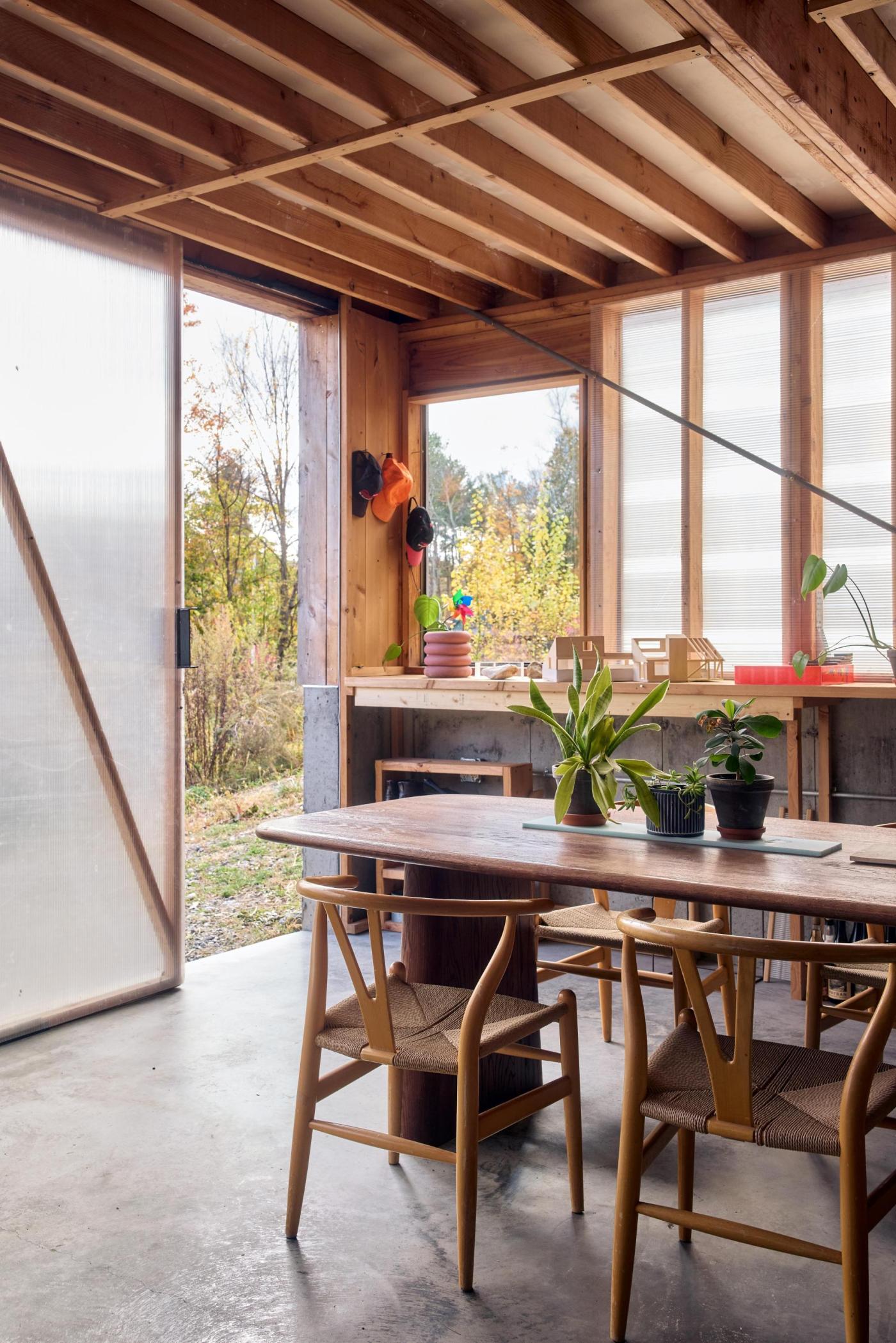
In spring 2021, they began building a house where they could live and work full time. The compact structure included a 475-square-foot walkout basement dug into the hillside, which would serve as Brand’s office, and a 450-square-foot living space above with a sleeping loft.
Brand used local hemlock for exterior siding and interior wall paneling, floors and built-in cabinetry. When a few oak trees had to be cut down to make way for the driveway and house, Brand took the opportunity to have them milled into flooring by Hudson Valley Timberworks and Restoration for a future project.
For light and warmth, much of the basement is wrapped in twin-wall polycarbonate panels, which are commonly used in greenhouses and can create significant heat on sunny winter days. A wood stove provides additional heat and sits within a double-height niche that rises to the living space, where interior windows can be opened to warm the upstairs as well.
The couple installed a small mini-split heat pump, which they rarely use, and tubing for a possible future hydronic radiant heating system under the floors. “We were making sure we had flexibility,” said Mecklenburg, who works in international development. “It’s about being adaptable.”
By spring 2023, when they were married, the house was largely complete. But after tackling so much construction themselves, “we tried to agree to a year of no building,” she said.
When they put down their tools, they were happy to find that the tiny house they had built was everything they needed — at least for a while.
The next spring, Mecklenburg became pregnant with the couple’s son, who is now nearly 1. Fearing they didn’t have enough space for a child, they began building again. Brand designed an addition with the aim of creating a framework for all the space they might need, now and in the future.
The extension measures 850 square feet, but the family is using just 200 square feet of it at first. Finished with oak flooring and paneling made from their own trees, the space allowed them to expand the kitchen from a small space for cooking basic meals to a full-size kitchen where it will be possible to prepare holiday meals.
“Before, it was really a kitchenette, with very little counter space,” Brand said.
“Now, we end up spending most of our time as a family there,” Mecklenburg said.
They are leaving the rest of the addition as raw, unfinished space for now and plan to gradually use more of it as their needs and desires change. They envision wanting a primary suite separate from their child’s room in the future, for instance.
So far, by doing so much of the work themselves and relying on free labor provided by friends, the couple have kept construction costs to about $325,000.
With a design that’s meant to change over time, Brand said, “this house has the capacity to be there for the different phases of our lives.”
This article originally appeared in The New York Times.