
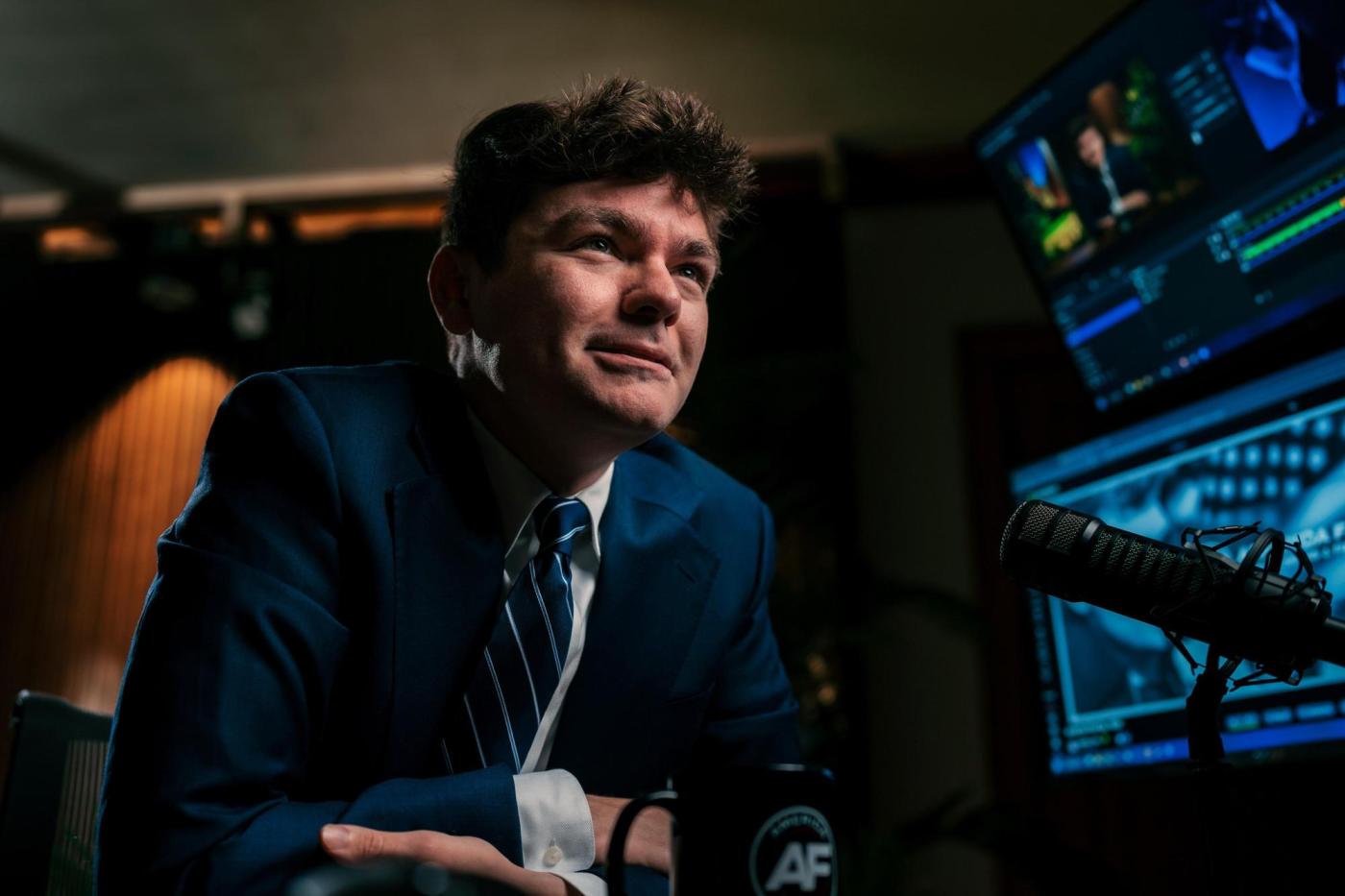
Last month, Tucker Carlson’s genial interview with white nationalist Nick Fuentes detonated a bomb that further fractured the Trump-era conservative movement he once helped galvanize. This month, Carlson decided to escape the wreckage for weeks of bird hunting in Maine, South Dakota, Nebraska and southwest Florida.
During three hours of interviews driving to and from a quail hunting site outside Fort Myers, Florida, Carlson was by turns indignant, reflective and seething — and thoroughly unrepentant for having roiled the conservative movement with the interview, or for his own escalating attacks on those who support Israel.
“Israel does not matter,” he said from behind the steering wheel, casually contradicting the view of President Donald Trump and every president before him, while his two spaniels sat in the back seat. “It’s a country the size of what, Maryland? It has a population of 9 million. It has no resources. It’s not strategically important. In fact, it’s a strategic liability.”
Carlson expressed bafflement over the reaction to his session with Fuentes. He said he did not understand what was so problematic about his guest, beyond the fact that conservative commentator Ben Shapiro, an Orthodox Jew, had depicted Fuentes as antisemitic just as he had done to Carlson.
“My impression is of a guy who Ben Shapiro attempted to destroy his freshman year of college for asking completely legitimate questions about the U.S. commitment to Israel,” Carlson said.
In choosing not to challenge Fuentes’ antisemitism during their discussion on his popular YouTube show, Carlson focused furious new attention on whether he was deliberately mainstreaming views that were once embraced only on the fringes of American politics — and, in particular, whether he was seeking to further inject far-right ideology into the Republican Party as it begins to think about what it will stand for after Trump leaves office.
On one level, the debate brought into focus by Carlson is about the line between free speech and hate speech. On another, it is about whether American conservatism needs to do more to expel racism and extremism from its dialogue and policies. The fissures over those questions are growing more pronounced among Republicans, a shift that is evident in the angry reaction among many on the right to Carlson’s handling of Fuentes and his increasingly vocal criticism of American policy toward Israel.
What struck many about Carlson’s interview was what was not discussed. Carlson did not explore Fuentes’ skepticism about the Holocaust or his admiration for Adolf Hitler. He did not bring up Fuentes’ racist disparagement of Black people and the vice president’s Indian American wife.
When Fuentes volunteered during the interview that he was “a fan” of Josef Stalin, Carlson suggested that they “circle back” to the subject but never did so. Nor did he respond when Fuentes expressed concern over “organized Jewry in America.”
The interview was in many ways the culmination of Carlson’s growing feud with conservative fellow travelers. Long a standard-bearer for Trump’s “America first” mantra, Carlson, 56, openly criticized the president in June for straying from his principles and for “being complicit in the act of war” by bombing three Iranian nuclear sites in cooperation with the Israeli government.
In the months following the airstrikes, Carlson continued to question Israel’s strategic value to the U.S. In early September, after Turning Point USA conservative activist Charlie Kirk vowed that Carlson would still be speaking at the group’s events, a pro-Israel donor angrily revoked a $2 million pledge to Turning Point.
Then came the interview with Fuentes, which instantly made Carlson radioactive among many on the right. When Kevin D. Roberts, the president of the Heritage Foundation conservative think tank, spoke up to defend Carlson, he was pilloried by colleagues for having done so, prompting Roberts to apologize.
While Megyn Kelly and a few other conservative influencers continued to vouch for Carlson, others, such as Shapiro and radio host Mark Levin, condemned him. Carlson’s two good friends in the White House, Trump and Vice President JD Vance, have been conspicuous in their silence.
“I’ve never gotten along better with him,” Carlson said of the current status of his relationship with Trump. “He’s never been nicer.” But, Carlson conceded, his attacks on Israel, along with his gentle treatment of Fuentes, cost him friendships and led to death threats.
“I just want to be clear about this: I knew what would happen,” Carlson said of the reaction to his anti-Israel posture. “And I felt that, at this point in my life, I can take it. And it’s worth it, because I want to force a rational public conversation about what’s in our country’s interest.”
Ten minutes later in the interview, though, he returned to the subject of how his fellow conservatives had turned on him, and his unflappability gave way to outrage.
“The most dispiriting fact of the last nine months is that huge proportions of the institutional Republican Party all kind of hate free speech every bit as much as the left does,” he said. “They are every bit as censorious as some blue-haired, menopausal Black Lives Matter activist. And I just didn’t know that. And I’m disgusted. I feel betrayed. I take it personally.”
Still, Carlson has deep ties in the movement. He campaigned for Trump in 2024 and, along with Kirk, was one of the most vocal Republicans to urge Trump to select Vance as his running mate. His Fox News evening show had more than 3 million viewers until he was fired from the network in 2023. His podcast, “The Tucker Carlson Show,” ranked in the top 20 during the first quarter of 2025, ahead of every other conservative political host, according to Edison Research.
If anything, Carlson’s interview with Fuentes may have increased his visibility, or, at least, it did not hurt it. According to the YouTube monitoring website VidIQ.com, his show had 1.46 million paid subscribers the week before the interview. The week after, his subscribers totaled 1.5 million.
Such numbers would seem to confirm the view held by several current and former friends that Carlson knew exactly what he was doing.
‘Undue Pleasure in Going After Israel’
Carlson, who has often been derided for his claim that he is “just asking questions” when his questions center on conspiracy theories, is starting to find some conspiratorial answers. On a recent show, he described the race-related riots of 2020 as “a manufactured crisis” that had been staged in an effort “to effect broad social change.” In another episode, Carlson referred to the coronavirus pandemic as a “creation.” The Jan. 6, 2021, riot at the Capitol? “The whole thing was managed.”
Carlson has also produced a documentary about the 9/11 terrorist attacks. The U.S. government, he said, “had foreknowledge” of the attacks on the World Trade Center, as did “other actors.”
But Carlson said that his foremost concern is what he sees as America’s misplaced priorities. Instead of U.S. policymakers attending to domestic challenges like skyrocketing housing costs and a crumbling health care system, he said, “We’ve spent the last 80 years administering a global empire. It’s commanded a massive percentage of our attention and money. That’s the core problem, which no one wants to say.”
In particular, Carlson said during the interview, America’s devotion to Israel was misplaced. He scoffed at its characterization as America’s one abiding ally in the dangerous neighborhood of the Middle East, saying, “Israel is not only not our most important ally in the Middle East, I’m not even sure they are an ally.”
Carlson went on to say that he did not altogether blame the Israeli government for “trying to get what it can” from the U.S. Rather, he found fault with U.S. leaders in both parties for “handing over their sovereignty to an irrelevant country in exchange for campaign contributions or, in some cases, protection from blackmail. They’re the ones I have contempt for.”
Carlson said he abhors antisemitism and that he has numerous Jewish friends who share his qualms with the Israeli government. Still, his characterization of the Jewish state as a devious manipulator leeching resources from a great power is a familiar trope that has aroused suspicions.
“At best, I’d say he’s antisemitic-adjacent,” said Matthew Brooks, the CEO of the Republican Jewish Coalition.
For that matter, Carlson once offered a similarly skeptical appraisal of the conservative politician Pat Buchanan — who, Carlson said on a political TV program in 1999, may protest that he was merely speaking “truth to power” and may very well have Jewish friends. But, Carlson said, “I do believe there is a pattern with Pat Buchanan of needling the Jews. Is that antisemitic? Yeah.”
Several people who were once friendly with Carlson said in interviews that they found few common traits between the affable libertarian-leaning contrarian of the past and the strident polemicist they see today.
“The undue pleasure he gets in going after Israel and being attacked for it probably comes down more to his desire to be transgressive than to animosity toward Jews,” said Jonah Goldberg, the editor-in-chief of the conservative online publication The Dispatch and a former friend of Carlson.
Carlson acknowledged that, on certain levels, he is not who he once was. “I’ve changed my opinion on almost every big topic over the years,” he said, citing in particular his previous advocacy of the Iraq War as “one of the worst things I’ve ever done.”
A lifelong Protestant, Carlson said that he had recently grown “much more devout” and that he had spent a year and a half reading the Bible in its entirety. What drove him to do so, he said, was his belief that “the spiritual war is real” in America. He now recites the Lord’s Prayer daily, he said, as a guard against “hating people on the basis of their race, or just hating them in general.”
Not a ‘Full-on Ambush’
Carlson explained his nonconfrontational approach to Fuentes in part by saying that he viewed himself as more of an oral historian in the manner of Studs Terkel than an interrogator. Acknowledging that he had not prepared much before interviewing Fuentes, he said, “Honestly, I was guilty of the same thing I criticize others for, which is judging him by a few three-minute clips I saw.”
The two had dinner at Carlson’s house in Maine the night before the interview. The host could see that Fuentes, who came alone, “was rattled, like he thought it was a hit or something.”
In a text exchange, Fuentes confirmed that he “was very uneasy” and “thought that the show would most likely be a full-on ambush or at least very negative.” Fuentes added that, after the two went over what the discussion topics would be, “I felt much more comfortable.”
Brooks of the Republican Jewish Coalition compared what he called “the fawning way” that Carlson handled Fuentes with his openly hostile interview of Sen. Ted Cruz, R-Texas, the month before. The two argued over Israel, Russia and the U.S. bombing of Iranian nuclear sites. Cruz wondered aloud about Carlson’s “obsession with Israel,” causing Carlson to respond that the senator was accusing him of antisemitism “in a sleazy, feline way.”
“I have contempt for Ted Cruz,” Carlson said as he drove back from the quail hunt, where he managed to bag six birds. “Not just in his public positions, but in the way that he lives.” (Cruz, in a speech the previous evening, said of Carlson’s interview with Fuentes that he had “spread a poison that is profoundly dangerous.”)
It remains to be seen whether Carlson will seek to repair his antagonisms — and, if he does not, what his intransigence will mean for the Republican Party.
“He’s putting a lot of people in a difficult situation,” Brooks said. “We’re heading into 2028, and one of the key questions that people running for president will face is, ‘Do you stand on Tucker Carlson’s side, or the other side?’”
Goldberg, the editor of The Dispatch, believes that forcing a choice is exactly what his former friend has in mind.
“A lot of this is about jockeying for position ahead of 2028,” he said. “If you’re a Republican who believes in a return to normalcy, it’s not hard to disavow Tucker. But if you’ve made your bed with the idea that conservatism is going to remain MAGA — well, then he’s made it complicated.”
This article originally appeared in The New York Times.