On a recent Friday night in the heart of the Silver Lake neighborhood of Los Angeles, 700 people showed up to a party with one major caveat: No phones allowed.
Catherine Goetze, or @askcatgpt as she’s widely known on TikTok and Instagram, announced she was throwing a no-phone Y2K throwback party. Four days later, the Los Angeles venue El Cid was overflowing with one-night Luddites. The result, according to Goetze, was “amazing.”
“I can’t remember the last time I was at a party that was so packed in, literally like sardines,” Goetze said during a recent call. “Everyone was dancing, free flowing and just totally present.”
To prepare for any phone-related infractions, Goetze had stickers made to slap on any screens she spotted — a fun gimmick more than a serious penalty — but she said she didn’t really need them. “I think people just need an excuse, they need an outside force to buy into this idea that, ‘OK, we’re all gonna not use our phones,’” she said.
“There’s an aspect of social isolation that comes from being the only one not on your phone. You’re kind of awkwardly standing around, and everyone looks so important, looking down at their phones. So just by showing up to a no-phone party, you’re stepping in with this expectation. People bought in.”
Goetze said she wasn’t sure if 7 or 70 people would show up to El Cid. Then hundreds of Angelenos dressed in retrofuturist Y2K fashion (think low-rise jeans paired with baby tees and metallic handbags) poured into the venue with a shared mission: to say bye, bye, bye to their phones.
She had a vision that the party would play out like a middle school dance from the early aughts, and it did — a dance circle formed in the center of the club where partygoers took turns bustin’ a move in the center. People took flash photos on actual cameras, rather than endless selfies to share on the gram. And maybe the most stand-out success of the night — people who’d never met before were tucked away chatting and making new friends. Goetze said a large number of the party-goers were people who’d arrived alone.
She even witnessed an old-school meet-cute that didn’t involve swiping right — a guy gave a girl his number by writing it on a bar napkin.
Under Goetze’s post sharing the party’s success and plans for a nationwide (or maybe global) tour, hundreds of followers commented with cities they hope she’ll bring the party to next: “Phoenix Az! Let’s go!,” “Tulsa please the South needs this,” “Bring this to Seattle,” “Boise Idaho needs you.” Followers outside of America also rallied behind the idea, asking her to come to Paris, Toronto, Dubai, Singapore and Hong Kong.
As for Goetze taking the no-phone party on the road, she said it’s definitely in the works.
The initial idea for the event was a rather spontaneous one, but the need for a night out and unplugged stemmed from an alarming statistic Goetze read in the Atlantic back in January. “Americans need to party more,” detailed that only 4.1% of Americans attended or hosted a social event on an average weekend or holiday in 2023, according to a study published by the Bureau of Labor Statistics.
In the video announcing the party, Goetze read from the piece: “Many Americans are alone, friendless, isolated, undersexed, sick of online dating, glued to their couches, and transfixed by their phones,” she said, standing on her bed in sunglasses and a hoodie.
As a full-time content creator who pays her rent by making videos for people to watch from their phones, she said she was sick of just being part of the problem rather than part of the solution.
But since launching her social pages a year ago, her ethos has hinged on balance. “I make content helping people break down AI and get off their phones. Basically, talking about how we can live in harmony with technology without completely throwing our phones in the ocean,” she said.
Goetze, originally from Chicago but an Angeleno for eight years now, is uniquely qualified to educate the internet on the subject. She has a degree in science, technology and society with a focus on media and communication from Stanford University. “That’s a mouthful, but it basically is an interdisciplinary major that looks at how the technology that we build impacts humans and the society that we live in and vice versa,” she explained.


“I want to teach people how to use tech like a billionaire. If you look at the people who are in positions of power within the tech industry, do they use technology to their advantage? Absolutely. These people are on the cutting edge and are constantly learning about and understanding how technology is changing the world that they live in, and figuring out how they can take advantage of it to improve their lives, build businesses, create support and wealth for them and their families, etc.”
But at the same time, Goetze said these power players don’t let their children scroll endlessly on Instagram all day, and they don’t let them stare at an iPad for the first three years of their lives. “There’s a very interesting connection between the people who are the most educated about how to get the most out of technology, and also understand all of the downsides. And to me, you can’t have one without the other.”
Last month, the New York Times published a piece on a movement among college students in New York. Members of the Lamp Club are Gen Z and millennials with Luddite dreams and analog wishes, who organize to protest the hyper-reliance on technology.
According to a recent study published by Consumer Affairs, cell phone users look at their phones 144 times a day on average and spend approximately 4 hours and 30 minutes on them every day. Nearly 57% of Americans consider themselves “mobile phone addicts.”
“I think the spirit behind that is right,” said Goetze of the Lamp Club movement. “But I think where that mission gets lost on 90% of people is that it’s not realistic to say, ‘Get off of your iPhone and never use technology.’ It’s simply not the world that we live in.”
“My mission is to strike that middle ground. There is so much that is valid about how this technology has drastically and negatively impacted us, and there’s also so much that’s happening that’s going to change the world that we live in. Basically, how do you use tech and not let tech use you?”
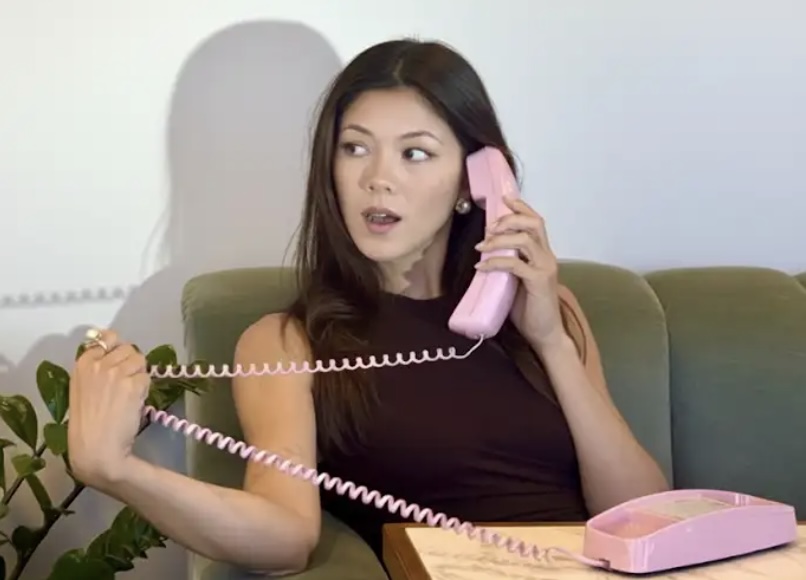
One of Goetze’s many creative approaches to feeding both sides of the issue is the company she launched this year: Physical Phones. She bought a landline a few years ago and hijacked it to be Bluetooth-compatible. She liked the idea of answering a telephone of yore rather than being glued to her cell phone. The phone was a conversation starter whenever Goetze hosted people at her house, and the chatter online around cellphone addiction was increasing.
“So I decided to make a video talking about it, thinking maybe 20 or 30 people would order them, and then I’d just order the parts myself, make them myself, and then ship them off,” she said. “But we ended up doing $118,000 in sales in 72 hours. And we’ve topped over a quarter million dollars in revenue from just a couple of viral videos. So that’s when I was like, oh, f—, we need a different plan.”
When Goetze saw the preorders for the physical phones skyrocket, she called in the cavalry. “I called the smartest people I know who work in e-commerce and have done product development and hardware development with China,” she said. “And I was like, ‘Please, help me. Please, please, please help me.’”
“Now we have a warehouse, and we have a manufacturer in China, and they’re doing the first run, and we’re getting our final production samples pretty soon, and we’re hoping to ship out by Christmas.”
Goetze, despite being a content creator who educates people on advancing tech, also tries to practice the balance that she preaches. She said reading books, including “The Anxious Generation” by social psychologist Jonathan Haidt and “Stolen Focus: Why You Can’t Pay Attention — and How to Think Deeply Again” by Johann Hari were game-changers for understanding life in the age of modern tech.
On her channel, she shares practical solutions for spending less time on her phone. One hack is using an alarm clock in the morning instead of her iPhone alarm. She also changes the icons on her phone to black and white to trick the brain into thinking the screen is boring.
“The one that’s made the biggest difference on my life is not looking at my phone for the first 30 minutes of the day,” she said.
“If I can not look at my phone from the moment I wake up to 30 minutes after that, I notice a significant decrease in my overall screen time throughout the course of the rest of the 12 hours that I’m awake.”