
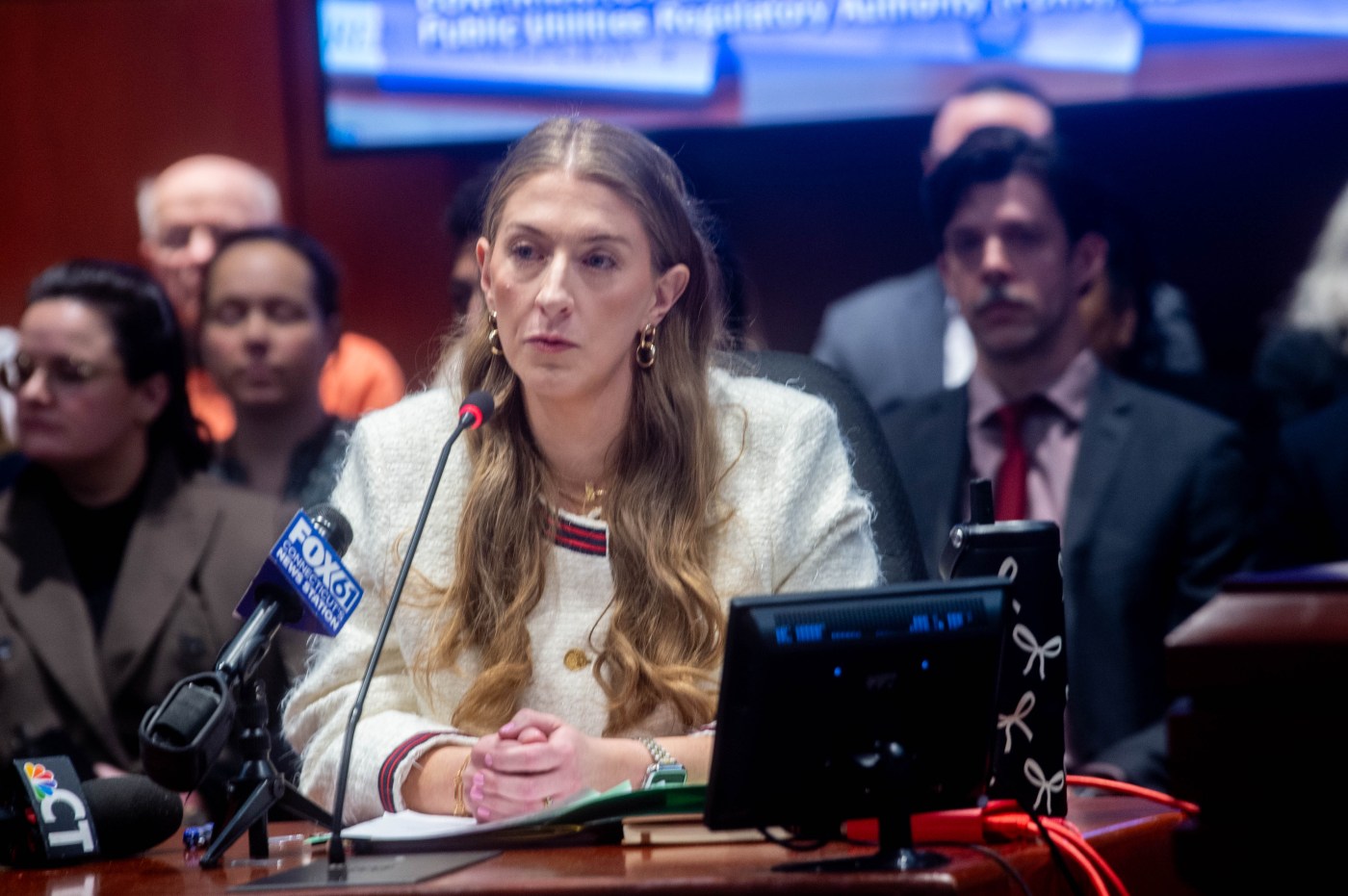
Two of Connecticut’s largest utility companies are pressing forward with an effort to uncover evidence of bias by the state’s former top utility regulator, Marissa Gillett, despite her departure from government and a shakeup of the agency she once led.
That effort is playing out largely through of pair of lawsuits filed over the last year by Eversource and Avangrid, the parent company of United Illuminating, alleging that Gillett flouted state laws and exerted near total control over rate cases during her roughly six years spent as chair of the Public Utilities Regulatory Authority.
The allegations raised in those lawsuits, as well as mounting pressure from lawmakers, led to Gillett’s resignation on Oct. 10.
Since then, attorneys for PURA have conceded in court filings that many of Gillett’s actions — including her decision to appoint herself “presiding officer” over hundreds of contested matters — violated the state’s Uniform Administrative Procedures Act.
They’ve also offered to reconsider a 2024 rate case involving two of Avangrid’s gas utilities that is at the center of one of the lawsuits.
Attorneys for the utilities say that is not enough. They are seeking access to records and permission to conduct interviews with Gillett’s former colleagues regarding her alleged bias against utility companies — including allegations that she helped author an op-ed with two state lawmakers accusing the companies of “propaganda.”
CT utility commissioner testimony supports claims of being frozen out of decisions by ex-chairwoman
“All of these issues remain in play, and we need to get to the bottom of it,” Perry Rowthorn, an attorney representing Avangrid said during a hearing Wednesday in New Britain.
The judge overseeing the case, Matthew Budzik, at times during Wednesday’s hearing appeared skeptical of the utility’s argument, asking more than once why he needed to “get to the bottom of it.”
The state has agreed to send the underlying rate case — PURA’s decision to deny Avangrid’s request for an increase in gas rates and instead ordering the company to lower prices — back to regulators for a new set of hearings. In those hearings, Budzik noted that PURA has agreed to implement new procedures to correct the issues raised during Gillett’s tenure.
“I’m not sure what you want me to do other than say that this process was infected by all these issues and you have to do it over again,” Budzik said.
Neither PURA nor Gillett responded to requests for comment on Wednesday. Gillett is currently serving as a senior fellow for the American Economic Liberties Project, a nonprofit which describes itself as part of the “anti-monopoly movement.”
A colleague’s testimony
The utilities’ claims against Gillett were further bolstered last week when one of her former colleagues, PURA Commissioner Michael Caron, gave a deposition in which he said Gillett was a self-described “control freak” who appeared to harbor a bias against utilities.
Caron also called Gillett a “talented… borderline brilliant person” whose tactics were nonetheless controversial, even within the agency.
“There’s some who find her a champion [of consumers] and there’s some who believe she’s upending the regulatory compact,” Caron said, according to a transcript of the deposition. “I found that the decisions that have come out during her tenure tended to push costs out into the future. She wasn’t really saving the ratepayers anything.”
Caron’s deposition was delivered in a joint lawsuit, filed by Eversource and Avangrid in January, in which the companies alleged that Gillett had overstepped her authority by issuing hundreds of rulings on procedural matters without approval or input from her fellow commissioners. Caron stated in his deposition that he felt sidelined by Gillett, and that the chair limited his access to staff and information about pending cases.
On Monday, Attorney General William Tong’s office filed a complaint in that case accusing the utilities’ attorneys of using Caron’s deposition as a “fishing expedition” into other topics, such as whether Gillett helped to write the controversial op-ed or whether she attempted to cover up communications with the piece’s authors through an auto-delete setting on her personal cell phone.
Tong’s office is also seeking a pause in future depositions in order to get a court ruling limiting the scope of those proceedings.
In their response filed on Wednesday, attorneys for Eversource and Avangrid argued that their questioning of Gillett’s biases and use of auto-delete was necessary to determine whether those issues were present throughout the agency, including among existing staffers.
In addition, while the companies acknowledged efforts to reform internal procedures under Gillett’s successor, Interim Chairman Thomas Wiehl, they said those changes have yet to be fully put in place.
“To understand the ongoing problems at PURA, the parties need to have a truthful, straightforward understanding of what has happened over time to distort the agency’s internal procedures and decision making protocols, including what was done to hide, reinforce, or modify those procedures to avoid public scrutiny,” the companies said in their response.
Both Gillett and the two listed authors of the op-ed, state Sen. Norm Needleman, D-Essex, and Rep. Jonathan Steinberg, D-Westport, have repeatedly denied that she played any role in its drafting. Attorneys for Avangrid have sought to depose both lawmakers regarding the op-ed, though the state is opposing that effort.
Steinberg and Needleman are co-chairs of the Energy and Technology Committee, which oversees legislation dealing with utility costs and regulations.
“Chair Gillett is gone, I would have hoped that the utilities would have moved on,” Steinberg said in an interview on Wednesday. “It would be good for everybody if these lawsuits were resolved and PURA was allowed to focus on the things that matter to the people of Connecticut.”
John Moritz is a reporter for the Connecticut Mirror. Copyright 2025 @ CT Mirror (ctmirror.org).