
By Milla Surjadi, The Dallas Morning News
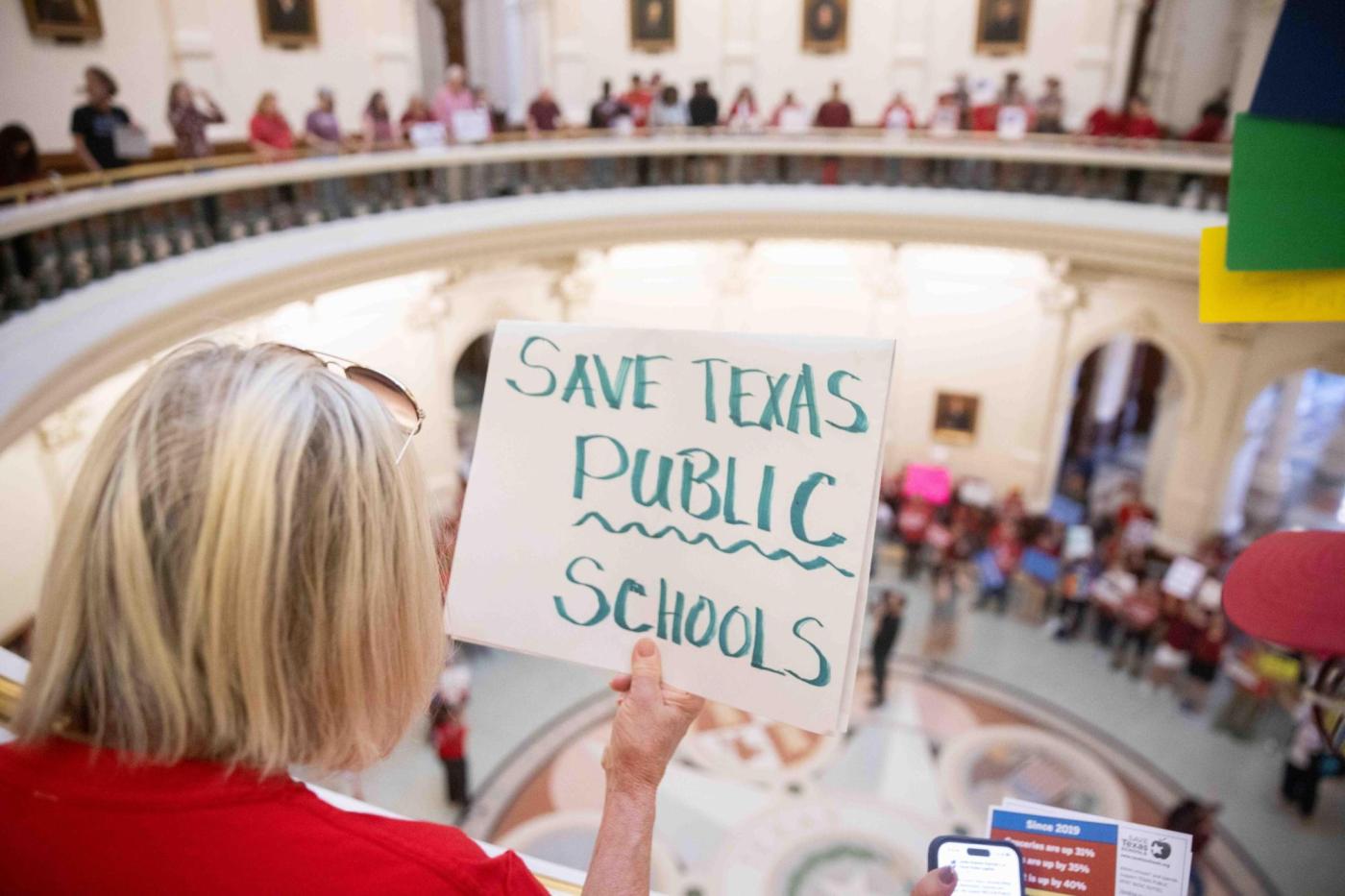
DALLAS — As Texas public schools grapple with stretched finances, an advocacy group is calling on state lawmakers to create an education endowment to establish a long-term funding strategy for schools.
State leaders have approached schools’ financial challenges with “temporary fixes,” said Raise Your Hand Texas, a public education advocacy nonprofit. Public school funding, which occurs on a two-year budget cycle, needs new long-term revenue sources and increased investments, the group says.
“We believe it’s time for the state to think creatively and boldly about how we can begin to more competitively fund our public schools and to do this in a way that truly has a long-term vision and strategy that isn’t subject to the political climate and give-and-take of any given session,” Libby Cohen, the group’s CEO, said at a recent briefing.
Amid rising inflation, enrollment declines and stagnant state funding, school budgets have stretched thin. Their bleak financial outlook is driving school leaders to make hard choices, including closing campuses and cutting staff. Others asked voters to approve tax increases to fill budget shortfalls this November.
Lawmakers invested a historic additional $8.5 billion earlier this year in public schools, raising the per-student allotment for the first time since 2019. District officials across the state say the $55 increase isn’t enough to catch up with inflation.
A March survey from the Texas Association of School Business Officials, which included responses from 190 districts, found 63% expected to end fiscal year 2025 in a shortfall. Around 80% reported planned cuts for fiscal year 2026.
A new public education endowment would move Texas beyond its two-year budget cycle, giving schools the opportunity to plan ahead and alleviate the uncertainty of state budget allocations, Raise Your Hand Texas says. It would be the first new revenue source for school funding in Texas since 2006.
Some lawmakers said the group is climbing a steep hill ahead of the next legislative session — making the idea into reality would take a lot of political will.
Cohen said she envisions seeding the proposed endowment with $10 billion from the state’s rainy day fund, which currently sits at around $24 billion and is approaching its cap, according to the comptroller’s website. Funds from the endowment would supplement the general revenue funding that already goes toward public schools.
That seed money would generate over $560 million in distributions by the fifth year and $650 million by the 10th year, according to Raise Your Hand Texas.
“We see this as not the tool that can help to necessarily fix every element of the current school funding crisis, but as a really meaningful first step to … move Texas from this kind of hand-to-mouth, always near the bottom of the barrel, when it comes to per-student funding,” Cohen said.
Watt Lesley Black Jr., a professor at Southern Methodist University who studies education policy, said the idea “might be a tough sell” for state lawmakers.
“I haven’t seen our state Legislature, across the board, be super interested in doing much to really address the problem of funding,” he said.
The Dallas Morning News reached out to several lawmakers and some Democratic lawmakers said they were interested in the idea, noting it would provide more stability for schools during sessions where the allotment isn’t increased or a new funding mechanism isn’t introduced.
“This would be an opportunity to have some kind of durability. That’s important for our school districts to create budgets that are sustainable and not continue to run these deficits,” said Rep. Mihaela Plesa, D-Dallas. “If you knew that this money was a sure thing that was going to come from the state — our basic responsibility — then it would be easier to have that predictability.”
Whether a majority of lawmakers would vote to fund such an idea is up in the air, said state Rep. Diego Bernal, D-San Antonio. He called it a “question of will, not whether the money is there.”
State Rep. Chris Turner, D-Grand Prairie, put it more bluntly: “The biggest challenge is getting Republicans to see that funding public schools is a priority.”
State Rep. Matt Shaheen, R-Prosper, pushed back on the characterization that public schools are experiencing a “funding crisis.” He believes districts’ financial strains and recent campus closures, such as those at Plano ISD, are primarily due to declining enrollment, not a lack of state funding.
“[Raise Your Hand Texas is] trying to fix a problem that doesn’t exist,” said Shaheen. “That’s what I’m struggling with.”
He doesn’t believe additional funding will improve the quality of public education.
“It’s not, ‘If we fix the funding crisis, our schools are going to get better.’ That is an inaccurate assumption,” he said. “The problem is we have low-performing schools, and they tend to be in our low-income areas. That’s the problem. And so how do we fix that?”
He criticized the group’s proposal to seed the endowment with money from the state’s rainy day fund.
“Let’s say in the second year of our budget, there’s an economic crisis, a hurricane wipes out the southern part of Texas, and the revenues to the state collapse. That’s what the rainy day fund is for … If you take money away from the rainy day fund, you’re placing the state at significant risk,” Shaheen said.
Cohen acknowledged making this idea a reality will take “a lot of political will and momentum.” Creating an endowment would likely require lawmakers and Texas voters to adopt and approve a constitutional amendment. The group has started having conversations with lawmakers and communities across the state about the idea, Cohen said.
Bernal said conversations about creating a supplemental endowment should consider whether it would spur lawmakers to withhold investments in traditional state funding in future years.
“I’m excited about any new idea that would permanently and adequately support public schools. I would caution the Legislature to not just do it and then take their hands off the wheel. That’s the mistake that we made after 2019,” he said.
Before this year’s legislative session, lawmakers had not increased the per-student allotment since 2019.
Cohen said Raise Your Hand Texas hopes to have conversations with lawmakers about priorities for the endowment fund ahead of the 90th legislative session.
“It could be tailored and sort of hooked to any number of particular goals or needs that lawmakers decided upon for this particular moment, and then provide a way to steadily increase funding for that need over time,” she said, citing increasing the basic allotment or teacher pay as examples.
Turner and Plesa raised questions about whether the endowment’s governance structure would be free from political pressure and what safeguards would be in place to ensure funds are equitably distributed.
“Who makes the decisions about how that money is allocated and how much comes out every year?” Turner said. “If they’re the same decision-makers as people who’ve underfunded public schools for a long time, it’s fair to ask, is that going to create the kind of change proponents want?”
Black, the SMU professor, cautioned that while a new endowment could “pull us out of the cycle of politics theoretically … even with endowed funds, politics come into play.”
He pointed to the existing state-backed trust dedicated to K-12 schools called the Permanent School Fund, which came under scrutiny in recent years after the two governing bodies — the State Board of Education and the School Land Board — clashed over how to best oversee the fund.
The proposed endowment would not replace the $57 billion Permanent School Fund, Cohen said. Created in 1845, the Permanent School Fund serves as a guarantee on local school district bonds and makes distributions to the legislative appropriations process.
Few states have created similar endowments that supplement state dollars for public schools, Black said. Connecticut’s endowment, which launched in August, offers $36 million in funding for early childhood education programs each year.
“Maybe that’s what Texas would have to do in order for an idea like this to get traction: make it more targeted, something like early childhood or early grades,” Black said. “Even money flowing into a targeted sector of education would ease funding issues across the board.”
————
©2025 The Dallas Morning News. Distributed by Tribune Content Agency, LLC.